 Bug FAQ
Confused Flour Beetle
Tribolium confusum · Order: Coleoptera · Family: Tenebrionidae
Also called: Flour Beetle
Source: Wikipedia
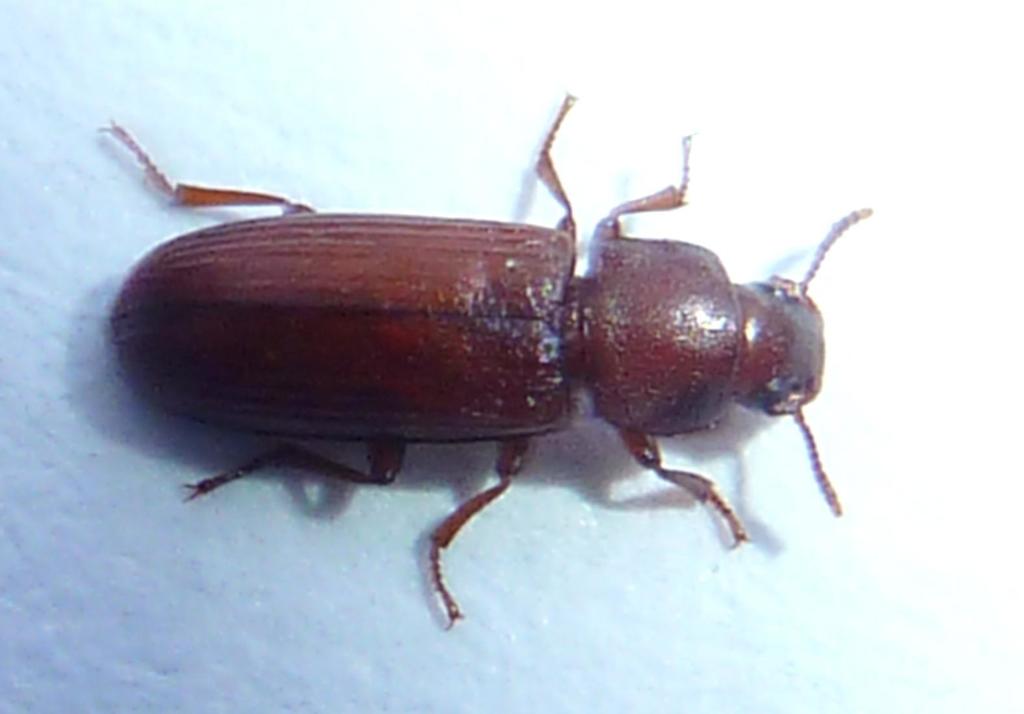
These beetles are small, reddish-brown insects about 3 to 6 mm long and can be told apart from similar species by their four-segmented antenna clubs. They live in places where grain is stored, such as mills, bakeries, warehouses and homes, feeding on broken grain, flour, rice, nuts and other pantry items. A female can lay a few hundred eggs and the life cycle from egg to adult takes 1 to 3 months, with adults living up to three years.
Source: Wikipedia
How to recognize it
The beetle is reddish-brown and 3 to 6 mm long; its antennae grow gradually and end in four clubs, unlike the red flour beetle’s three-club antennae.
Source: Wikipedia
Size
Adults measure roughly 3 to 6 mm (about 1⁄8 to 1⁄4 inch) in length.
Source: Wikipedia
Is it a pest in the house?
They are among the most common pests that damage stored grain and pantry foods in homes and commercial storage. Infested food shows beetle bodies, droppings and a foul odor from their secretions.
Source: Wikipedia
How to get rid of it
Even tiny amounts of grain can support an infestation, so careful management is needed. Freezing infested grain for four to five days will kill the beetles.
Source: Wikipedia
Where it lives
You’ll find them in mills, bakeries, warehouses and other storage areas where grain products are kept.
Source: Wikipedia
What it eats
Both larvae and adults eat broken grain, flour, cornmeal, rice, dried fruit, nuts and beans, but not whole, intact kernels.
Source: Wikipedia
Life cycle
Development from egg to adult takes 40 to 90 days, and adults can survive up to three years. A female can produce between 200 and 500 eggs over her lifetime.
Source: Wikipedia
When you see it
In the U.S. they are found throughout the southern states, but they also thrive in cooler northern areas.
Source: Wikipedia
Where it comes from
Originally from Africa, they now occur worldwide and are more common in cooler northern regions.
Source: Wikipedia
Lookalikes
They look a lot like the red flour beetle and the destructive flour beetle, which is why they got the name “confused”.
Source: Wikipedia
Where it is found in the US
Recorded in 31 of 51 states and DC. Most records: Arizona, Kentucky, Utah, Colorado, Iowa, Illinois, Kansas, Ohio.
Darker = more records. Counts are museum and citizen-science records, not population size.
Source: GBIF
Status: native in North America; native in Canada. Source: iNaturalist
Months it is reported in the US
Source: GBIF
Questions people ask
How can I get rid of them in my pantry?
Freeze any contaminated grain for at least four days, and discard heavily infested items.
Source: Wikipedia
What makes them different from red flour beetles?
Their antennae have four gradually enlarging clubs, while red flour beetles have three clubs.
Source: Wikipedia
Are they a problem for my garden crops?
The evidence only mentions damage to stored grain, not to field crops.
Source: Wikipedia
Same family (Tenebrionidae)


Sources
- Wikipedia: https://en.wikipedia.org/wiki/Confused_flour_beetle
Look it up elsewhere: GBIF · iNaturalist · BugGuide · ITIS · Wikipedia
Text written 2026-10-22 from the sources above and checked sentence by sentence against them. Data fetched 2026-10-22.