 Bug FAQ
Eastern Elderberry Borer
Desmocerus palliatus · Order: Coleoptera · Family: Cerambycidae
Also called: Eastern Elder Borer, Elderberry Borer, Elderberry Longhorn Borer, elder borer

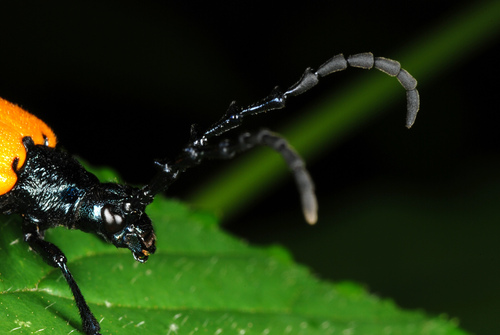
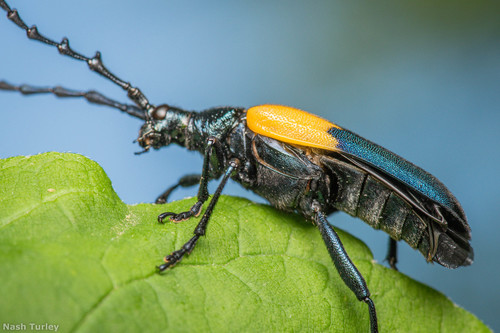
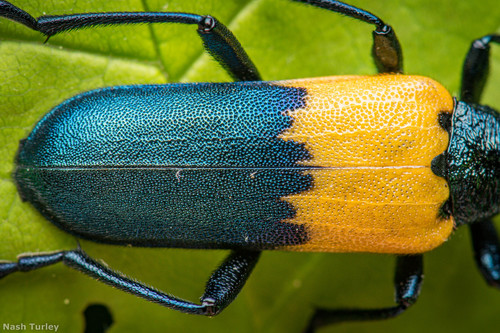
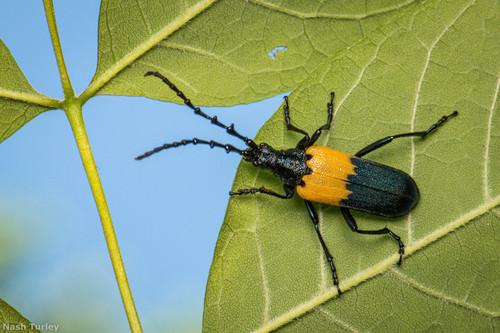
The adult Eastern Elderberry Borer is 17 to 26 mm long, shiny dark blue with yellow-red bases on the wing covers. It lives in swampy areas and near streams where its host plant, elderberry, grows, and can be seen from April through August.
Source: Wikipedia
How to recognize it
Adults are mostly a shimmering dark blue and have yellow to yellow-red at the base of the elytra.
Source: Wikipedia
Size
Adults measure between 17 and 26 mm in length.
Source: Wikipedia
What it eats
Adults feed on pollen. Larvae feed on Sambucus (elderberry) plants.
Source: Wikipedia
Life cycle
Females lay eggs near stems or at the plant base; larvae burrow into stems and tunnel into the roots of the living plant.
Source: Wikipedia
When you see it
They are active and can be seen from April through August.
Source: Wikipedia
Where it is found in the US
Recorded in 35 of 51 states and DC. Most records: North Carolina, Pennsylvania, Vermont, New York, New Hampshire, Virginia, Tennessee, Michigan.
Darker = more records. Counts are museum and citizen-science records, not population size.
Source: GBIF
Status: native in North America; native in United States; native in Canada. Source: iNaturalist
Months it is reported in the US
Source: GBIF
More photos
Questions people ask
When are Eastern Elderberry Borers visible?
They can be seen from April through August.
Source: Wikipedia
What plants do the larvae of Eastern Elderberry Borer use?
Larvae feed on Sambucus, the elderberry plant.
Source: Wikipedia
Same family (Cerambycidae)
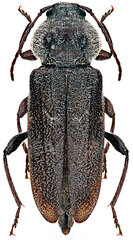 House LonghornHylotrupes bajulusCan damage your home
 Asian Longhorned BeetleAnoplophora glabripennisDamages trees, gardens or crops
 Red Milkweed BeetleTetraopes tetrophthalmus
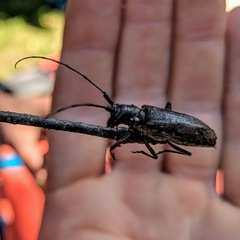 White-spotted SawyerMonochamus scutellatusCan damage your home
 Red Pine Longhorn BeetleStictoleptura rubra
 Spotted Longhorn BeetleRutpela maculata
Sources
- Wikipedia: https://en.wikipedia.org/wiki/Desmocerus_palliatus
Look it up elsewhere: GBIF · iNaturalist · BugGuide · ITIS · Wikipedia
Text written 2026-10-24 from the sources above and checked sentence by sentence against them. Data fetched 2026-10-24.