 Bug FAQ
Eurasian White Admiral
Limenitis camilla · Order: Lepidoptera · Family: Nymphalidae
Also called: Brush Foots, Brush-footed Butterflies, Brush-footed Butterfly, Brushfoot Butterflies
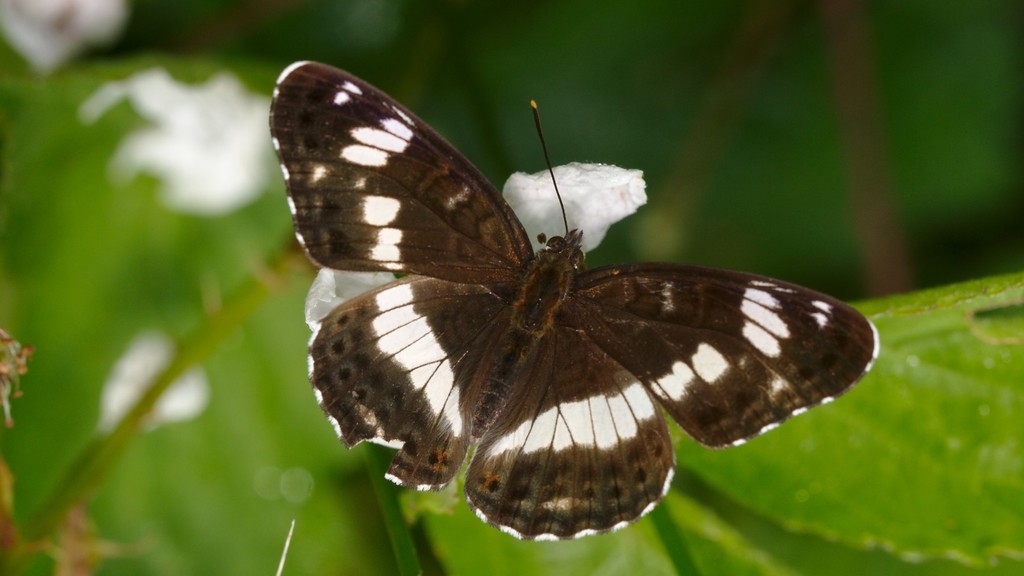
The Eurasian White Admiral is a medium-sized butterfly with a wingspan of about 60 to 65 mm. Adults have dark wings crossed by striking white bands that break up the wing outline for camouflage. It lives in shady woodlands across southern Britain and much of temperate Eurasia, extending to Japan, where larvae feed on honeysuckle and Weigela.
Source: Wikipedia
How to recognize it
Adults have dark wings with contrasting white bands that help hide them from predators.
Source: Wikipedia
Size
Wingspan is roughly 60 to 65 mm.
Source: Wikipedia
Where it lives
Found in shady woodland areas.
Source: Wikipedia
What it eats
Caterpillars eat honeysuckle species (Lonicera) and Weigela horstensis.
Source: Wikipedia
Life cycle
In autumn the caterpillar builds a leaf-fold shelter (hibernaculum) and hibernates attached to a stem with silk. In spring it feeds briefly, molts to a spiny green larva, then pupates in summer in a green-gold chrysalis; the adult emerges after about two weeks.
Source: Wikipedia
When you see it
Adults feed on bramble blossoms and honeydew; females lay single eggs on honeysuckle shoots in dense woodland.
Source: Wikipedia
Lookalikes
Similar to Limenitis sydyi, but differs in forewing spot placement and the shape of the hindwing white band; the underside spots are rounded rather than forming a light-spot band.
Source: Wikipedia
Where it is found in the US
Recorded in 51 of 51 states and DC. Most records: Texas, California, Kansas, Florida, Illinois, Ohio, Vermont, Virginia.
Darker = more records. Counts are museum and citizen-science records, not population size.
Source: GBIF
Months it is reported in the US
Source: GBIF
More photos


Questions people ask
Are they a garden pest?
They feed on honeysuckle leaves as caterpillars, but there is no source indicating they damage crops or garden plants.
Source: Wikipedia
Same family (Nymphalidae)





Sources
- Wikipedia: https://en.wikipedia.org/wiki/Limenitis_camilla
Look it up elsewhere: GBIF · iNaturalist · BugGuide · Wikipedia
Text written 2026-10-22 from the sources above and checked sentence by sentence against them. Data fetched 2026-10-22.