 Bug FAQ
European Mantis
Mantis religiosa · Order: Mantodea · Family: Mantidae
Also called: European Praying Mantis, Praying Mantis, Preying Mantis

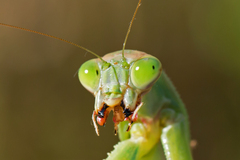
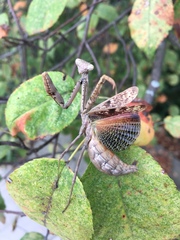
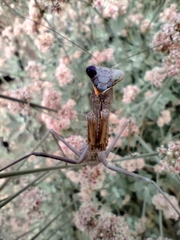
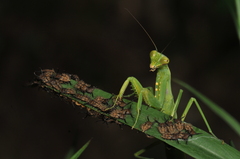
The European mantis has an elongated body with two pairs of wings and a triangular, mobile head with large eyes and raptorial front legs for catching prey. Females are 6 to 8 cm long and heavier, while males are 5 to 7 cm but have larger antennae and eyes. It lives across Europe, Asia, Africa and has been introduced to North America, where it is now recorded in parts of England.
Source: Wikipedia
How to recognize it
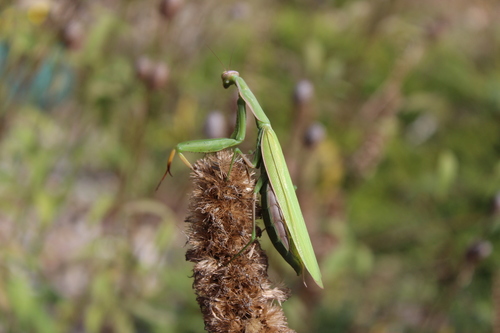
Both sexes have an elongated body, two pairs of wings, a triangular head with large compound eyes, and front legs modified into raptorial limbs for catching prey.
Source: Wikipedia
Size
Females measure 6 to 8 cm, males 5 to 7 cm; males have proportionally larger antennae and eyes.
Source: Wikipedia
Does it bite or sting?
They are not meant to be caught or kept as pets.
Source: Wikipedia
Where it lives
The species occurs throughout Europe, Asia, Africa and has been introduced to North America. In England it has been recorded in Cornwall, the Isle of Wight and Oxfordshire.
Source: Wikipedia
What it eats
It is a carnivorous ambush predator that eats most insects it can capture with its rapid raptorial legs. Common prey include grasshoppers, crickets and cockroaches.
Source: Wikipedia
Life cycle
Adults become sexually mature a few days after their final molt.
Source: Wikipedia
When you see it
Males are most attracted to females around midday when temperatures are highest.
Source: Wikipedia
Where it comes from
Its natural range includes Europe, Asia and Africa, with introduced populations in North America.
Source: Wikipedia
Where it is found in the US
Recorded in 45 of 51 states and DC. Most records: California, Washington, Oregon, Colorado, Utah, New York, Idaho, Michigan.
Darker = more records. Counts are museum and citizen-science records, not population size.
Source: GBIF
Status: introduced in North America; introduced in Canada; introduced in United States. Source: iNaturalist
Months it is reported in the US
Source: GBIF
More photos
Same family (Mantidae)
Sources
- Wikipedia: https://en.wikipedia.org/wiki/European_mantis
Look it up elsewhere: GBIF · iNaturalist · BugGuide · ITIS · Wikipedia
Text written 2026-10-22 from the sources above and checked sentence by sentence against them. Data fetched 2026-10-22.