 Bug FAQ
Great Basin Wood-Nymph
Cercyonis sthenele · Order: Lepidoptera · Family: Nymphalidae
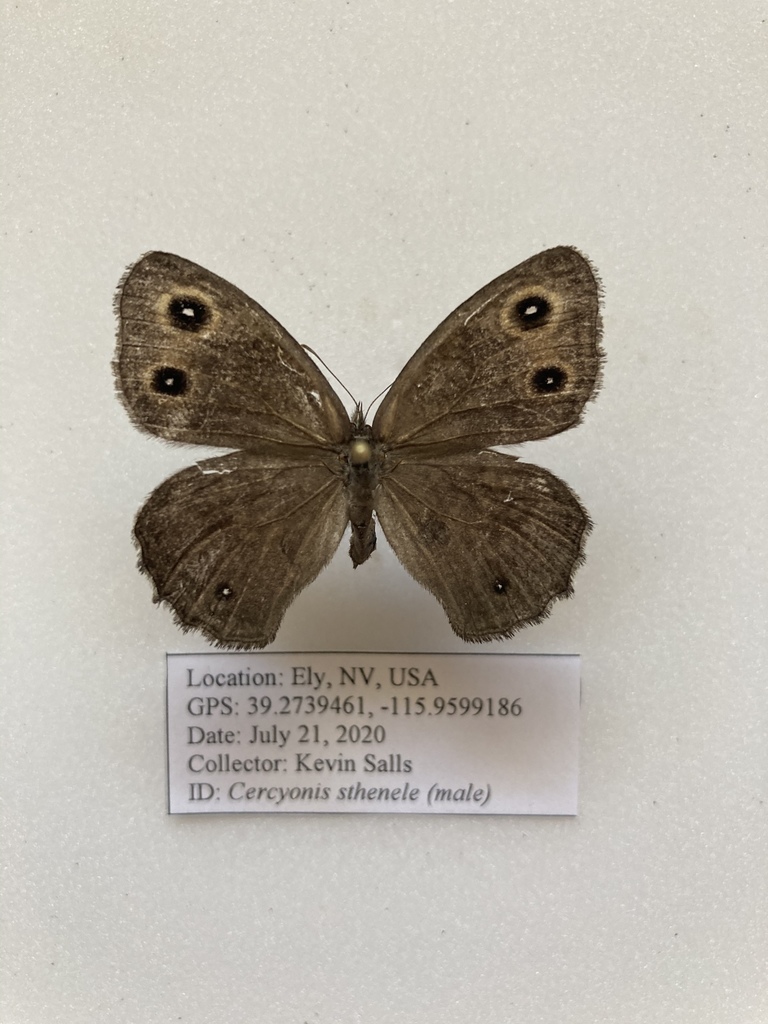
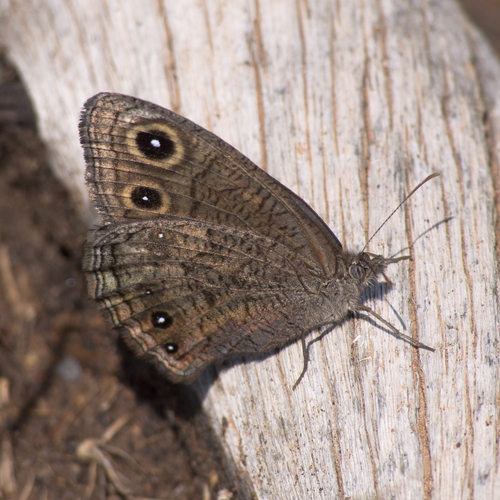
The Great Basin wood-nymph is a dark brown butterfly with two eyespots on each forewing, the upper spot larger than the lower. Its wingspan is about 39 to 44 mm and it flies from late June through late August in arid woodlands and brushy habitats of the western United States.
Source: Wikipedia
How to recognize it
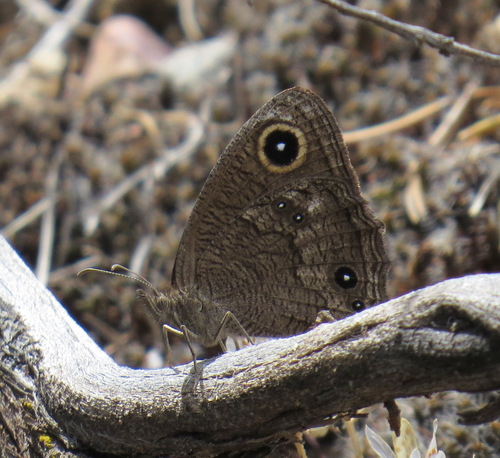
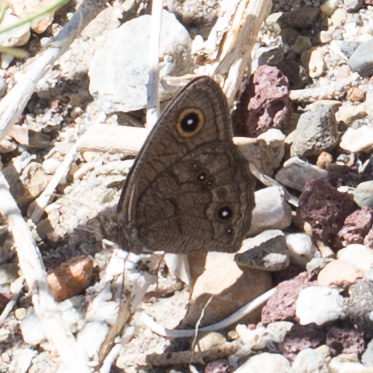
It is dark brown and has two eyespots on the forewing, the upper one larger than the lower.
Source: Wikipedia
Size
The wingspan ranges from 39 to 44 mm (about 1.5 to 1.7 in).
Source: Wikipedia
Where it lives
It lives in dry woodlands, especially pinyon-juniper, chaparral and brushland areas.
Source: Wikipedia
What it eats
The larvae feed on a variety of grass species.
Source: Wikipedia
Life cycle
The first instar of the caterpillar overwinters in hibernation.
Source: Wikipedia
When you see it
Adults are on the wing from late June to late August.
Source: Wikipedia
Where it comes from
It is native to much of the western United States. Its range also reaches southern British Columbia in Canada.
Source: Wikipedia
Lookalikes
It can be confused with the common wood-nymph, which is larger and has eyespots of similar size. It also resembles the small wood-nymph; males lack the lower eyespot and females have the lower spot nearer the wing margin than the upper spot.
Source: Wikipedia
Where it is found in the US
Recorded in 12 of 51 states and DC. Most records: California, Idaho, Utah, Nevada, Oregon, Washington, Colorado, Wyoming.
Darker = more records. Counts are museum and citizen-science records, not population size.
Source: GBIF
Status: native in North America; native in Canada; native in United States. Source: iNaturalist
Months it is reported in the US
Source: GBIF
More photos
Questions people ask
When can I see Great Basin wood-nymphs?
Adults fly from late June through late August.
Source: Wikipedia
How can I tell it apart from the common wood-nymph?
The Great Basin wood-nymph is smaller and its upper eyespot is noticeably larger than the lower one, unlike the common wood-nymph where the spots are similar in size.
Source: Wikipedia
What habitats should I look in for this butterfly?
Search in dry woodlands, especially pinyon-juniper, chaparral and brushland areas.
Source: Wikipedia
Same family (Nymphalidae)





Sources
- Wikipedia: https://en.wikipedia.org/wiki/Cercyonis_sthenele
Look it up elsewhere: GBIF · iNaturalist · BugGuide · ITIS · Wikipedia
Text written 2026-10-23 from the sources above and checked sentence by sentence against them. Data fetched 2026-10-23.