 Bug FAQ
Half-edged Wall Jumping Spider
Menemerus semilimbatus · Order: Araneae · Family: Salticidae
Also called: Jumping spider
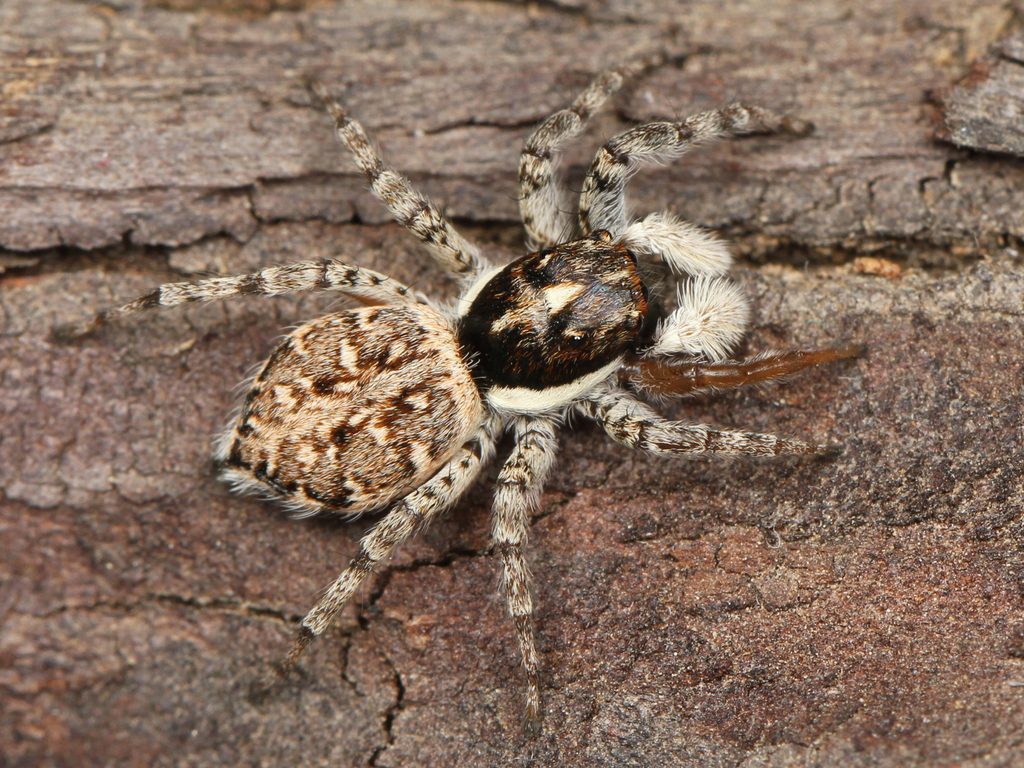
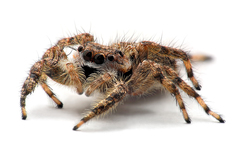
The half-edged wall jumping spider is about 6.5 to 8.4 mm long, with the male slightly smaller than the female. It has a flattened body covered in short gray-white hairs, a white band on the carapace sides, a small white triangle in the middle, light-brown legs with darker rings, and a abdomen with bright V-shaped markings. This spider lives on building walls, in gardens, and both inside and outside houses, where it hunts prey.
Source: Wikipedia
Size
Adults measure about 6.5 to 8.4 mm (0.26 to 0.33 in) in length, females being slightly larger than males.
Source: Wikipedia
Is it a pest in the house?
It lives in close association with human habitats, both inside and outside homes.
Source: Wikipedia
Where it lives
It is synanthropic, found in gardens and on the interior and exterior of houses. It is commonly seen on building walls where it stalks its prey.
Source: Wikipedia
Where it comes from
The species originates from the Mediterranean region and is widely distributed across Europe, southern Asia, and Africa.
Source: Wikipedia
Where it is found in the US
Recorded in 12 of 51 states and DC. Most records: California, Texas, New Mexico, Oregon, Indiana, Maryland, Nevada, North Carolina.
Darker = more records. Counts are museum and citizen-science records, not population size.
Source: GBIF
Status: introduced in North America; introduced in United States; introduced in Canada. Source: iNaturalist
Months it is reported in the US
Source: GBIF
More photos


Same family (Salticidae)



Sources
- Wikipedia: https://en.wikipedia.org/wiki/Menemerus_semilimbatus
Look it up elsewhere: GBIF · iNaturalist · BugGuide · ITIS · Wikipedia
Text written 2026-10-22 from the sources above and checked sentence by sentence against them. Data fetched 2026-10-22.