 Bug FAQ
Zebra Jumping Spider
Salticus scenicus · Order: Araneae · Family: Salticidae
Also called: zebra spider, Zebra Jumper
Source: Penn State Extension

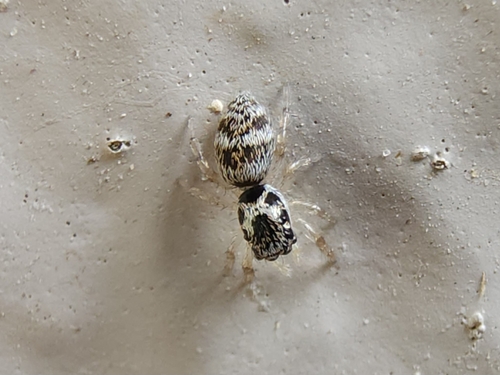
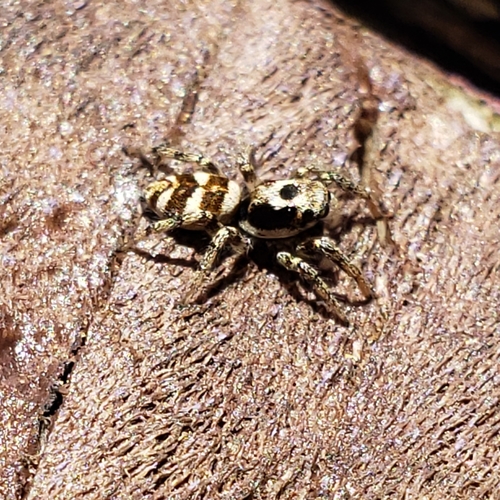
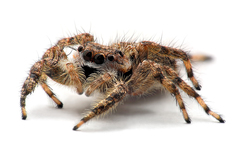
Zebra jumping spiders are small, dark brown to black with white striped hairs that form chevron patterns. They are 5 to 9 mm long in females and 5 to 6 mm in males and are often found on windowsills, garden fences, walls, under stones and in high grass. These spiders hunt tiny arthropods such as fruit flies and even mosquitoes larger than themselves, and they breed in spring and summer.
Source: Wikipedia, Penn State Extension
How to recognize it
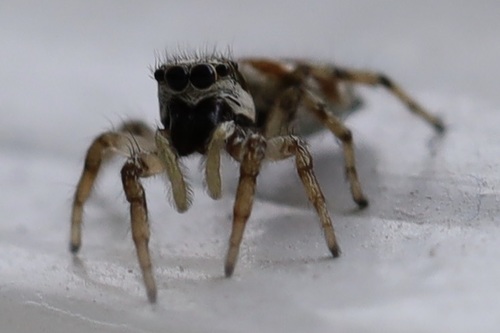
The cephalothorax has a white side band and extra white hairs around the eyes.
Source: Penn State Extension
Size
Females measure 5 to 9 mm, males 5 to 6 mm.
Source: Wikipedia
Is it a pest in the house?
They often enter homes and can be found on windowsill corners. They are also seen on the exterior of buildings and garden structures.
Source: Wikipedia, Penn State Extension
Does it bite or sting?
Their bite is not medically important and they are considered beneficial.
Source: Penn State Extension
How to get rid of it
Because they do not pose a health risk, they are generally left alone.
Source: Penn State Extension
Where it lives
They like open vertical spots and are common on garden fences, building walls and windowsill corners. They are also found under stones, in high grass and on bushes.
Source: Wikipedia, Penn State Extension
What it eats
They prey on smaller spiders, fruit flies and other tiny arthropods. They have been seen catching mosquitoes almost twice their length.
Source: Wikipedia
Life cycle
Breeding occurs in spring and summer. After the second molt, spiderlings leave the mother to live on their own.
Source: Wikipedia
When you see it
They breed during the spring and summer months.
Source: Wikipedia
Where it comes from
Their range covers Europe, North America and North Asia across the Holarctic region.
Source: Wikipedia
Where it is found in the US
Recorded in 46 of 51 states and DC. Most records: Washington, New York, Oregon, Illinois, Minnesota, Colorado, Ohio, Idaho.
Darker = more records. Counts are museum and citizen-science records, not population size.
Source: GBIF
Status: introduced in United States; introduced in Canada. Source: iNaturalist
Months it is reported in the US
Source: GBIF
More photos

Questions people ask
Do zebra jumping spiders bite people?
Their bite is not medically significant and they are not considered dangerous.
Source: Penn State Extension
Where might I find a zebra jumping spider in my house?
They often hide in the corners of windowsills and on the interior walls.
Source: Wikipedia
What do zebra jumping spiders eat?
They hunt small spiders, fruit flies and even mosquitoes larger than themselves.
Source: Wikipedia
Are zebra jumping spiders a pest for my garden?
They are not known to damage plants; they actually help by catching other small insects.
Source: Penn State Extension
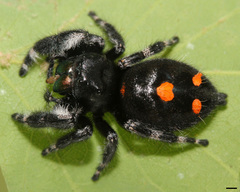
Same family (Salticidae)


Sources
- Penn State Extension: https://extension.psu.edu/zebra-jumper
- Wikipedia: https://en.wikipedia.org/wiki/Zebra_spider
Look it up elsewhere: GBIF · iNaturalist · BugGuide · ITIS · Wikipedia
Text written 2026-10-23 from the sources above and checked sentence by sentence against them. Data fetched 2026-10-23.