 Bug FAQ
Hycleus biundulatus
Hycleus biundulatus · Order: Coleoptera · Family: Meloidae
Source: Wikipedia
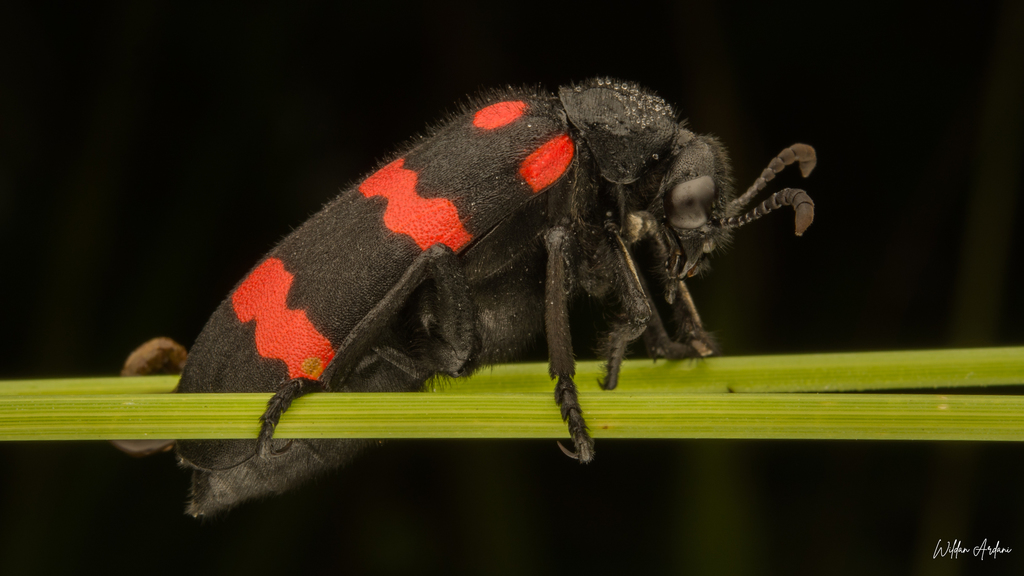
Adults feed on flowers and developing pods of many crops, making them a major agricultural pest. The beetle can produce cantharidin, a blistering chemical that can irritate skin.
Source: Wikipedia
How to recognize it
The head and pronotum have moderately coarse, deep, dense punctures. Elytra show moderately coarse and deep punctures. The base of the elytra has two reddish rectangular spots visible from above and the side.
Source: Wikipedia
Size
Body length ranges from about 15.4 to 32.8 mm.
Source: Wikipedia
Is it a pest in the house?
Adults are a major pest of pigeon pea and feed on many crops including hibiscus, maize and mango.
Source: Wikipedia
Does it bite or sting?
The species can biosynthesize cantharidin, a potent blistering agent.
Source: Wikipedia
How to get rid of it
They can be easily removed by hand-picking.
Source: Wikipedia
What it eats
Adults eat flowers from many plant families. First-instar larvae are active predators of soft insects such as aphids.
Source: Wikipedia
Life cycle
The first larval stage is a mobile triungulin that preys on aphids.
Source: Wikipedia
When you see it
Feeding peaks in July through October but they remain active year-round.
Source: Wikipedia
Where it comes from
Its distribution includes India, Sri Lanka, China, Java and Pakistan.
Source: Wikipedia
Questions people ask
How can I control Hycleus biundulatus?
Hand-pick the beetles from plants; they are easy to remove manually.
Source: Wikipedia
What crops does Hycleus biundulatus damage?
It feeds on flowers and pods of pigeon pea, hibiscus, maize, mango and several other crops.
Source: Wikipedia
Does Hycleus biundulatus cause skin irritation?
Yes, it produces cantharidin, a chemical that can cause blistering on skin.
Source: Wikipedia
Same family (Meloidae)



Sources
- Wikipedia: https://en.wikipedia.org/wiki/Hycleus_biundulatus
Look it up elsewhere: GBIF · iNaturalist · BugGuide · Wikipedia
Text written 2026-10-23 from the sources above and checked sentence by sentence against them. Data fetched 2026-10-22.