 Bug FAQ
Mylabris variabilis
Mylabris variabilis · Order: Coleoptera · Family: Meloidae
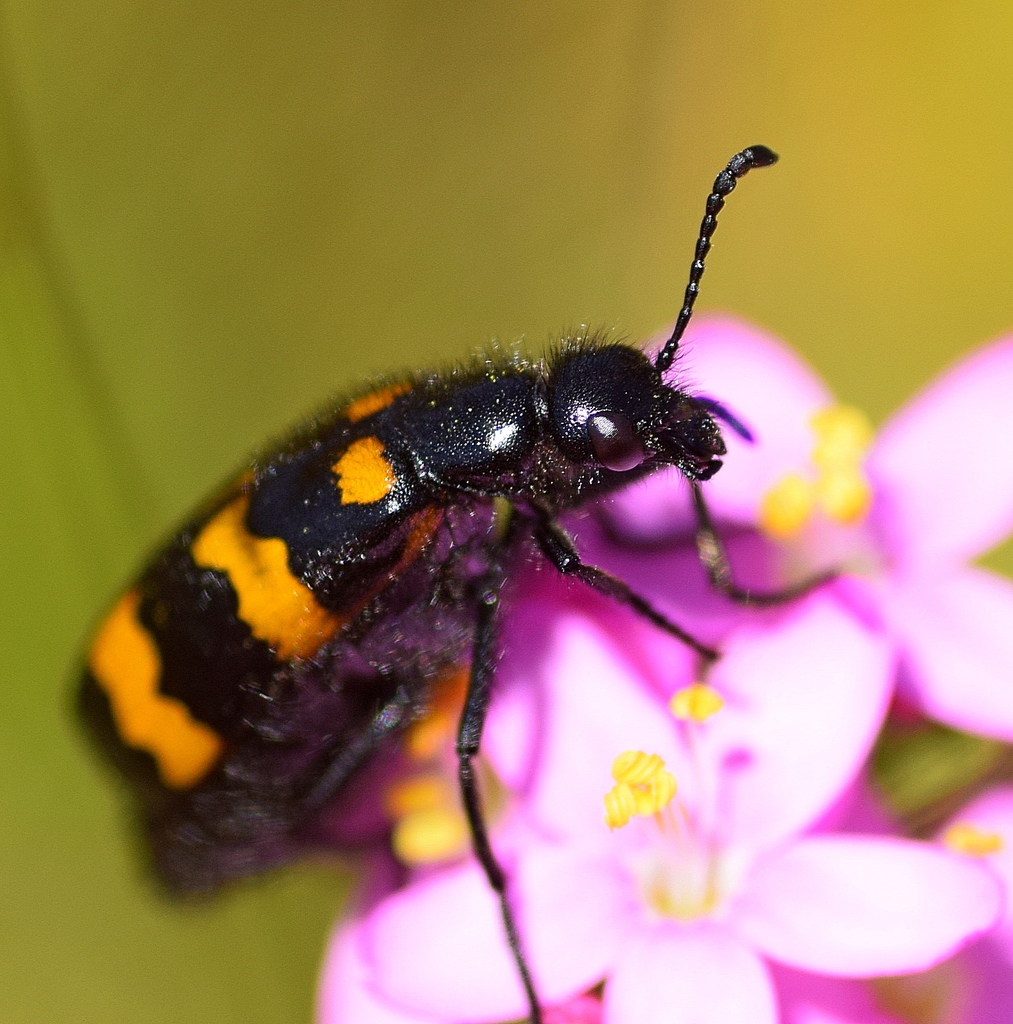
Mylabris variabilis is a beetle 8 to 20 mm long with a cylindrical body and yellow-orange wing covers marked by three black wavy bands. Adults fly from June to September and feed on flowers, while the larvae eat grasshopper eggs and larvae.
Source: Wikipedia
How to recognize it
The beetle has a long, convex body with yellow-orange elytra crossed by wide black wavy stripes, usually three bands.
Source: Wikipedia
Size
Body length ranges from 8 to 20 mm (0.31 to 0.79 in).
Source: Wikipedia
Where it lives
Adults are active in summer, flying and feeding on flowers. The species has a complex biological cycle.
Source: Wikipedia
What it eats
Larvae feed on eggs and larvae of grasshoppers. Adults feed on flower nectar and pollen.
Source: Wikipedia
Life cycle
The species has a very complex biological cycle.
Source: Wikipedia
When you see it
Adults are on the wing from June through September.
Source: Wikipedia
Lookalikes
It looks very similar to Mylabris pannonica.
Source: Wikipedia
More photos

Questions people ask
When are adult beetles active?
Adults fly and feed on flowers from June to September.
Source: Wikipedia
How can I tell this beetle apart from similar species?
It is very similar to Mylabris pannonica, so identification may require close examination of the stripe pattern.
Source: Wikipedia
Same family (Meloidae)



Sources
- Wikipedia: https://en.wikipedia.org/wiki/Mylabris_variabilis
Look it up elsewhere: GBIF · iNaturalist · BugGuide · Wikipedia
Text written 2026-10-22 from the sources above and checked sentence by sentence against them. Data fetched 2026-10-22.