 Bug FAQ
Japanese Beetle
Popillia japonica · Order: Coleoptera · Family: Scarabaeidae
Source: Wikipedia, USDA APHIS
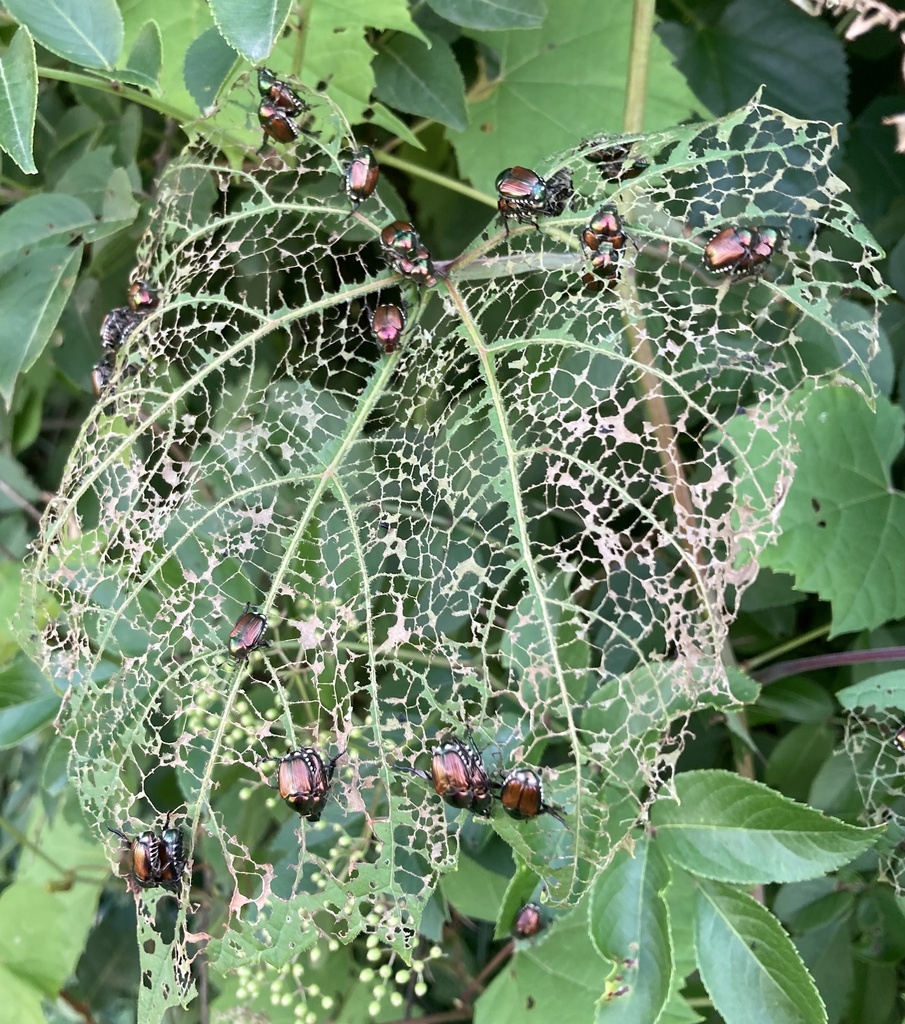
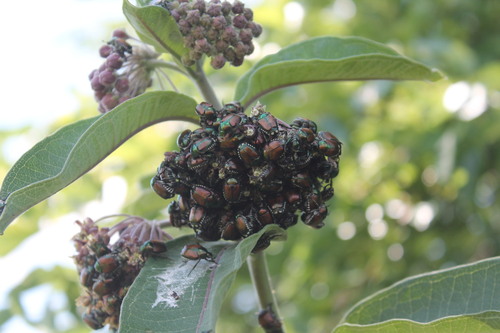
Adult beetles chew the leaves of over 300 plant species, often leaving a skeletonized appearance, and they also feed on fruit. The larvae live in lawns, eating grass roots and causing turf to brown and die.
Source: Wikipedia, USDA APHIS
How to recognize it
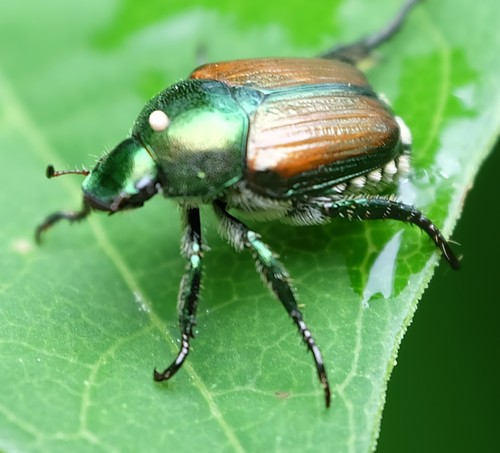
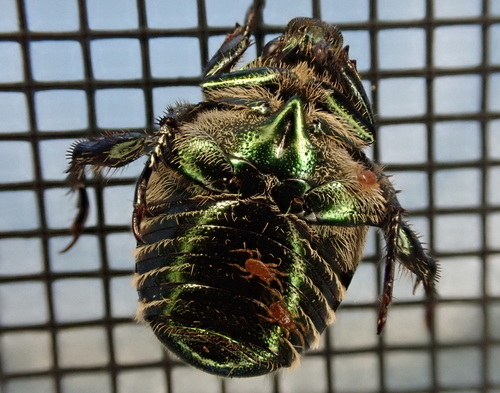
Adults have a metallic green body with bronze-colored wing covers and six small white tufts of hair along the sides under the wing edges. A row of white hair tufts projects from under each wing cover on both sides of the beetle.
Source: USDA APHIS, Wikipedia
Size
An adult Japanese beetle is about 15 mm long and 10 mm wide. A mature grub is roughly 2.5 cm (1 in) long.
Source: Wikipedia
How to get rid of it
Traps have been made specifically for Japanese beetles, and a USDA-approved biological control powder is available for lawns. Homeowners can combine chemical, biological, and cultural methods to manage them with minimal environmental impact. For detailed local advice, contact your county or state cooperative extension service.
Source: Wikipedia, USDA APHIS
Where it lives
Japanese beetles are scarab beetles that live in lawns and other grasslands during their larval stage.
Source: Wikipedia
What it eats
Adults skeletonize foliage and sometimes eat fruit, while larvae feed on grass roots.
Source: Wikipedia
Life cycle
Females lay eggs near the soil surface; the eggs hatch in about two weeks and the larvae feed on fine roots and organic matter. Larvae overwinter in small soil cells and emerge in spring when soil warms.
Source: Wikipedia
When you see it
In 2021, more than 20,000 beetles were found in Grandview, Washington between late June and early September.
Source: Wikipedia
Where it comes from
They originate from Japan and are invasive in North America and Europe.
Source: Wikipedia
Where it is found in the US
Recorded in 46 of 51 states and DC. Most records: New York, Illinois, Pennsylvania, Michigan, Colorado, Virginia, Ohio, North Carolina.
Darker = more records. Counts are museum and citizen-science records, not population size.
Source: GBIF
Status: introduced in North America; introduced in Canada; introduced in United States. Source: iNaturalist
Months it is reported in the US
Source: GBIF
More photos

Questions people ask
How can I get rid of Japanese beetles in my yard?
Use traps, apply the USDA-approved biological control powder, and integrate chemical and cultural practices; check with your local extension office for recommendations.
Source: Wikipedia, USDA APHIS
What damage do the larvae cause?
Larvae feed on grass roots, which can brown and kill turf.
Source: Wikipedia, USDA APHIS
Are Japanese beetles native to my area?
They are native to Japan and are invasive in North America and Europe.
Source: Wikipedia
Same family (Scarabaeidae)
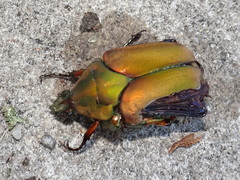 Common Green June BeetleCotinis nitidaDamages trees, gardens or crops
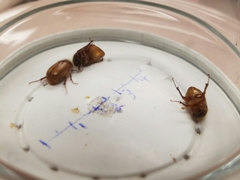 Phyllophaga crinitaPhyllophaga crinitaDamages trees, gardens or crops
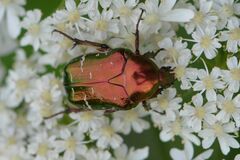 European Rose ChaferCetonia aurata
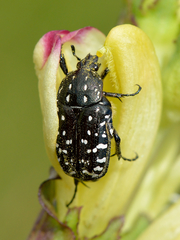 Mediterranean Spotted ChaferOxythyrea funestaDamages trees, gardens or crops
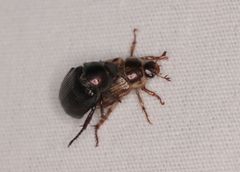 Oriental BeetleExomala orientalisDamages trees, gardens or crops
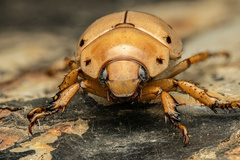 Grapevine BeetlePelidnota punctataDamages trees, gardens or crops
Sources
- Wikipedia: https://en.wikipedia.org/wiki/Japanese_beetle
- USDA APHIS: https://www.aphis.usda.gov/plant-pests-diseases/japanese-beetle
Look it up elsewhere: GBIF · iNaturalist · BugGuide · ITIS · Wikipedia
Text written 2026-10-22 from the sources above and checked sentence by sentence against them. Data fetched 2026-10-22.