 Bug FAQ
Joro Spider
Trichonephila clavata · Order: Araneae · Family: Araneidae
Source: Wikipedia, news.uga.edu
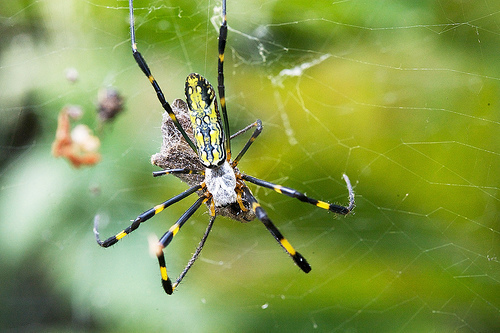
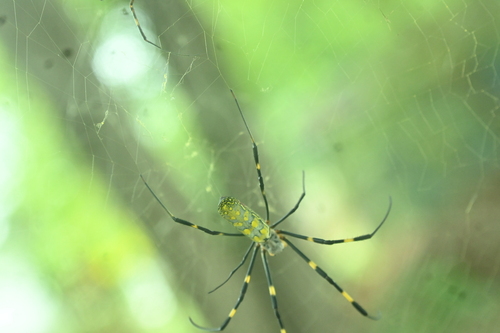
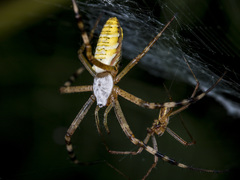
Adult females are large, up to 3 inches wide with yellow-blue striped backs and bright red undersides, while males are much smaller and brownish. They have spread across the eastern United States since the 2010s, building large golden-yellow webs that can be several meters long.
Source: Wikipedia, news.uga.edu
How to recognize it
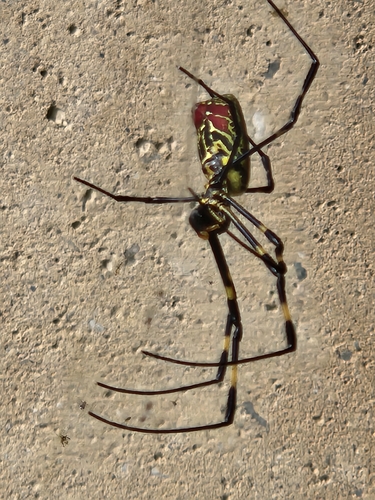
The back shows distinctive yellow and blue-black stripes and bright red markings on the underside.
Source: news.uga.edu
Size
Adult females measure 17 to 30 mm in body length, while males are only 4 to 8 mm. With legs fully extended they can span almost 3 inches across.
Source: Wikipedia, news.uga.edu
Is it a pest in the house?
Their ecological impact in the new range is still unknown. They are preyed upon by mud-dauber wasps and birds. They likely arrived via shipping containers from China or Japan.
Source: Wikipedia, news.uga.edu
Does it bite or sting?
Bites are rare, the spiders are reluctant to bite, and any bite causes only temporary pain and redness similar to a bee sting. All spiders use venom to subdue prey.
Source: Wikipedia, news.uga.edu
How to get rid of it
You can gently shoo a Joro spider away with a broom if it gets too close. Permanently removing them is as ineffective as shoveling sand at the beach.
Source: news.uga.edu
Where it lives
They are now common across the eastern United States. Female webs can reach several meters and appear golden in sunlight.
Source: Wikipedia
What it eats
Members of the Nephilidae family have been observed feeding on amphibians, small birds and mammals. Joro spiders are prey for the mythical Ao-Nagas.
Source: Wikipedia
Life cycle
The life cycle lasts about one year. Females lay eggs in autumn; the egg sac overwinters and hatches in spring.
Source: Wikipedia
When you see it
Males appear in female webs in autumn to mate right after the female’s final molt. After mating the female creates a single egg sac with 400 to 1,500 eggs and then dies in late autumn or early winter.
Source: Wikipedia
Where it comes from
The species is native to East Asia to China, Japan (except Hokkaidō), Korea and Taiwan.
Source: Wikipedia
Lookalikes
They may be confused with banana spiders or yellow garden spiders because of similar size.
Source: news.uga.edu
Where it is found in the US
Recorded in 14 of 51 states and DC. Most records: Georgia, South Carolina, Tennessee, North Carolina, Maryland, Alabama, Massachusetts, Virginia.
Darker = more records. Counts are museum and citizen-science records, not population size.
Source: GBIF
Status: introduced in United States. Source: iNaturalist
Months it is reported in the US
Source: GBIF
More photos
Questions people ask
Do Joro spiders bite people?
Bites are uncommon and only cause temporary, bee-sting-like pain and redness.
Source: Wikipedia, news.uga.edu
How can I get rid of a Joro spider in my house?
Gently sweep it away with a broom; trying to eradicate them permanently is largely ineffective.
Source: news.uga.edu
Same family (Araneidae)


Sources
- Wikipedia: https://en.wikipedia.org/wiki/Trichonephila_clavata
- news.uga.edu: https://news.uga.edu/joro-spiders-are-here-to-stay/
Look it up elsewhere: GBIF · iNaturalist · BugGuide · ITIS · Wikipedia
Text written 2026-10-23 from the sources above and checked sentence by sentence against them. Data fetched 2026-10-23.