 Bug FAQ
Noble False Widow
Steatoda nobilis · Order: Araneae · Family: Theridiidae
Also called: Cobweb weaver
Source: Wikipedia
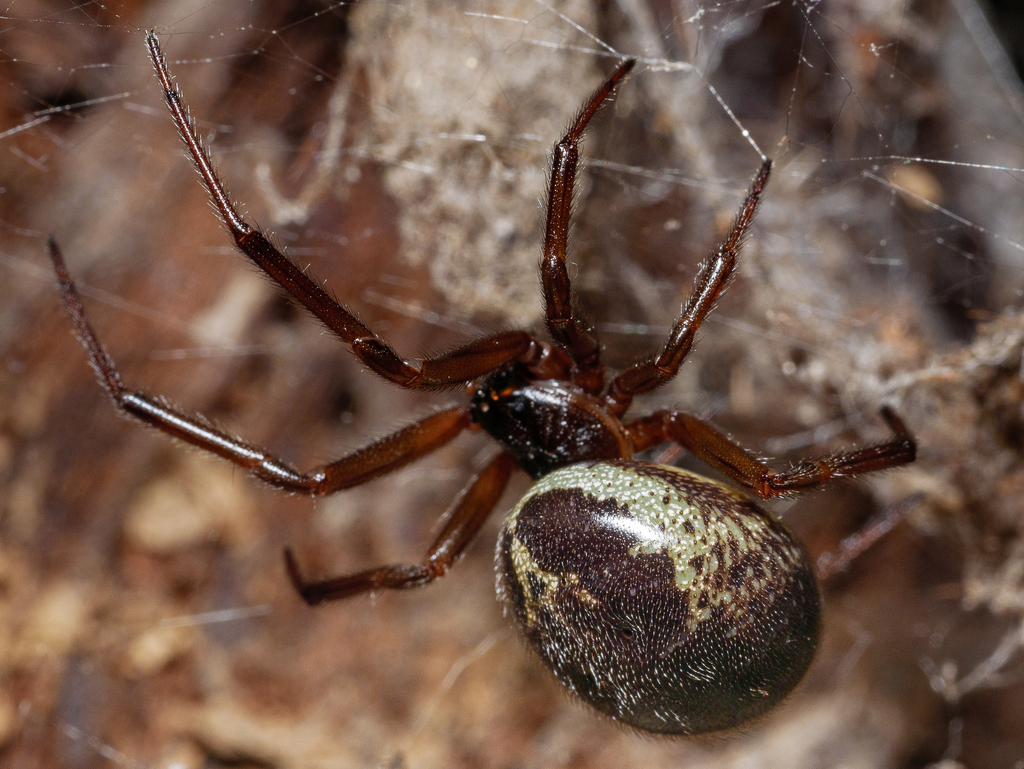
The noble false widow is a medium-sized spider with a brown, bulbous abdomen marked with cream-colored patterns that look like a skull, and reddish-orange legs. It lives year-round in homes and outdoors, originally from the Canary Islands and Madeira, and has spread across Europe and other continents. Bites are usually mild, similar to a wasp sting, but can cause more serious problems if bacteria enter the wound.
Source: Wikipedia
How to recognize it
The spider’s abdomen is brown with cream markings that often resemble a skull, and its legs are a reddish-orange colour.
Source: Wikipedia
Size
Females measure about 9.5 to 14 mm, with the largest reaching 13.7 mm; males are 7 to 11 mm, up to 11.66 mm for the biggest.
Source: Wikipedia
Is it a pest in the house?
It is considered one of the more dangerous spiders in western Europe because it lives close to humans, especially in temperate areas.
Source: Wikipedia
Does it bite or sting?
A bite usually feels like a bee or wasp sting, though some can cause more serious effects due to bacterial infection.
Source: Wikipedia
How to get rid of it
If a bite is left untreated, it can develop into severe infection such as gangrene or sepsis.
Source: Wikipedia
Where it lives
It can be found all year in both indoor and outdoor settings, including on cacti, roadside cuttings, and ruined buildings.
Source: Wikipedia
What it eats
It catches insects and small vertebrates by wrapping them in silk, using venom to paralyse the prey.
Source: Wikipedia
Life cycle
Young males and females look the same, and size or pattern differences are not linked to location.
Source: Wikipedia
When you see it
The spider is observed throughout the year in both indoor and outdoor environments. In England it is now moving northward, having been most common in southern counties.
Source: Wikipedia
Where it comes from
The species is native to the Canary Islands and Madeira and has spread to Europe, the US, Chile and Colombia.
Source: Wikipedia
Lookalikes
It is often confused with true black widows because of its similar appearance, and the term “false widow” is used for several look-alike species.
Source: Wikipedia
Where it is found in the US
Recorded in 14 of 51 states and DC. Most records: California, Oregon, Arizona, Utah, Texas, New York, Idaho, Iowa.
Darker = more records. Counts are museum and citizen-science records, not population size.
Source: GBIF
Status: introduced in North America; introduced in Canada; introduced in United States. Source: iNaturalist
Months it is reported in the US
Source: GBIF
More photos

Questions people ask
Do noble false widows bite humans?
Yes, their bite is usually comparable to a bee sting but can become serious if infection sets in.
Source: Wikipedia
How can I tell a noble false widow apart from a black widow?
Look for a brown, bulbous abdomen with cream skull-like markings and reddish-orange legs; black widows are typically shiny black with a red hourglass.
Source: Wikipedia
Where might I find this spider in my home?
They are present year-round indoors and outdoors, often in dry, sheltered spots like corners, sheds, or among plant debris.
Source: Wikipedia
Same family (Theridiidae)


Sources
- Wikipedia: https://en.wikipedia.org/wiki/Steatoda_nobilis
Look it up elsewhere: GBIF · iNaturalist · BugGuide · ITIS · Wikipedia
Text written 2026-10-22 from the sources above and checked sentence by sentence against them. Data fetched 2026-10-22.