 Bug FAQ
North American Wheel Bug
Arilus cristatus · Order: Hemiptera · Family: Reduviidae
Also called: Wheel Bug
Source: Wikipedia, citybugs.tamu.edu, entomology.ca.uky.edu

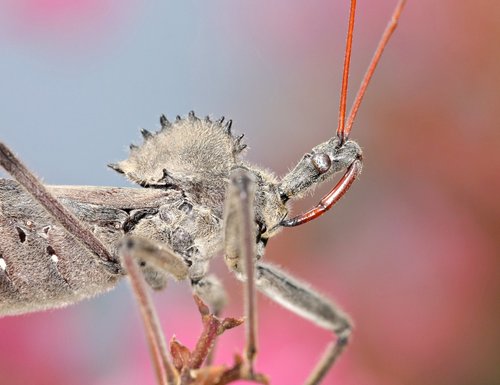
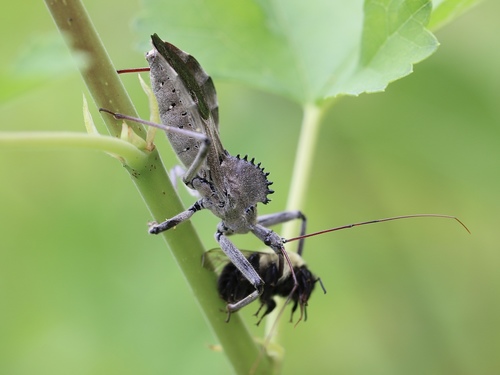
Adult wheel bugs are large gray insects about 3 cm (1¼ in) long with a distinctive cog-shaped ridge on the thorax. They live in sunny, leafy areas such as meadows, trees, shrubs and gardens, and are most active in daylight.
Source: citybugs.tamu.edu, entomology.ca.uky.edu, extension.purdue.edu, Wikipedia
How to recognize it
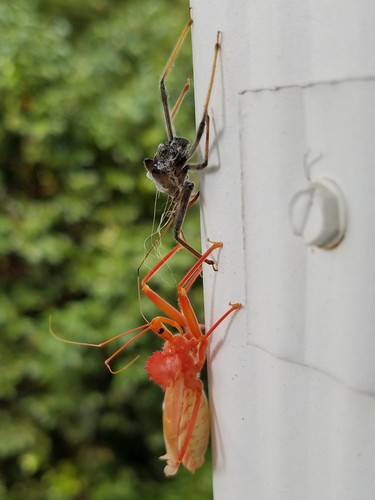
A half-wheel-shaped, toothed ridge sits on the top of the thorax, giving the bug its common name. Adults are gray to brownish-gray, while nymphs lack the wheel and have bright red or orange abdomens.
Source: entomology.ca.uky.edu, extension.purdue.edu, citybugs.tamu.edu, Wikipedia
Does it bite or sting?
If provoked or mishandled, the wheel bug will try to bite, and the bite is immediately and intensely painful. The pain from the bite can last several minutes and may persist for months, sometimes leaving a small scar.
Source: Wikipedia, citybugs.tamu.edu, entomology.ca.uky.edu, extension.purdue.edu
How to get rid of it
Wheel bugs are beneficial garden predators and are not considered a pest that requires control.
Source: entomology.ca.uky.edu, citybugs.tamu.edu
Where it lives
They are found on sunflowers, goldenrod, cotton, locust trees and other fruit or tree groves. Wheel bugs are day-active and hide in leafy vegetation when not hunting.
Source: Wikipedia
Life cycle
Eggs are laid in autumn, hatch in early May as red nymphs about 8 mm long, and after five molts become adults by July of the same year.
Source: Wikipedia
When you see it
Adults are most active during daylight hours.
Source: Wikipedia
Lookalikes
Nymphs are red and black, lacking the wheel crest that adults have. Cone-nosed (kissing) bugs look similar but lack the thoracic crest and have orange-black markings on the abdomen.
Source: entomology.ca.uky.edu, citybugs.tamu.edu
Where it is found in the US
Recorded in 42 of 51 states and DC. Most records: Texas, Virginia, Florida, North Carolina, Maryland, Pennsylvania, Oklahoma, Missouri.
Darker = more records. Counts are museum and citizen-science records, not population size.
Source: GBIF
Status: native in North America; native in Canada; native in United States. Source: iNaturalist
Months it is reported in the US
Source: GBIF
More photos

Questions people ask
Do wheel bugs bite people?
Yes, they will bite if handled, and the bite is intensely painful for several minutes.
Source: Wikipedia, citybugs.tamu.edu, entomology.ca.uky.edu
Are wheel bugs good for my garden?
They are beneficial because they prey on garden pests such as caterpillars and beetles.
Source: entomology.ca.uky.edu, Wikipedia
How big do wheel bugs get?
Adults grow up to about 3 cm (1¼ in) long, with some reaching 38 mm (1.5 in).
Source: citybugs.tamu.edu, Wikipedia
Same family (Reduviidae)
 Leafhopper Assassin BugZelus renardiiCan bite
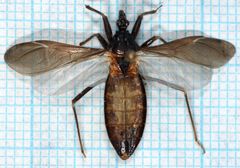 Masked HunterReduvius personatusCan bite
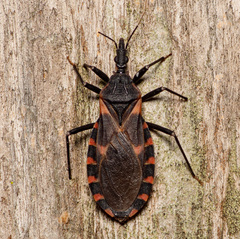 Eastern Bloodsucking ConenoseTriatoma sanguisugaCan spread germs or disease
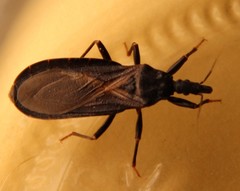 Western Bloodsucking ConenoseTriatoma protractaCan spread germs or disease
 Pale Green Assassin BugZelus luridusCan bite
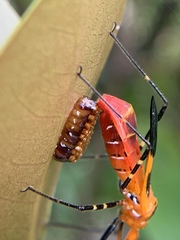 Milkweed Assassin BugZelus longipes
Sources
- Wikipedia: https://en.wikipedia.org/wiki/Arilus_cristatus
- citybugs.tamu.edu: https://citybugs.tamu.edu/factsheets/landscape/others/ent-1003/
- entomology.ca.uky.edu: https://entomology.ca.uky.edu/ef705
- extension.purdue.edu: https://extension.purdue.edu/news/county/whitley/2024/09/an-insect-that-resembles-a-dinosaur.html
Look it up elsewhere: GBIF · iNaturalist · BugGuide · ITIS · Wikipedia
Text written 2026-10-23 from the sources above and checked sentence by sentence against them. Data fetched 2026-10-23.