 Bug FAQ
Polaris Fritillary
Clossiana polaris · Order: Lepidoptera · Family: Nymphalidae
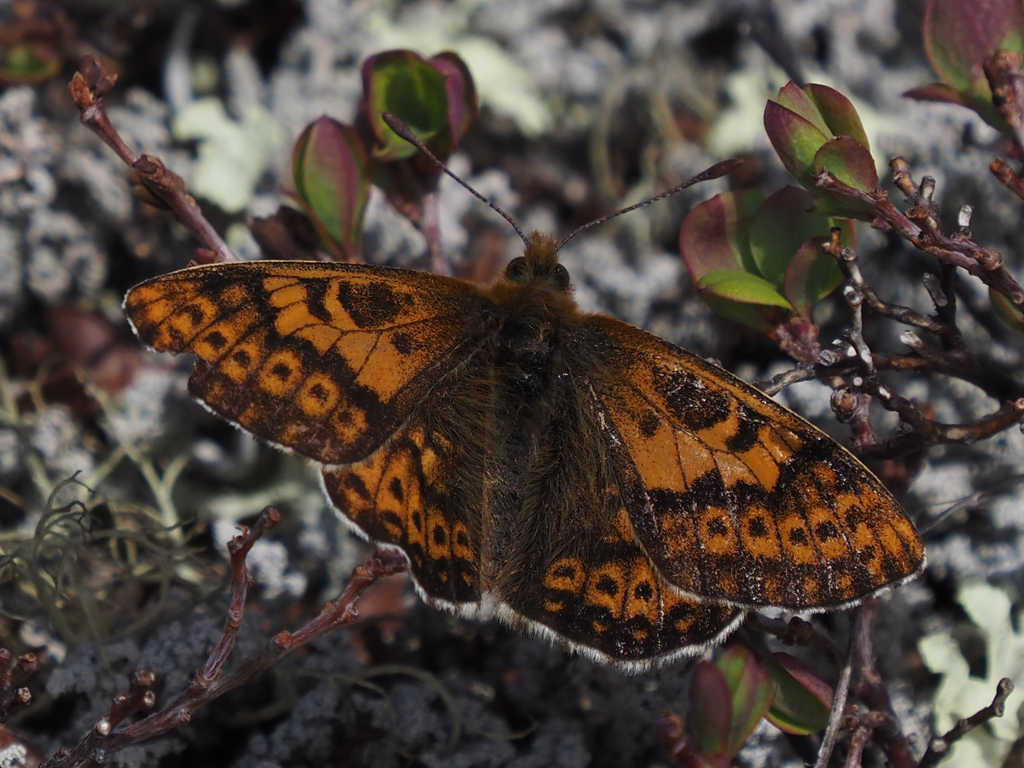
The Polaris fritillary has a wingspan of about 32 to 38 mm and lives in mountain tundra, often near rocks or in meadow areas where it feeds on plants such as astragalus, wild rosemary and dryad. Its caterpillars eat the flowers and leaves of Dryas octopetala and several Vaccinium species, developing over two years with two periods of hibernation. Adults fly from June to August across northern Scandinavia, Greenland, northeastern Alaska, northern Canada and parts of Russia.
Source: Wikipedia
How to recognize it
The forewing shows a heavy, deep black median band that is strongly sinuous near the base, while the hindwing underside is variegated with a mother-of-pearl ground colour and silvery-toothed bands.
Source: Wikipedia
Size
Wingspan ranges from 32 to 38 mm.
Source: Wikipedia
Where it lives
Found in mountain tundra, especially near rocky areas, and in meadow tundra where it feeds on astragalus, wild rosemary and dryad.
Source: Wikipedia
What it eats
Caterpillars feed on flowers and leaves of Dryas octopetala and various Vaccinium species.
Source: Wikipedia
Life cycle
The species develops over two years, with caterpillars hibernating twice, once after hatching and again at the fourth instar; they do not feed before the first winter.
Source: Wikipedia
When you see it
Adults are on the wing from June to August, with peak activity in July and August in Norway, Finland and Lapland.
Source: Wikipedia
Where it comes from
It occurs in North America, specifically northeastern Alaska and northern Canada.
Source: Wikipedia
Lookalikes
It resembles the preceding species freija but is more variable in appearance.
Source: Wikipedia
Where it is found in the US
Recorded in 2 of 51 states and DC. Most records: Alaska, Colorado.
Darker = more records. Counts are museum and citizen-science records, not population size.
Source: GBIF
Status: native in North America; native in Canada. Source: iNaturalist
Months it is reported in the US
Source: GBIF
More photos
Questions people ask
When can I see the Polaris fritillary?
Adults fly from June through August, with the highest numbers in July and August.
Source: Wikipedia
What do the caterpillars eat?
They feed on the flowers and leaves of Dryas octopetala and several Vaccinium species.
Source: Wikipedia
How can I tell it apart from similar butterflies?
It has a heavy, deep-black median band on the forewing and a variegated hindwing underside with silvery-toothed bands, unlike the more uniform freija.
Source: Wikipedia
Same family (Nymphalidae)






Sources
- Wikipedia: https://en.wikipedia.org/wiki/Boloria_polaris
Look it up elsewhere: GBIF · iNaturalist · BugGuide · ITIS · Wikipedia
Text written 2026-10-24 from the sources above and checked sentence by sentence against them. Data fetched 2026-10-24.