 Bug FAQ
Small Heath
Coenonympha pamphilus · Order: Lepidoptera · Family: Nymphalidae
Also called: Small Heath Butterfly

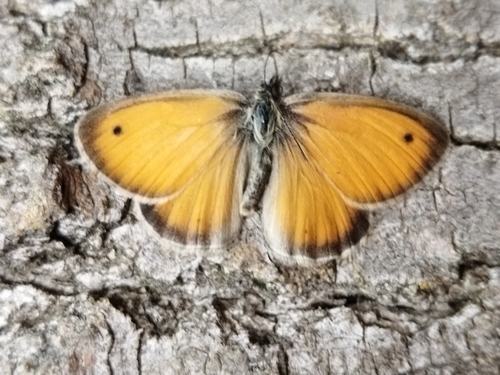
The small heath is the tiniest butterfly in the Satyrinae subfamily of Nymphalidae and has reddish-yellow sand coloured upper wings with a small eye-spot on the forewing underside. It lives in dry grasslands, salt marshes, alpine meadows and wetland edges across Europe, north-west Africa and parts of Asia, being especially common in England and Wales. Adults sip nectar from flowers such as bramble, yarrow and ragwort, while the caterpillars feed on various grasses.
Source: Wikipedia
How to recognize it
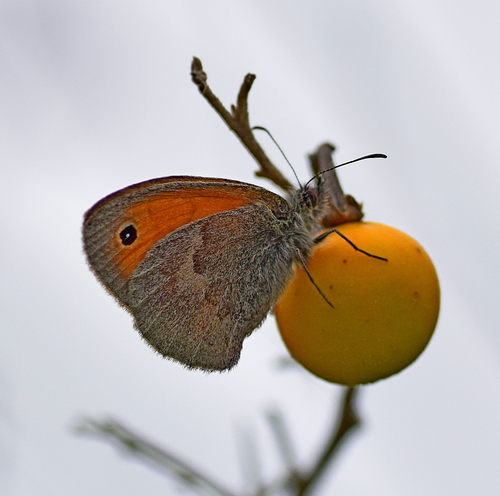
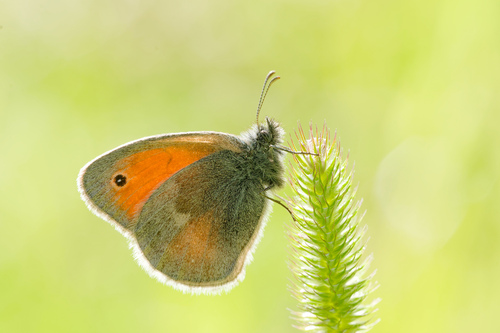
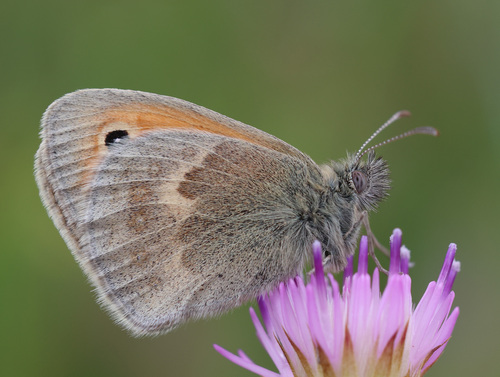
It belongs to the Nymphalidae family, subfamily Satyrinae, and is the smallest member of that group. Upper wings are reddish-yellow like sand; underside of forewing is reddish-yellow with a grey border and a small eye-spot, hindwing has a grey-diluted area with a short curved white band.
Source: Wikipedia
Size
It is the smallest butterfly in the Satyrinae subfamily.
Source: Wikipedia
Where it lives
Found in dry grasslands, salt marshes, alpine meadows, wetlands and grassy areas near streams across Eurasia and north-west Africa.
Source: Wikipedia
What it eats
Caterpillars feed on grasses found in many habitats.
Source: Wikipedia
Life cycle
The species has several generations per year. Young females lay many yellow eggs early in life, while older females lay fewer, more yellow eggs.
Source: Wikipedia
When you see it
They fly low, with a hopping, slow flight, often entering gardens and even walking on pavement. Adults are on the wing from late April through October across meadows, fields and hilltops.
Source: Wikipedia
Where it comes from
It occurs widely throughout the Western Palearctic, especially in Europe where it has been recorded in at least 40 countries since 2002. It is common in the United Kingdom (England and Wales) and also present in southwest Siberia, parts of Asia and north Africa.
Source: Wikipedia
Lookalikes
They look similar to a small meadow brown but have noticeably paler wing brown in flight. They can be confused with Coenonympha caeca (no apical spots), C. tullia (smaller apical spot) or C. symphita (no white hindwing spot and a full row of forewing spots).
Source: Wikipedia
More photos
Questions people ask
What does the small heath butterfly look like?
It has reddish-yellow sand coloured upper wings, a small eye-spot on the underside of the forewing and a short curved white band on the hindwing underside.
Source: Wikipedia
Where can I find small heath butterflies?
They live in dry grasslands, salt marshes, alpine meadows, wetlands and grassy areas near streams across Europe, north-west Africa and parts of Asia.
Source: Wikipedia
When are small heaths active?
Adults fly from the end of April until October, often low and hopping over fields and gardens.
Source: Wikipedia
Same family (Nymphalidae)






Sources
- Wikipedia: https://en.wikipedia.org/wiki/Small_heath_%28butterfly%29
Look it up elsewhere: GBIF · iNaturalist · BugGuide · Wikipedia
Text written 2026-10-24 from the sources above and checked sentence by sentence against them. Data fetched 2026-10-22.