 Bug FAQ
Southern Field Cricket
Gryllus bimaculatus · Order: Orthoptera · Family: Gryllidae
Also called: Field cricket, Two-spotted Cricket

They live under logs, in grasses, in crevices, and they dig or occupy holes in the ground. Females lay eggs in humid soil or sand using an ovipositor, and the eggs hatch in about two weeks.
Source: Wikipedia
How to recognize it
Two small dot-like spots on the wing base identify this species.
Source: Wikipedia
Where it lives
They also make or use holes in the ground for shelter.
Source: Wikipedia
What it eats
They are commonly raised as live feed for pets and zoo animals. They are easy to rear and do not need long cold periods to complete their life cycle.
Source: Wikipedia
Life cycle
Females use an ovipositor to deposit eggs into the ground. Eggs hatch in roughly two weeks when kept in humid soil or sand.
Source: Wikipedia
Where it comes from
They are called the two-spotted cricket and are found across Africa, the Mediterranean, and much of Asia, including China, Indochina, and Borneo.
Source: Wikipedia
Lookalikes
The wing-base dots also distinguish it from other Gryllus species.
Source: Wikipedia
Where it is found in the US
Recorded in 1 of 51 states and DC. Most records: Hawaii.
Darker = more records. Counts are museum and citizen-science records, not population size.
Source: GBIF
Status: introduced in United States. Source: iNaturalist
Months it is reported in the US
Source: GBIF
More photos
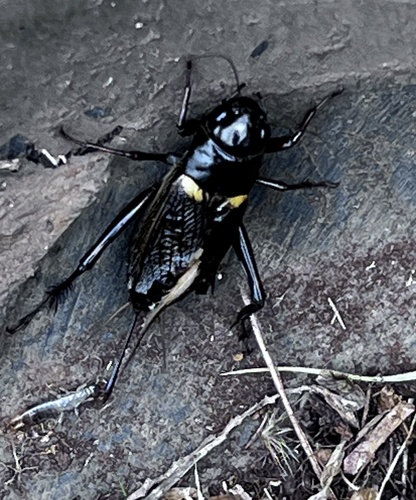
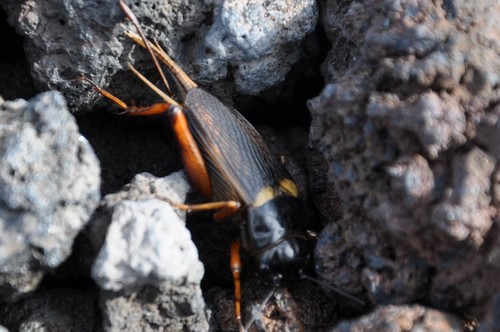
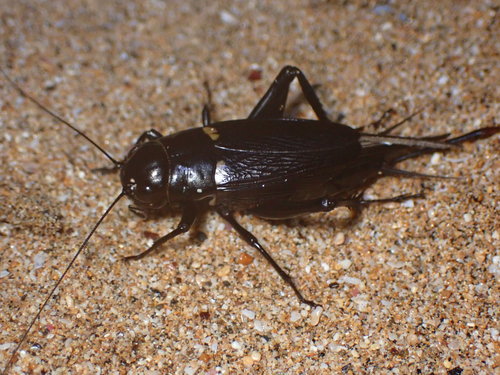
Same family (Gryllidae)
 Fall Field CricketGryllus pennsylvanicusCan damage your home
 Tropical House CricketGryllodes sigillatusNuisance, not dangerous
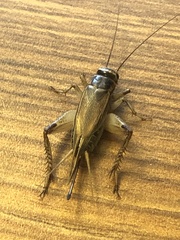 House CricketAcheta domesticusCan damage your home
 European Field CricketGryllus campestris
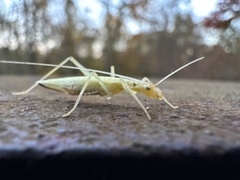 Narrow-winged Tree CricketOecanthus niveus
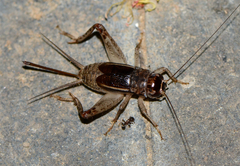 Japanese Burrowing CricketVelarifictorus micado
Sources
- Wikipedia: https://en.wikipedia.org/wiki/Gryllus_bimaculatus
Look it up elsewhere: GBIF · iNaturalist · BugGuide · Wikipedia
Text written 2026-10-22 from the sources above and checked sentence by sentence against them. Data fetched 2026-10-22.