 Bug FAQ
Spotted Cucumber Beetle
Diabrotica undecimpunctata · Order: Coleoptera · Family: Chrysomelidae
Also called: Southern Corn Rootworm
Source: Wikipedia

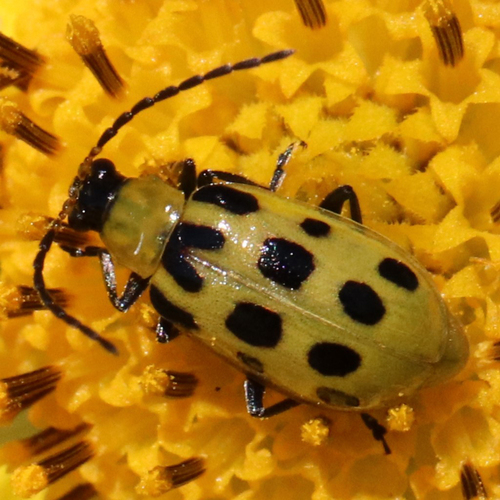
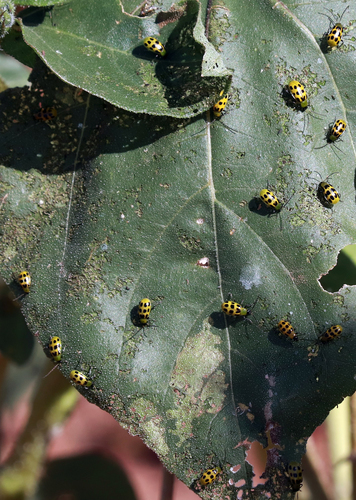
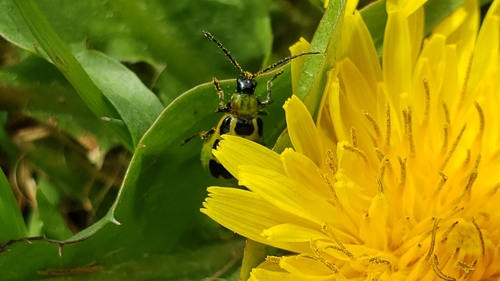
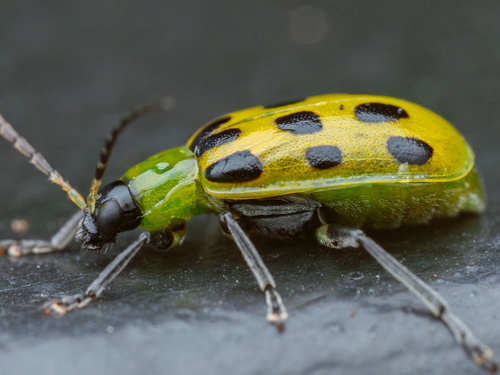
Adult spotted cucumber beetles are greenish-yellow with six black spots on each wing cover. Both larvae and adults feed on many plants, with larvae attacking roots and adults eating over fifty crop and wild species. They develop in 2 to 3 weeks as yellowish larvae, emerge as adults after about a week, and can live 60 days in summer or up to 200 days in winter.
Source: Wikipedia
How to recognize it
Adults are greenish-yellow and have six large black spots on each elytron.
Source: Wikipedia
Size
They are about half a centimeter long.
Source: Wikipedia
How to get rid of it
Encouraging natural predators can help control their numbers.
Source: Wikipedia
What it eats
Larvae feed on the roots of young plants, causing the most damage.
Source: Wikipedia
Life cycle
Adults emerge after 6 to 10 days as the larvae pupate.
Source: Wikipedia
Where it comes from
They are native to North America.
Source: Wikipedia
Lookalikes
The other common cucumber beetles are the banded cucumber beetle and the striped cucumber beetle.
Source: Wikipedia
Where it is found in the US
Recorded in 50 of 51 states and DC. Most records: Texas, California, Ohio, Oregon, Illinois, Virginia, Pennsylvania, Maryland.
Darker = more records. Counts are museum and citizen-science records, not population size.
Source: GBIF
Status: native in North America; native in Canada; native in United States. Source: iNaturalist
Months it is reported in the US
Source: GBIF
More photos
Questions people ask
How can I reduce damage to my garden?
Promoting predators of the beetle is an effective biological control method.
Source: Wikipedia
Same family (Chrysomelidae)
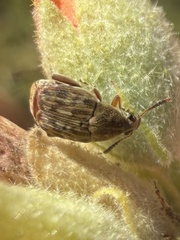 Bean WeevilAcanthoscelides obtectusDamages trees, gardens or crops
 Cowpea WeevilCallosobruchus maculatusDamages trees, gardens or crops
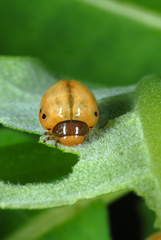 Swamp Milkweed Leaf BeetleLabidomera clivicollisDamages trees, gardens or crops
 Alder Leaf BeetleAgelastica alniDamages trees, gardens or crops
 Dogbane Leaf BeetleChrysochus auratus
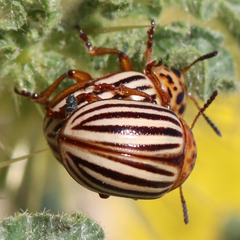 Colorado Potato BeetleLeptinotarsa decemlineata
Sources
- Wikipedia: https://en.wikipedia.org/wiki/Diabrotica_undecimpunctata
Look it up elsewhere: GBIF · iNaturalist · BugGuide · ITIS · Wikipedia
Text written 2026-10-22 from the sources above and checked sentence by sentence against them. Data fetched 2026-10-22.