 Bug FAQ
Texas Agapostemon
Agapostemon texanus · Order: Hymenoptera · Family: Halictidae
Also called: Texas Striped Sweat Bee
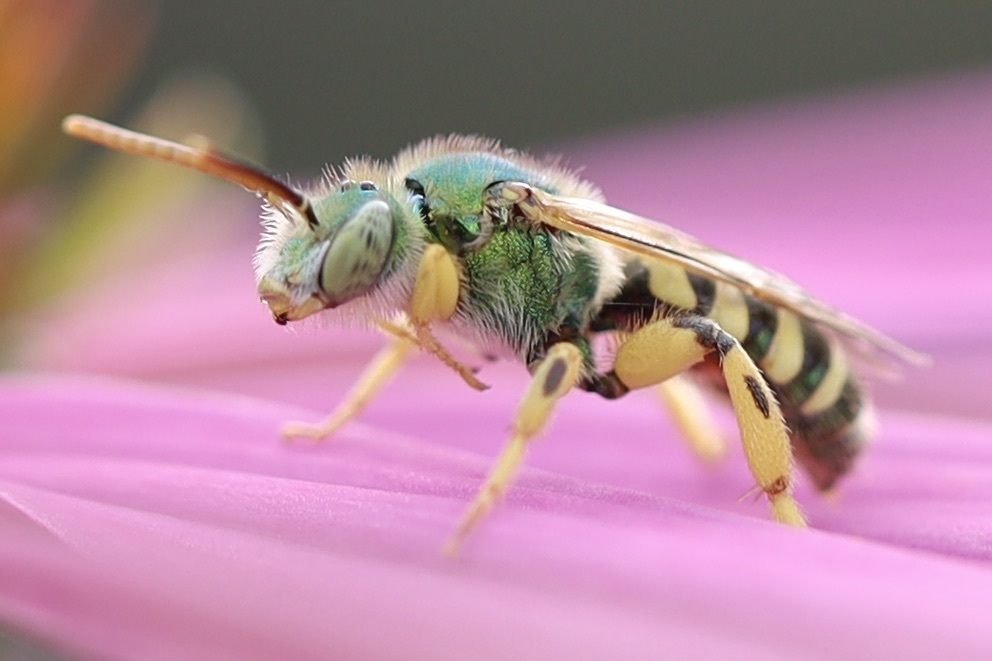
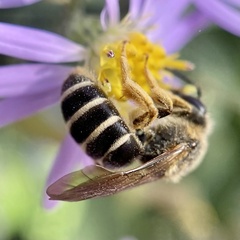
Females are about 11 mm long and males are 9-10 mm long. Both sexes have a metallic blue-green head and thorax; males show black and yellow bands on the abdomen while females are a single solid color. They nest in the ground on banks or flat surfaces, fly low searching for hidden spots, occur across North America from southern Canada to Costa Rica, carry pollen on their hind legs and make short direct flights between flowers, and are active from March to October with a peak from May to September.
Source: Wikipedia
How to recognize it
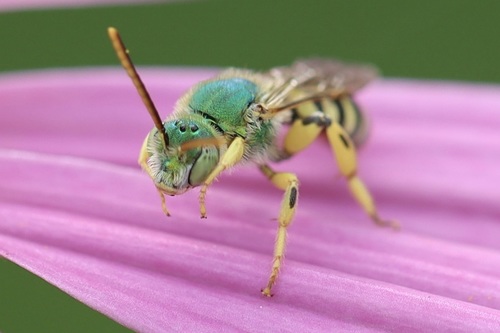
The head and thorax are metallic blue or green; males have black-yellow bands on the abdomen, females are uniformly colored.
Source: Wikipedia
Size
Females are about 11 mm long, while males measure 9-10 mm.
Source: Wikipedia
Where it lives
They nest in the ground on both vertical banks and horizontal surfaces, and females fly close to the ground looking for dark, hidden nesting spots.
Source: Wikipedia
What it eats
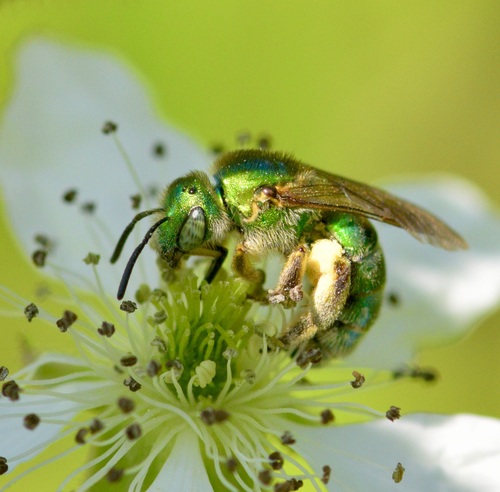
They transport pollen on their hind legs and make short, direct flights between flowers they visit.
Source: Wikipedia
Life cycle
At night the nest entrance is sealed with dirt.
Source: Wikipedia
When you see it
Their flight season runs from March to October, with peak activity from May to September.
Source: Wikipedia
Where it comes from
Agapostemon texanus is native to North America and has the widest range of its genus, from southern Canada down to Costa Rica.
Source: Wikipedia
Where it is found in the US
Recorded in 43 of 51 states and DC. Most records: California, Texas, Oregon, Arizona, Pennsylvania, Utah, Massachusetts, Colorado.
Darker = more records. Counts are museum and citizen-science records, not population size.
Source: GBIF
Status: native in North America; native in United States. Source: iNaturalist
Months it is reported in the US
Source: GBIF
More photos

Questions people ask
How can I identify Agapostemon texanus?
Look for a metallic blue-green head and thorax; males have black-yellow bands on the abdomen, while females are a single solid color.
Source: Wikipedia
When are these bees active?
They are active from March through October, with the highest numbers between May and September.
Source: Wikipedia
Where does Agapostemon texanus live?
It is found throughout North America, from southern Canada down to Costa Rica.
Source: Wikipedia
Same family (Halictidae)

Sources
- Wikipedia: https://en.wikipedia.org/wiki/Agapostemon_texanus
Look it up elsewhere: GBIF · iNaturalist · BugGuide · ITIS · Wikipedia
Text written 2026-10-23 from the sources above and checked sentence by sentence against them. Data fetched 2026-10-23.