 Bug FAQ
Violet-winged Grasshopper
Tropidacris collaris · Order: Orthoptera · Family: Romaleidae
Source: Wikipedia

Adults are 5 to 7 cm long for males and 8.5 to 10.5 cm for females, with a wingspan of about 18 cm; the wings show bright blue in flight. It eats a wide range of plants, including crops, plantation trees and ornamental garden species, and is regarded as a pest in parts of its range.
Source: Wikipedia
How to recognize it
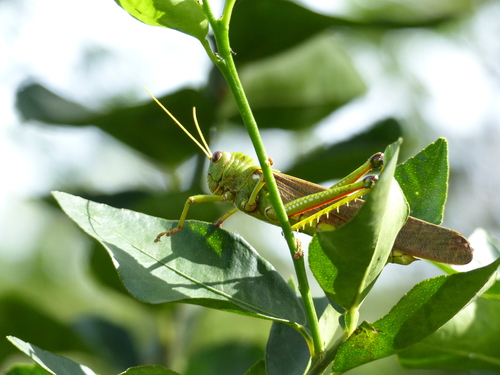
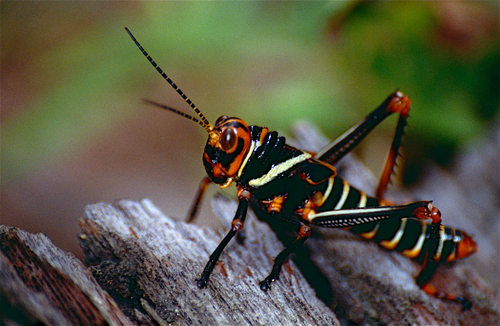
When it flies, the wings are usually bright blue, though they can sometimes look grayish or greenish. The young, wingless nymphs are black, red and yellow and are thought to be toxic.
Source: Wikipedia
Size
Males measure about 5 to 7 cm long; females are larger at 8.5 to 10.5 cm, and the wingspan is roughly 18 cm.
Source: Wikipedia
Is it a pest in the house?
Because it eats crops and garden plants, it is considered a pest in some parts of its range.
Source: Wikipedia
Where it lives
It lives in many South American habitats, from rainforests to dry open areas such as Caatinga and Cerrado.
Source: Wikipedia
What it eats
It feeds on many plant types, including agricultural crops, plantation trees and ornamental garden plants.
Source: Wikipedia
More photos

Questions people ask
What plants does the violet-winged grasshopper damage?
It eats many crops, plantation trees and ornamental garden plants, so it can damage fields, orchards and garden beds.
Source: Wikipedia
How big are adult violet-winged grasshoppers?
Males are about 5 to 7 cm long, females 8.5 to 10.5 cm, with a wingspan near 18 cm.
Source: Wikipedia
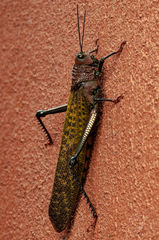
Same family (Romaleidae)
Sources
- Wikipedia: https://en.wikipedia.org/wiki/Tropidacris_collaris
Look it up elsewhere: GBIF · iNaturalist · BugGuide · Wikipedia
Text written 2026-10-22 from the sources above and checked sentence by sentence against them. Data fetched 2026-10-22.