 Bug FAQ
Black-and-Red Bug
Lygaeus equestris · Order: Hemiptera · Family: Lygaeidae
Also called: Harlequin bug
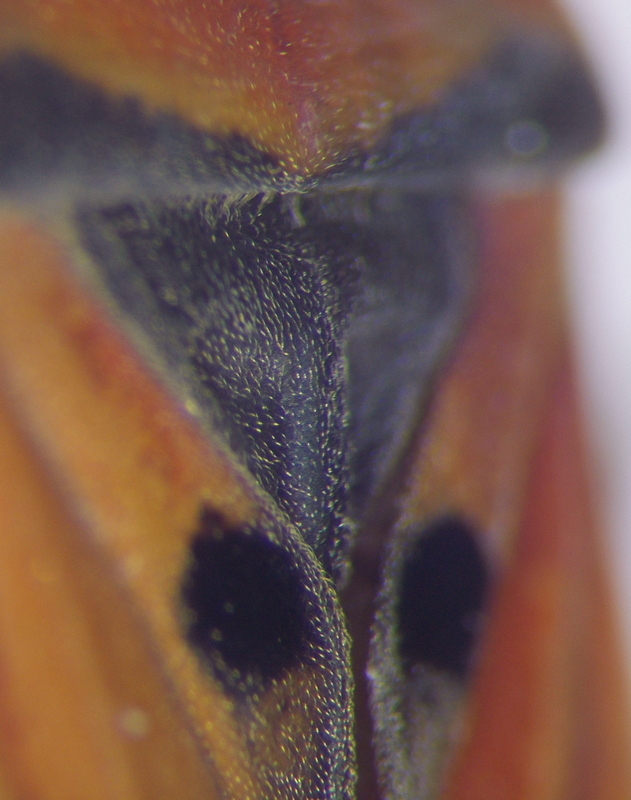
The black-and-red bug is about a centimetre long and shows a red-black pattern with two dark bands on its wings and a white spot on the membrane. It lives in warm, limestone-rich lawns, forest clearings and scrub areas across much of Europe and parts of Brazil. Both nymphs and adults feed on plant juices from milkweed, dandelions, taraxacum and other herbaceous plants, and adults survive the winter.
Source: Wikipedia
How to recognize it
It has a distinctive red-black coloration, fully developed wings, strong legs, two transverse dark bands on the hemelytra that reach the edge, and a round white spot on the wing membrane.
Source: Wikipedia
Size
Adults measure roughly 11 to 12 mm (0.43 to 0.47 in) in length.
Source: Wikipedia
Where it lives
It is found in lawns, forest clearings and scrub, preferring warm, calcareous sites.
Source: Wikipedia
What it eats
Both nymphs and adults suck plant juices, especially from milkweed (Vincetoxicum hirundinaria), dandelions, taraxacum species and spring pheasant's eye (Adonis vernalis).
Source: Wikipedia
Life cycle
Adults overwinter and re-appear in the spring.
Source: Wikipedia
When you see it
Adults are present throughout the winter months.
Source: Wikipedia
Where it comes from
Its range includes many European countries, from Albania to Sweden, as well as Brazil.
Source: Wikipedia
More photos
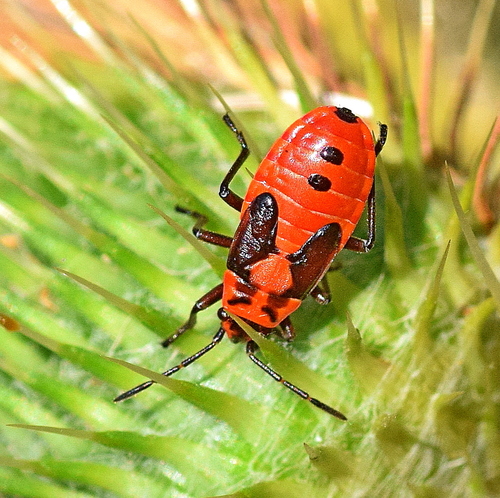
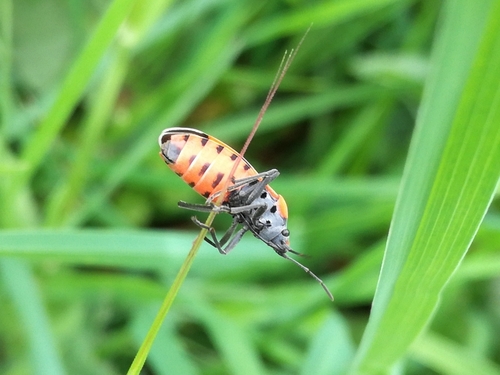
Same family (Lygaeidae)
 Large Milkweed BugOncopeltus fasciatus
 Small Milkweed BugLygaeus kalmii
 False Milkweed BugLygaeus turcicus
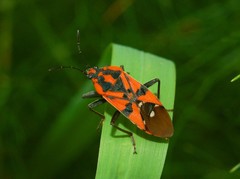 Indian Milkweed BugSpilostethus pandurusDamages trees, gardens or crops
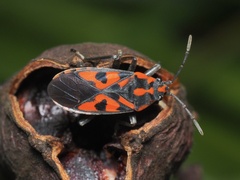 Harlequin bugSpilostethus saxatilisDamages trees, gardens or crops
 Darth Maul BugSpilostethus hospesDamages trees, gardens or crops
Sources
- Wikipedia: https://en.wikipedia.org/wiki/Lygaeus_equestris
Look it up elsewhere: GBIF · iNaturalist · BugGuide · ITIS · Wikipedia
Text written 2026-10-22 from the sources above and checked sentence by sentence against them. Data fetched 2026-10-22.