 Bug FAQ
Indian Milkweed Bug
Spilostethus pandurus · Order: Hemiptera · Family: Lygaeidae
Source: Wikipedia
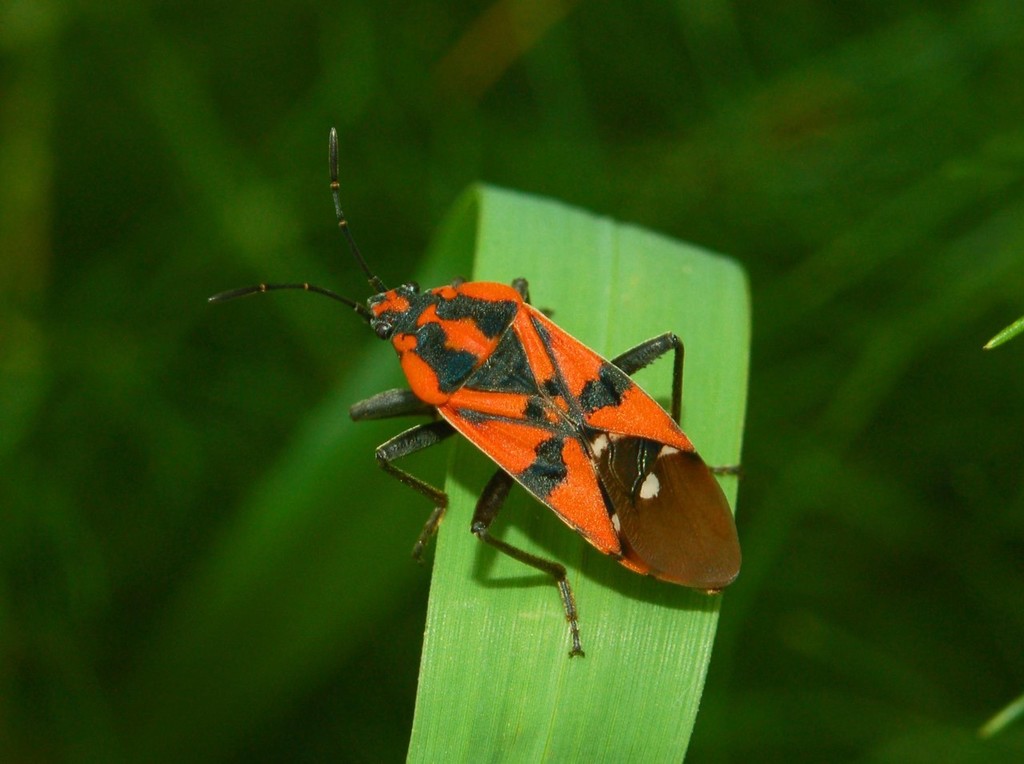
The Indian Milkweed Bug is a 13 to 15 mm red-black insect with distinctive white and black markings. It feeds on many flowers and seeds, especially those of the Apocynaceae family, and can harm crops like sesame and Calotropis species.
Source: Wikipedia
How to recognize it
Its body is red-black with a central white spot on the wing membrane. Two broad black wavy stripes run lengthwise on the pronotum, and the scutellum is black, sometimes showing a small red tip.
Source: Wikipedia
Size
Adults measure about 13 to 15 mm long (0.5 to 0.6 in).
Source: Wikipedia
Where it lives
In Europe it is found on toxic plants such as jimsonweed and oleander. It can cause serious damage to sesame and to Calotropis gigantea and C. procera.
Source: Wikipedia
What it eats
The bug feeds on flowers and seeds of many plant species. It prefers plants in the Apocynaceae family.
Source: Wikipedia
Life cycle
Nymphs are bright red with black markings. They have two dorsal prothoracic glands that release substances deterring predators.
Source: Wikipedia
Where it comes from
Its range covers the Euro-Mediterranean-Turanian region, extending farther south than the related Spilostethus saxatilis. It is recorded in many European countries, the Middle East, the Afrotropical realm, and from southern Asia to India and China.
Source: Wikipedia
Where it is found in the US
Recorded in 4 of 51 states and DC. Most records: Massachusetts, Florida, Illinois, Pennsylvania.
Darker = more records. Counts are museum and citizen-science records, not population size.
Source: GBIF
More photos

Questions people ask
What plants does it damage?
It can heavily damage sesame crops and the milkweed species Calotropis gigantea and C. procera.
Source: Wikipedia
Where is this bug found?
It occurs across much of Europe, the Middle East, parts of Africa, and extends into southern Asia up to India and China.
Source: Wikipedia
Same family (Lygaeidae)



Sources
- Wikipedia: https://en.wikipedia.org/wiki/Spilostethus_pandurus
Look it up elsewhere: GBIF · iNaturalist · BugGuide · Wikipedia
Text written 2026-10-22 from the sources above and checked sentence by sentence against them. Data fetched 2026-10-22.