 Bug FAQ
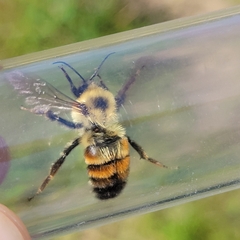
Brown-belted Bumble Bee
Bombus griseocollis · Order: Hymenoptera · Family: Apidae
Also called: Brown-belted Bumblebee

The queen is about 2.1 to 2.3 cm long and a centimetre wide at the abdomen, while workers are often under a centimetre long. It lives in many habitats, from meadows and wetlands to farms and cities, across most of the United States and southern Canada.
Source: Wikipedia
Size
Queens measure 2.1 to 2.3 cm long and about 1 cm wide at the abdomen. Workers are smaller, often less than 1 cm in length.
Source: Wikipedia
Where it lives
It can be found in meadows, wetlands, agricultural fields, and even densely populated urban areas.
Source: Wikipedia
What it eats
Adults feed on a wide variety of plants, including milkweeds, clovers, goldenrods, and many others. Queens especially prefer legume flowers.
Source: Wikipedia
Life cycle
Eggs are white, robust, slightly curved, about 2.9 mm long and 0.8 to 1.0 mm wide. The species is eusocial, forming colonies with reproductive and non-reproductive castes.
Source: Wikipedia
When you see it
Males wait in places where young queens pass to mate with them. It is a common species throughout its broad range.
Source: Wikipedia
Where it comes from
Native to most of the United States except the Southwest, and to the southern parts of several Canadian provinces.
Source: Wikipedia
Where it is found in the US
Recorded in 49 of 51 states and DC. Most records: Minnesota, Illinois, Missouri, Ohio, New York, Nebraska, Wisconsin, Massachusetts.
Darker = more records. Counts are museum and citizen-science records, not population size.
Source: GBIF
Status: native in North America; native in United States; native in Canada. Source: iNaturalist
Months it is reported in the US
Source: GBIF
More photos
Same family (Apidae)

Sources
- Wikipedia: https://en.wikipedia.org/wiki/Bombus_griseocollis
Look it up elsewhere: GBIF · iNaturalist · BugGuide · ITIS · Wikipedia
Text written 2026-10-22 from the sources above and checked sentence by sentence against them. Data fetched 2026-10-22.