 Bug FAQ
Common Blue Damselfly
Enallagma cyathigerum · Order: Odonata · Family: Coenagrionidae
Also called: Common Bluet, Desert Bluet
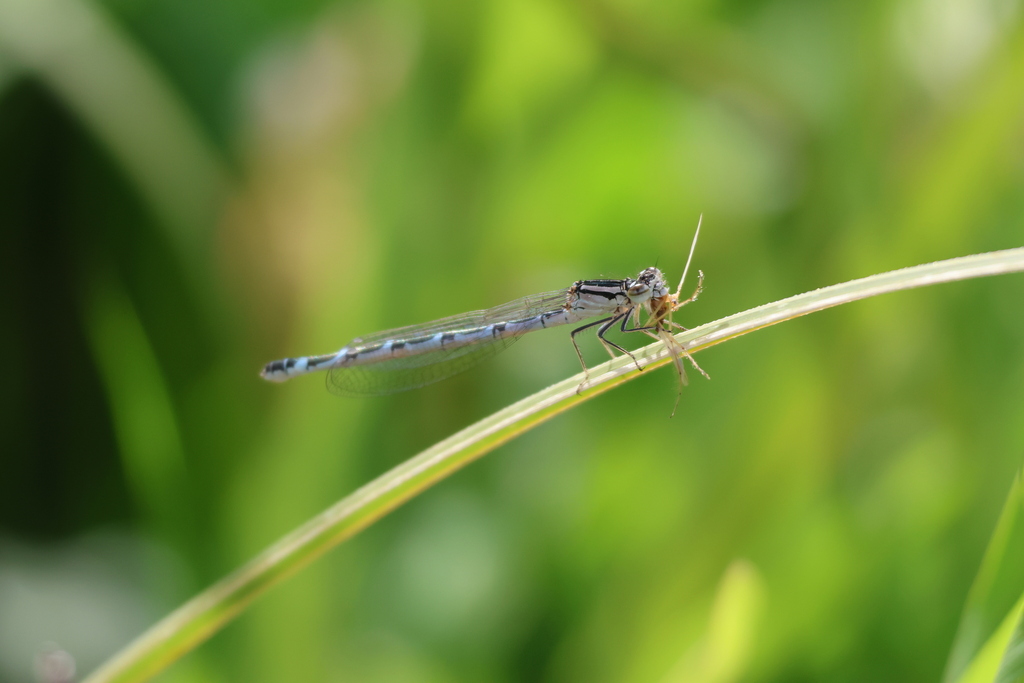
The common blue damselfly is a small, blue-colored insect found across most of Europe, parts of Asia and North America. It lives near fresh water, spends most of its life as an aquatic larva, and adults appear from May to August. Males are bright blue with black markings, while females show more colour variation, and it can be confused with the azure damselfly.
Source: Wikipedia
How to recognize it
Males are a vivid blue with black spots; females vary more in colour. Compared with the azure damselfly, the common blue has more blue than black on its back and thorax.
Source: Wikipedia
Size
Adults measure 29 to 36 mm long, with wings 18 to 20 mm in length.
Source: Wikipedia
How to get rid of it
Pesticides strongly affect this species because they are sensitive to chemicals. Long-term pesticide exposure reduces successful metamorphosis.
Source: Wikipedia
Where it lives
They are found at many freshwater sites, from acidic fens to nutrient-rich ponds. Larvae prefer waters with complex substrates and abundant plants.
Source: Wikipedia
What it eats
Larvae eat smaller aquatic larvae and are themselves eaten by fish and larger larvae. All coenagrionid larvae have a broad diet, allowing them to live in many habitats.
Source: Wikipedia
Life cycle
The life cycle starts in water, with most of the time spent as a larva. When temperatures fall, larvae can enter diapause instead of dying.
Source: Wikipedia
When you see it
Adults emerge from May through August, feed briefly, then mate and lay eggs. Adult colonies show an about 1:1 male-to-female ratio.
Source: Wikipedia
Where it comes from
Their range spans roughly 40° N to 72° N across the Palearctic, most of Europe, parts of Asia and Ontario in North America.
Source: Wikipedia
Lookalikes
It is often mistaken for the azure damselfly (Coenagrion puella). The Nearctic northern bluet (Enallagma annexum) was once considered the same species.
Source: Wikipedia
Where it is found in the US
Recorded in 20 of 51 states and DC. Most records: California, Colorado, New Mexico, Ohio, Pennsylvania, Washington, New York, Oregon.
Darker = more records. Counts are museum and citizen-science records, not population size.
Source: GBIF
Months it is reported in the US
Source: GBIF
More photos
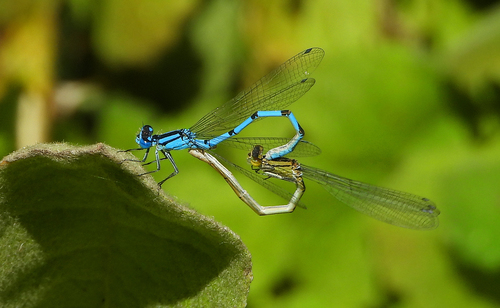
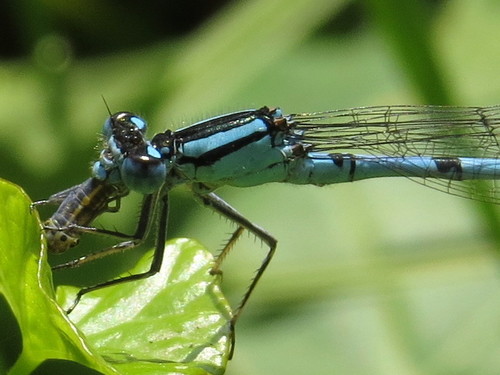
Questions people ask
How can I tell a common blue damselfly apart from an azure damselfly?
The common blue has more blue than black on its back and thorax, while the azure damselfly shows the opposite pattern.
Source: Wikipedia
Where might I find these damselflies?
Look near fresh water such as ponds, lakes, or fens across most of Europe, parts of Asia, and Ontario, Canada.
Source: Wikipedia
Same family (Coenagrionidae)


Sources
- Wikipedia: https://en.wikipedia.org/wiki/Enallagma_cyathigerum
Look it up elsewhere: GBIF · iNaturalist · BugGuide · ITIS · Wikipedia
Text written 2026-10-22 from the sources above and checked sentence by sentence against them. Data fetched 2026-10-22.