 Bug FAQ
Familiar Bluet
Enallagma civile · Order: Odonata · Family: Coenagrionidae

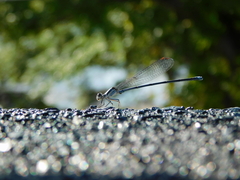
Familiar bluets are small damselflies about 30 to 39 mm long with a torpedo-shaped thorax and a slender, ten-segmented abdomen. Males are bright blue with black spots on the eyes, thorax and abdomen, while females can be pale blue or olive-tan. They live around clean freshwater with vegetation such as lakes, ponds, marshes and slow streams, and fly from mid-June to mid-October.
Source: Wikipedia
How to recognize it
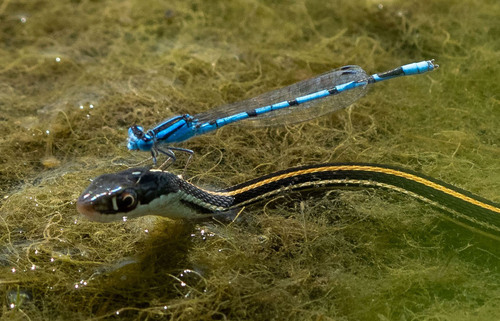
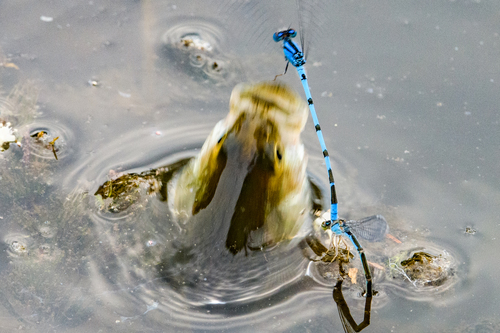
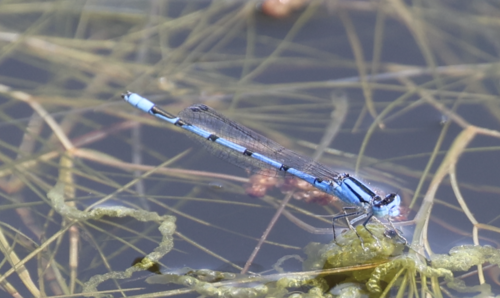
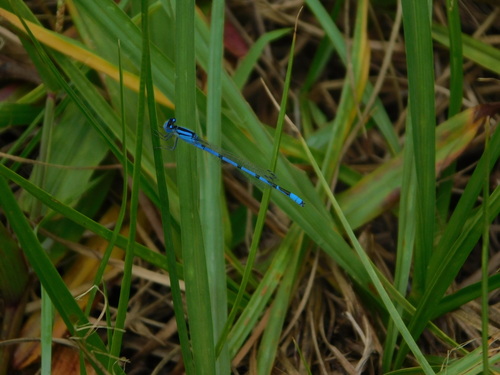
Males are bright blue with jet-black spots on the dorsal eyes, thorax and upper abdomen. Females may be pale blue or olive-tan.
Source: Wikipedia
Size
Adults are 30 to 39 mm long, with a torpedo-shaped thorax tapering into a slender ten-segmented abdomen.
Source: Wikipedia
Where it lives
They are found in natural or artificial ponds, lakes, marshes and slow-moving streams with clean freshwater and vegetation.
Source: Wikipedia
What it eats
Nymphs mainly eat chironomid larvae, water boatmen, cladocerans, ostracods and aquatic mites. Damselfly nymphs have six long legs and three external gills at the abdomen tip for underwater propulsion.
Source: Wikipedia
Life cycle
Damselflies undergo incomplete metamorphosis. After hatching, they spend most of their life as nymphs, molting and developing adult structures.
Source: Wikipedia
When you see it
In Maine, adults are on the wing from mid-June through mid-October.
Source: Wikipedia
Lookalikes
They look similar to tule bluets but have less extensive black coloration on the abdomen and thorax.
Source: Wikipedia
Where it is found in the US
Recorded in 49 of 51 states and DC. Most records: Texas, Ohio, New Jersey, Arizona, California, Maryland, New Mexico, Virginia.
Darker = more records. Counts are museum and citizen-science records, not population size.
Source: GBIF
Status: native in North America; native in United States; native in Canada. Source: iNaturalist
Months it is reported in the US
Source: GBIF
More photos
Same family (Coenagrionidae)

Sources
- Wikipedia: https://en.wikipedia.org/wiki/Familiar_bluet
Look it up elsewhere: GBIF · iNaturalist · BugGuide · ITIS · Wikipedia
Text written 2026-10-22 from the sources above and checked sentence by sentence against them. Data fetched 2026-10-22.