 Bug FAQ
Double-banded Plushback
Palpada agrorum · Order: Diptera · Family: Syrphidae
Also called: Double-banded Plushback Fly
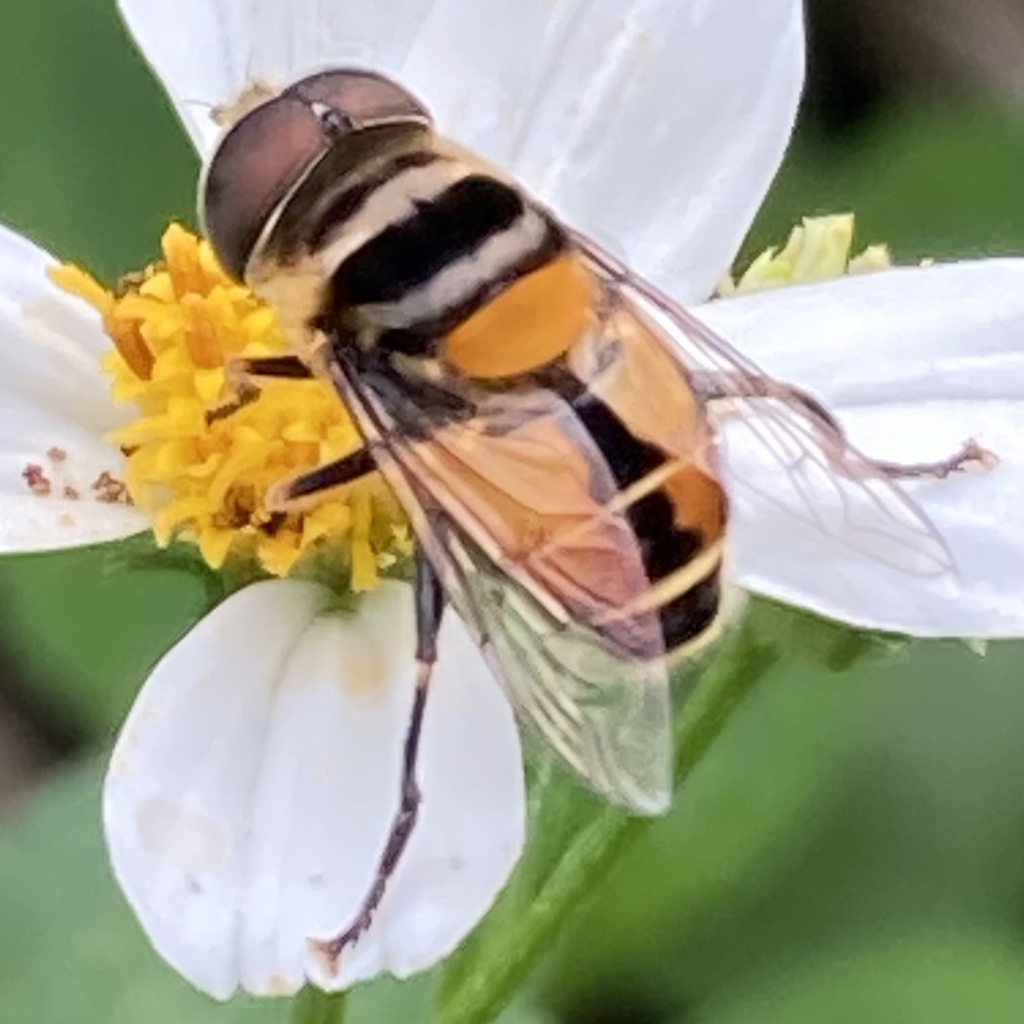
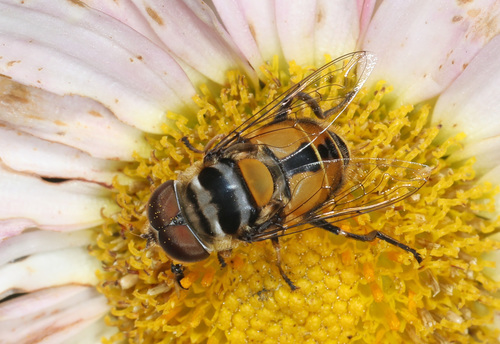
The Double-banded Plushback has a face hidden by white pollen and a thick white pile, especially on the frontal triangle. Adults are flower visitors that sip nectar and pollen, while the larvae live in water and filter feed with a rat-tailed shape. It occurs throughout North and South America, most commonly in the southeastern United States.
Source: Wikipedia
How to recognize it
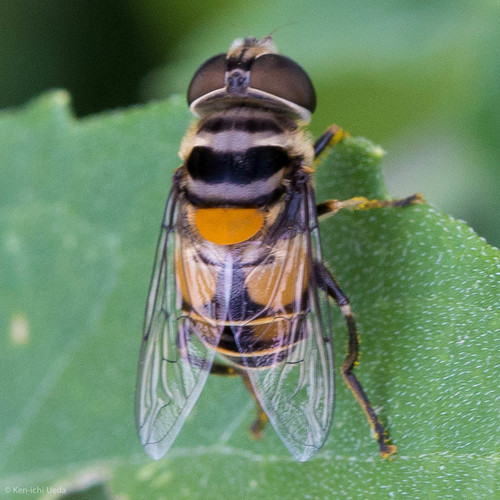
The face is covered by white pollen and a dense white pile, especially over the frontal triangle. The scutum is black with yellow-white pile in front and blackish pile behind. The scutellum is yellow with a narrow black base and bears black pile in females.
Source: Wikipedia
Where it lives
Adults are commonly seen on flowers where they feed on nectar and pollen. The larvae are aquatic, filter-feeding rat-tailed maggots.
Source: Wikipedia
Life cycle
Hoverflies can hover in place, staying nearly motionless while flying. The larvae are aquatic filter feeders with a rat-tailed morphology.
Source: Wikipedia
Where it comes from
This species is found across North and South America, with the highest numbers in the southeastern United States.
Source: Wikipedia
Lookalikes
Palpada agrorum, the Double-banded Plushback, was first described by Fabricius in 1787.
Source: Wikipedia
Where it is found in the US
Recorded in 28 of 51 states and DC. Most records: Florida, Louisiana, Texas, Georgia, North Carolina, South Carolina, Mississippi, Alabama.
Darker = more records. Counts are museum and citizen-science records, not population size.
Source: GBIF
Months it is reported in the US
Source: GBIF
More photos
Questions people ask
How can I identify a Double-banded Plushback?
Look for a face hidden by white pollen and thick white pile, a black scutum with yellow-white pile in front, and a yellow scutellum with a narrow black base and black pile on females.
Source: Wikipedia
Where are Double-banded Plushbacks most likely to be found?
They are most common in the southeastern United States but also occur throughout North and South America.
Source: Wikipedia
Same family (Syrphidae)






Sources
- Wikipedia: https://en.wikipedia.org/wiki/Palpada_agrorum
Look it up elsewhere: GBIF · iNaturalist · BugGuide · ITIS · Wikipedia
Text written 2026-10-24 from the sources above and checked sentence by sentence against them. Data fetched 2026-10-24.