 Bug FAQ
Eurasian Green Crab Spider
Diaea dorsata · Order: Araneae · Family: Thomisidae

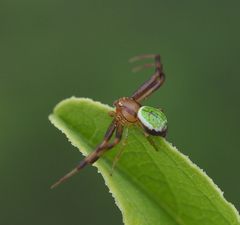
Females grow up to about 6 mm and males to about 4 mm. The spider has a green body and legs with a yellowish abdomen marked brown. It lives on forest edges, often on oak leaves, and overwinters as a sub-adult under dead-tree bark, with adults appearing in May.
Source: Wikipedia
How to recognize it
The prosoma and legs are green, while the abdomen is yellowish with a brown spot.
Source: Wikipedia
Size
Females can reach up to 6 mm and males up to 4 mm in length.
Source: Wikipedia
Where it lives
It prefers forest edges. It is commonly found on oak leaves.
Source: Wikipedia
Life cycle
Subadult spiders overwinter under the bark of dead trees. Adults emerge in May.
Source: Wikipedia
When you see it
Adults are present from May onward.
Source: Wikipedia
Where it comes from
Diaea dorsata has a Palearctic distribution.
Source: Wikipedia
Lookalikes
It can be confused with jumping spiders, which is unusual for crab spiders.
Source: Wikipedia
More photos


Questions people ask
Where can I find this spider?
Look for it on oak leaves at forest edges, especially in May when adults are active.
Source: Wikipedia
What does it look like?
It has a green body and legs with a yellowish abdomen marked with a brown spot.
Source: Wikipedia
Same family (Thomisidae)

Sources
- Wikipedia: https://en.wikipedia.org/wiki/Diaea_dorsata
Look it up elsewhere: GBIF · iNaturalist · BugGuide · ITIS · Wikipedia
Text written 2026-10-22 from the sources above and checked sentence by sentence against them. Data fetched 2026-10-22.