 Bug FAQ
Ipsilon Dart Moth
Agrotis ipsilon · Order: Lepidoptera · Family: Noctuidae
Also called: Black Cutworm, Dark Sword-Grass, Greasy Cutworm, Ipsilon Dart
Source: Wikipedia
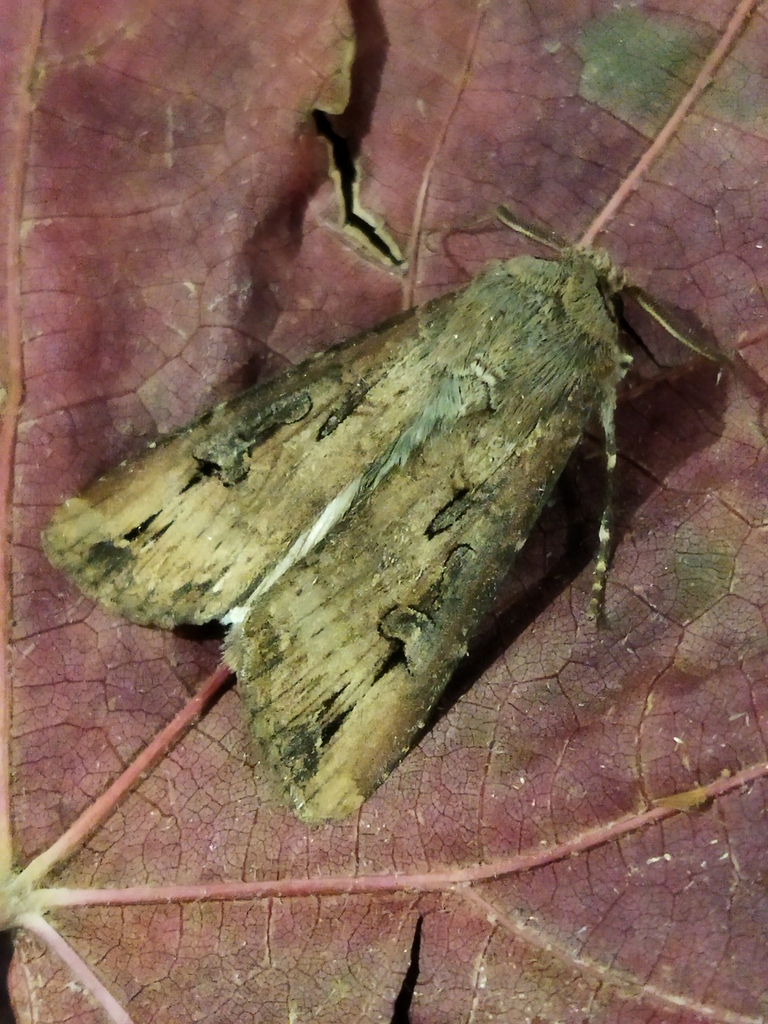
The black cutworm moth is 38 to 48 mm long and has brown forewings with dark Y-shaped markings and whitish-grey hindwings. Its larvae are serious pests that chew foliage and cut young plants at ground level, hurting many vegetable and grain crops.
Source: Wikipedia
How to recognize it
The forewings are brown with reddish tones, mixed with pale grey-ochre, and show dark Y-shaped marks outlined in black; the hindwings are whitish-grey, darker at the edges.
Source: Wikipedia
Size
Adults measure about 38 to 48 mm (1.5 to 1.9 in) across.
Source: Wikipedia
Is it a pest in the house?
The larvae damage plant tissue below the soil, making them a pest for cultivated plants.
Source: Wikipedia
How to get rid of it
One control method is applying soil insecticides before planting, though their effectiveness can vary with worm distribution. A rescue treatment applied after infestation, known as the wait-and-see system, is another option.
Source: Wikipedia
Where it lives
The moth gets its name from the Y-shaped markings on its wings, and its caterpillars are called cutworms because they cut seedlings.
Source: Wikipedia
What it eats
Larvae feed on almost all vegetables and many important grain crops. A single larva can eat over 400 cm² of foliage and later severs young plants at the soil line.
Source: Wikipedia
Life cycle
From egg to adult takes about 35 to 60 days, roughly two months.
Source: Wikipedia
When you see it
The species migrates north in spring and south in fall to avoid extreme temperatures. In the Midwest US it is a major corn pest, especially when corn is only one leaf old.
Source: Wikipedia
Where it is found in the US
Recorded in 50 of 51 states and DC. Most records: Maryland, Texas, Massachusetts, Pennsylvania, Ohio, California, Connecticut, New York.
Darker = more records. Counts are museum and citizen-science records, not population size.
Source: GBIF
Months it is reported in the US
Source: GBIF
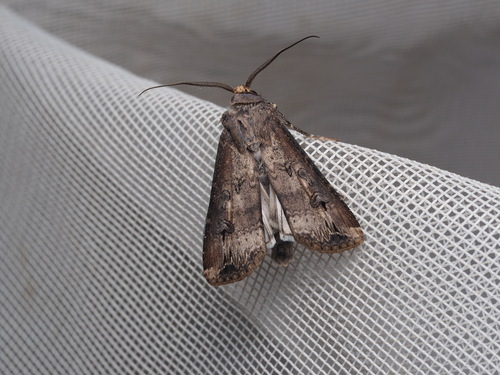
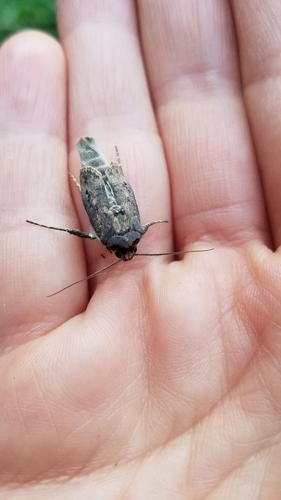
More photos


Questions people ask
How big is the black cutworm moth?
Adults are about 38 to 48 mm (1.5 to 1.9 in) long.
Source: Wikipedia
What do the moth’s wings look like?
The forewings are brown with reddish tones, pale grey-ochre patches and dark Y-shaped marks outlined in black; hindwings are whitish-grey, darker at the edges.
Source: Wikipedia
Why are the larvae called cutworms?
They cut young plants at ground level after feeding on foliage, which can destroy seedlings.
Source: Wikipedia
How can I manage a cutworm problem?
Apply a soil insecticide before planting, or use a rescue treatment after the worms appear.
Source: Wikipedia
Same family (Noctuidae)
 Fall Armyworm MothSpodoptera frugiperdaDamages trees, gardens or crops
 Army Cutworm MothEuxoa auxiliarisDamages trees, gardens or crops
 Large Yellow UnderwingNoctua pronubaDamages trees, gardens or crops
 Silver ΥAutographa gamma
 American DaggerAcronicta americanaCan irritate skin
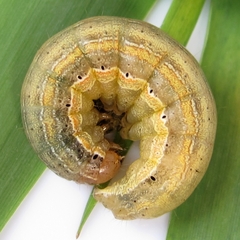 Armyworm MothPseudaletia unipunctaDamages trees, gardens or crops
Sources
- Wikipedia: https://en.wikipedia.org/wiki/Agrotis_ipsilon
Look it up elsewhere: GBIF · iNaturalist · BugGuide · ITIS · Wikipedia
Text written 2026-10-23 from the sources above and checked sentence by sentence against them. Data fetched 2026-10-22.