 Bug FAQ
Large Yellow Underwing
Noctua pronuba · Order: Lepidoptera · Family: Noctuidae
Also called: European Yellow Underwing, European Yellow Underwing Moth, Large Yellow Underwing Moth
Source: Wikipedia
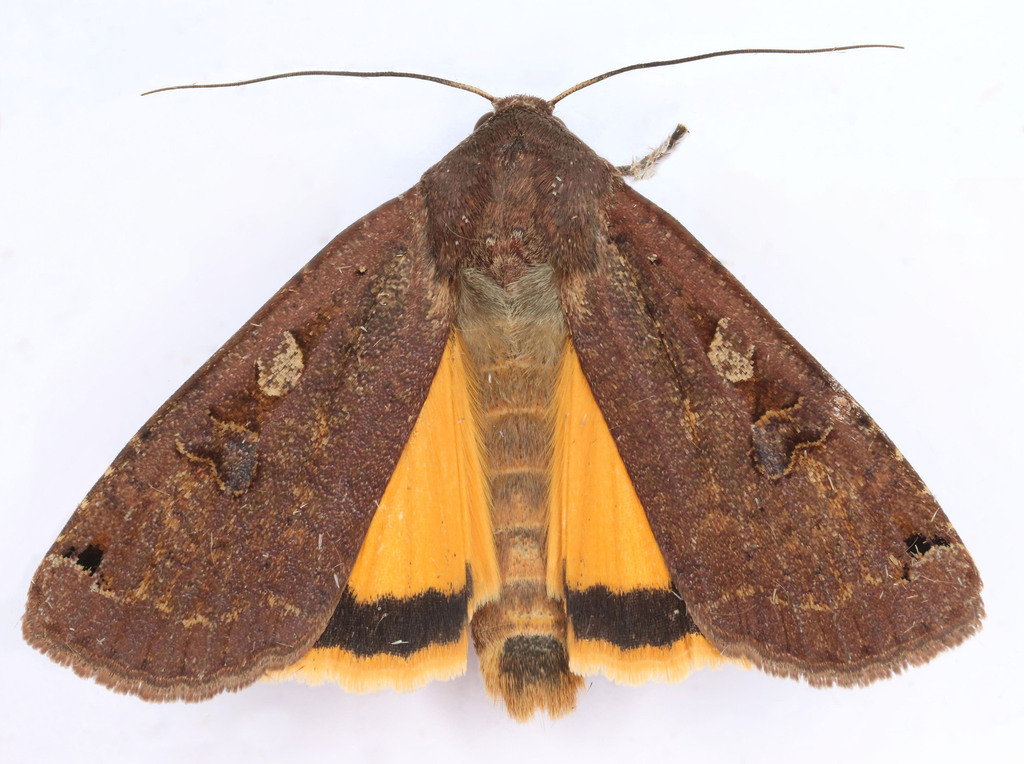
The moth flies at night in mid-to-late summer, is attracted to lights and can appear in large numbers. Larvae feed on garden plants and crops, sometimes causing noticeable damage.
Source: Wikipedia
How to recognize it
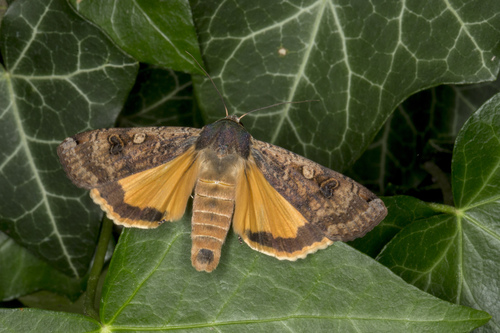
Forewings vary, but the underwings are consistently yellow-orange with a black basal stripe; hindwings are ochreous-orange with a dark terminal band.
Source: Wikipedia
Size
Wingspan ranges from roughly 45 to 55 mm.
Source: Wikipedia
What it eats
Larvae feed on a variety of garden plants and crops, often being regarded as pests.
Source: Wikipedia
Life cycle
Adults emerge and fly at night from mid to late summer, attracted to light.
Source: Wikipedia
When you see it
Adults are active at night during mid to late summer and can be seen in large numbers near lights.
Source: Wikipedia
Where it comes from
Found across Europe, North Africa, the Canary Islands, the Middle East, parts of Asia including Turkey, Iran, Afghanistan, northwest India, Russia and Central Asia.
Source: Wikipedia
Where it is found in the US
Recorded in 48 of 51 states and DC. Most records: California, Oregon, New York, Washington, Pennsylvania, Massachusetts, Vermont, Michigan.
Darker = more records. Counts are museum and citizen-science records, not population size.
Source: GBIF
Status: introduced in North America; introduced in Canada; introduced in United States. Source: iNaturalist
Months it is reported in the US
Source: GBIF
More photos

Questions people ask
Are they a problem for my garden?
Yes, the larvae can damage garden plants and crops.
Source: Wikipedia
Why do they appear in huge numbers around my lights?
The adults are nocturnal and are strongly attracted to artificial lights during their flight period in summer.
Source: Wikipedia
Same family (Noctuidae)
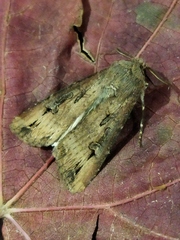 Ipsilon Dart MothAgrotis ipsilonDamages trees, gardens or crops
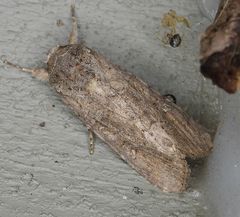 Fall Armyworm MothSpodoptera frugiperdaDamages trees, gardens or crops
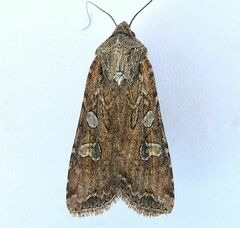 Army Cutworm MothEuxoa auxiliarisDamages trees, gardens or crops
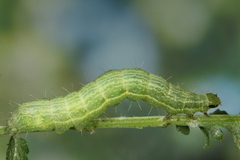 Silver ΥAutographa gamma
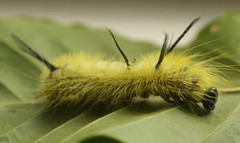 American DaggerAcronicta americanaCan irritate skin
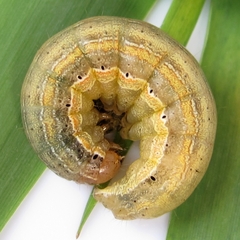 Armyworm MothPseudaletia unipunctaDamages trees, gardens or crops
Sources
- Wikipedia: https://en.wikipedia.org/wiki/Large_yellow_underwing
Look it up elsewhere: GBIF · iNaturalist · BugGuide · ITIS · Wikipedia
Text written 2026-10-22 from the sources above and checked sentence by sentence against them. Data fetched 2026-10-22.