 Bug FAQ
Ixodes angustus
Ixodes angustus · Order: Ixodida · Family: Ixodidae
Source: Wikipedia
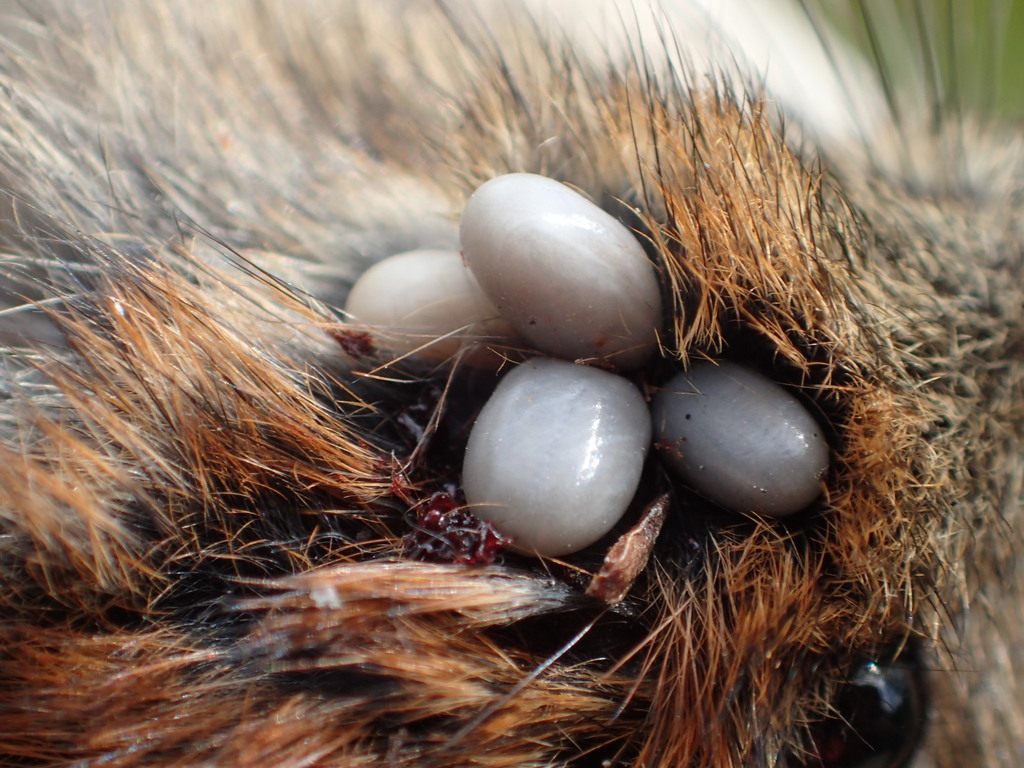
Ixodes angustus is a small tick that lives across most of Canada and the United States, preferring cool, moist places like boreal forests, mountains and riverbanks. Unfed females are about 2 mm long and can expand to up to 7 mm after feeding, while males stay near 2 mm and never swell with blood. It feeds on a wide range of hosts, including humans and dogs, and can carry the bacteria that cause Lyme disease, although it is not a primary vector.
Source: Wikipedia
How to recognize it
It has a diamond-shaped, smooth dorsal shield with rounded edges. Its mouthparts include long palps that are half-diamond shaped, straight on the outside and rounded inside.
Source: Wikipedia
Size
Females are roughly 2 mm when unfed and can grow to about 7 mm when engorged with blood. Males are about 2 mm long and cannot enlarge because their back plate covers the whole dorsal side.
Source: Wikipedia
Does it bite or sting?
It can act as a bridge vector for Lyme disease, but it is not a major transmitter because it rarely feeds on humans.
Source: Wikipedia
Where it lives
It is most common in cool, damp environments such as boreal forests, mountain zones and riparian areas.
Source: Wikipedia
What it eats
It is a generalist parasite that has been found feeding on over 90 different animal species, including people and domestic dogs.
Source: Wikipedia
Life cycle
Its life cycle includes egg, larva, nymph and adult stages. Under mild temperatures it can complete the whole cycle in about seven months, faster than most other Ixodes ticks.
Source: Wikipedia
Where it comes from
The tick is widespread throughout North America, occurring in most Canadian provinces and many U.S. states, as well as parts of northern Mexico.
Source: Wikipedia
Where it is found in the US
Recorded in 18 of 51 states and DC. Most records: Alaska, Oregon, Washington, California, Minnesota, Arizona, Utah, New Mexico.
Darker = more records. Counts are museum and citizen-science records, not population size.
Source: GBIF
Status: native in North America; native in Canada; native in United States. Source: iNaturalist
Months it is reported in the US
Source: GBIF
More photos

Questions people ask
Can Ixodes angustus bite humans?
It can bite people, though it does so infrequently, and may transmit Lyme disease when it does.
Source: Wikipedia
What habitats does Ixodes angustus prefer?
It favors cool, moist places such as boreal forests, mountain regions and areas near streams.
Source: Wikipedia
Where is Ixodes angustus found in North America?
It occurs throughout most of Canada and the United States and also in parts of northern Mexico.
Source: Wikipedia
How large does Ixodes angustus get?
Females start at about 2 mm and can swell to up to 7 mm after feeding; males stay around 2 mm and do not enlarge.
Source: Wikipedia
Same family (Ixodidae)
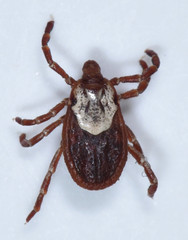 American Dog TickDermacentor variabilisCan spread germs or disease
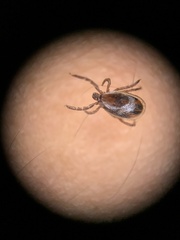 Eastern Black-legged TickIxodes scapularisCan spread germs or disease
 Lone Star TickAmblyomma americanumCan spread germs or disease
 Gulf Coast TickAmblyomma maculatumCan spread germs or disease
 Western Black-legged TickIxodes pacificusCan spread germs or disease
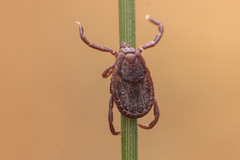 Brown Dog TickRhipicephalus sanguineusCan spread germs or disease
Sources
- Wikipedia: https://en.wikipedia.org/wiki/Ixodes_angustus
Look it up elsewhere: GBIF · iNaturalist · BugGuide · ITIS · Wikipedia
Text written 2026-10-24 from the sources above and checked sentence by sentence against them. Data fetched 2026-10-24.