 Bug FAQ
Multi-Coloured Phintella
Phintelloides versicolor · Order: Araneae · Family: Salticidae
Also called: Jumping spider
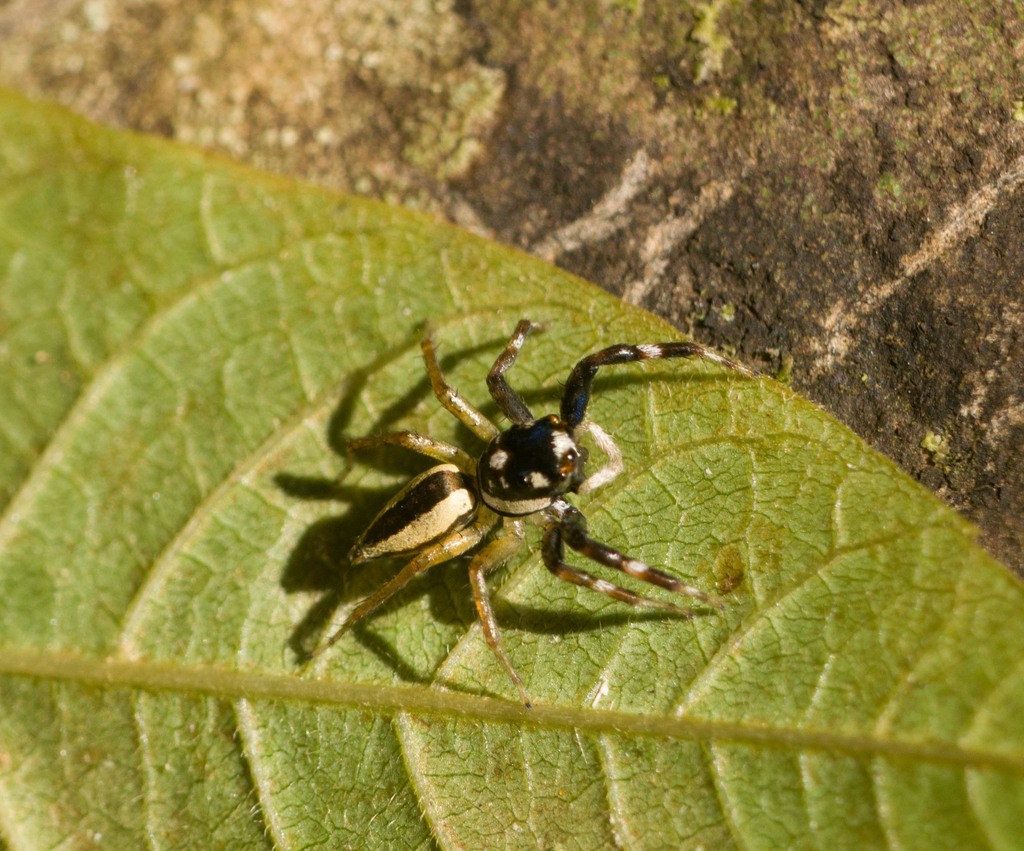
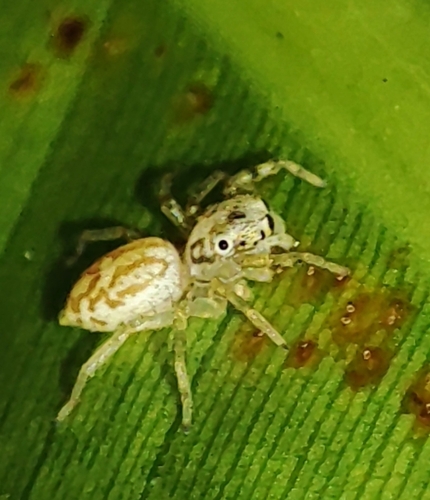
Males are 4.4 to 6.3 mm long, with a typical specimen measuring about 4.7 mm total length (carapace 2.3 mm long, 1.8 mm wide). The spider is easy to spot by its reversed abdominal pattern: a dark central band flanked by yellow-appearing white bands, unlike most related species. It lives on limestone forests from sea level up to roughly 300 m and is native to Bintan Island, Indonesia, but now occurs across tropical Southeast Asia.
Source: Wikipedia
How to recognize it
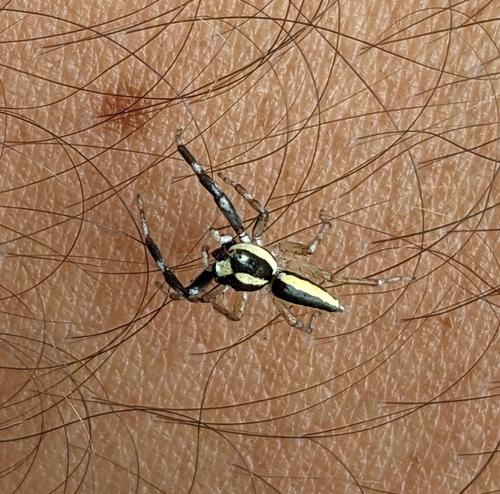
The abdomen shows a dark central stripe with yellow-looking white side bands, a pattern opposite to that of most Chrysilla and Phintella relatives. The thorax has a wide sub-marginal band edged dark, appearing black with two central white spots and several smaller ones in live specimens.
Source: Wikipedia
Size
Male total length ranges from 4.4 to 6.3 mm.
Source: Wikipedia
Where it lives
Found in various habitats, especially limestone forests, from sea level up to about 300 m elevation.
Source: Wikipedia
Where it is found in the US
Recorded in 2 of 51 states and DC. Most records: Hawaii, Kansas.
Darker = more records. Counts are museum and citizen-science records, not population size.
Source: GBIF
More photos
Same family (Salticidae)



Sources
- Wikipedia: https://en.wikipedia.org/wiki/Phintelloides_versicolor
Look it up elsewhere: GBIF · iNaturalist · BugGuide · ITIS · Wikipedia
Text written 2026-10-24 from the sources above and checked sentence by sentence against them. Data fetched 2026-10-22.