 Bug FAQ
Old World Swallowtail
Papilio machaon · Order: Lepidoptera · Family: Papilionidae
Also called: Artemisia Swallowtail, Common Swallowtail, Common Yellow Swallowtail, Swallowtail
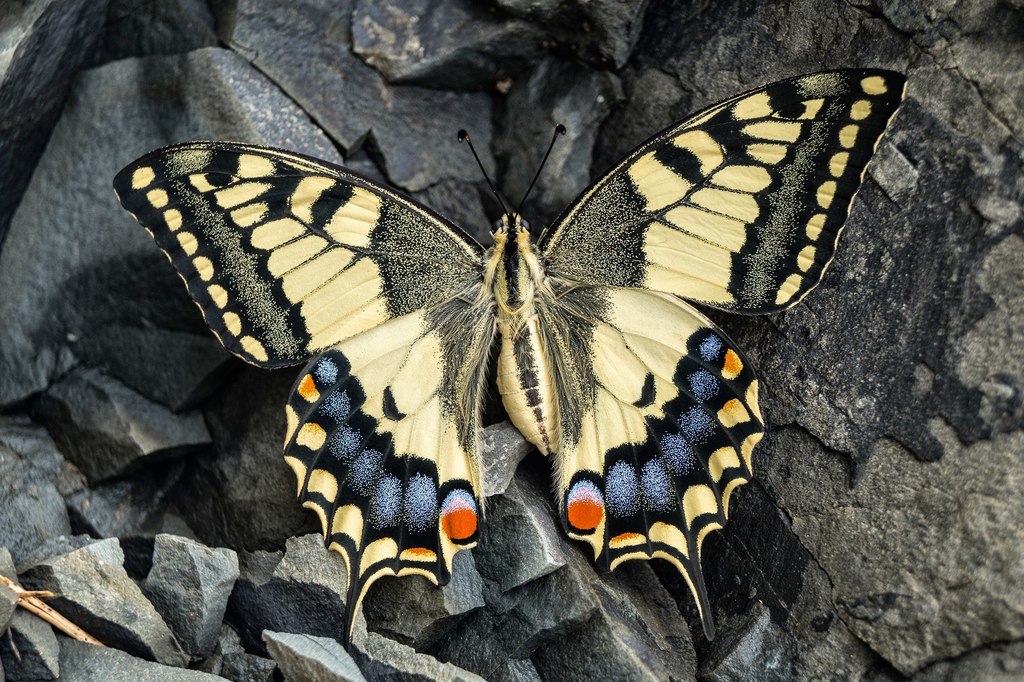
The Old World Swallowtail is a large yellow butterfly with black veins and distinctive eye spots near its tails. It lives in alpine meadows, hillsides, gardens and other areas where umbellifer plants grow, and flies from spring to early autumn depending on elevation. The species is widespread across the Palearctic and North America, laying eggs singly on a variety of umbellifers.
Source: Wikipedia
How to recognize it
Yellow wings with black veins and a wingspan of about 65 to 86 mm are typical. Each hindwing tail is flanked by one red and six blue eye spots.
Source: Wikipedia
Size
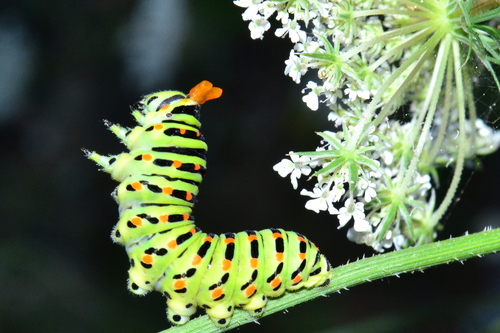
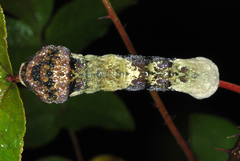
Adults have a wingspan of roughly 2.6 to 3.4 inches. Caterpillars grow to about 1.8 inches long.
Source: Wikipedia
Where it lives
Found in alpine meadows, hillsides and gardens where host plants are present.
Source: Wikipedia
What it eats
Adults lay eggs singly on umbellifer plants such as wild carrot, angelica, fennel and hogweed.
Source: Wikipedia
Life cycle
Usually produces two to three generations per year, but may have only one in northern areas.
Source: Wikipedia
When you see it
Flies from March to September at low elevations; higher elevations have a shorter flight period.
Source: Wikipedia
Where it comes from
Occurs throughout much of the Palearctic region and also in North America.
Source: Wikipedia
Lookalikes
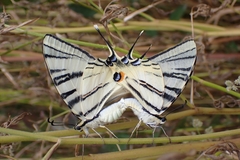
Can be told apart from Papilio hospiton by its longer hindwing tails. Distinguished from Papilio saharae by counting antenna segments.
Source: Wikipedia
Where it is found in the US
Recorded in 26 of 51 states and DC. Most records: Alaska, Washington, Idaho, Colorado, New Mexico, Arizona, Missouri, Oregon.
Darker = more records. Counts are museum and citizen-science records, not population size.
Source: GBIF
Status: native in North America; native in Canada; native in United States. Source: iNaturalist
Months it is reported in the US
Source: GBIF
More photos

Questions people ask
Are they a garden pest?
They feed on umbellifer plants but are not reported to damage crops or structures.
Source: Wikipedia
Where can I see them?
Look for them in alpine meadows, hillsides and gardens from spring through early autumn.
Source: Wikipedia
Same family (Papilionidae)
Sources
- Wikipedia: https://en.wikipedia.org/wiki/Papilio_machaon
Look it up elsewhere: GBIF · iNaturalist · BugGuide · ITIS · Wikipedia
Text written 2026-10-22 from the sources above and checked sentence by sentence against them. Data fetched 2026-10-22.