 Bug FAQ
Scarce Swallowtail
Iphiclides podalirius · Order: Lepidoptera · Family: Papilionidae
Also called: pear-tree swallowtail, sail swallowtail
Source: Wikipedia
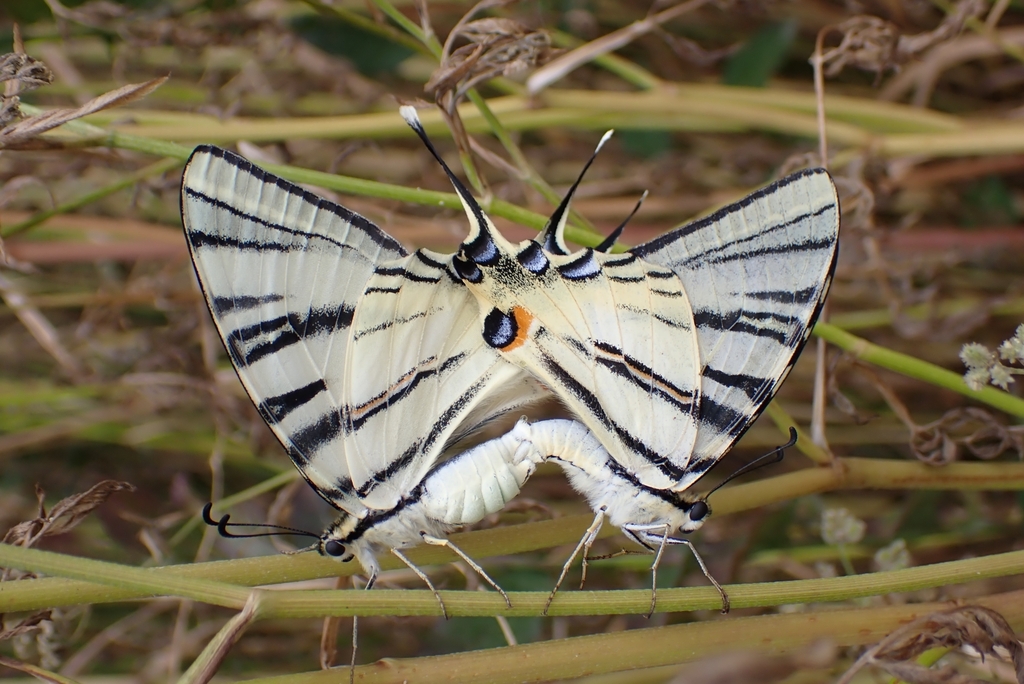
The scarce swallowtail has creamy-white or pale-yellow wings with six tiger-stripe markings on the forewings and blue crescents plus an orange spot on the hindwings, ending in a relatively long tail. Adults fly from March to October and may have one to three generations per year; summer chrysalids are green, while those that hibernate are brown.
Source: Wikipedia
How to recognize it
Wings are creamy white or pale yellow with six tiger-stripe patterns on the forewings and blue crescent marks with an orange spot on the hindwings, plus a long tail.
Source: Wikipedia
Size
Males have a wingspan of about 60 to 80 mm, while females are slightly larger at 62 to 90 mm.
Source: Wikipedia
Where it lives
They live in gardens, towns, fields, open woodlands, especially where sloe thickets and orchards are present.
Source: Wikipedia
What it eats
Caterpillars eat a wide variety of Rosaceae trees and shrubs, including hawthorn, apples, many Prunus species (plums, cherries, apricots, peaches, almonds), pears and rowan.
Source: Wikipedia
Life cycle
Adults are on the wing from March through October, producing one to three generations each year. Summer chrysalids are typically green, while those that overwinter turn brown.
Source: Wikipedia
When you see it
You can see adults flying between March and October.
Source: Wikipedia
Where it is found in the US
Recorded in 1 of 51 states and DC. Most records: Indiana.
Darker = more records. Counts are museum and citizen-science records, not population size.
Source: GBIF
More photos

Same family (Papilionidae)

Sources
- Wikipedia: https://en.wikipedia.org/wiki/Scarce_swallowtail
Look it up elsewhere: GBIF · iNaturalist · BugGuide · Wikipedia
Text written 2026-10-22 from the sources above and checked sentence by sentence against them. Data fetched 2026-10-22.