 Bug FAQ
Phoebus Apollo
Parnassius phoebus · Order: Lepidoptera · Family: Papilionidae
Also called: Small Apollo, Phoebus Parnassian

The Phoebus Apollo butterfly lives in mountainous areas between 1,600 and 2,800 m, favoring damp spots near streams and springs.
Source: Wikipedia
How to recognize it
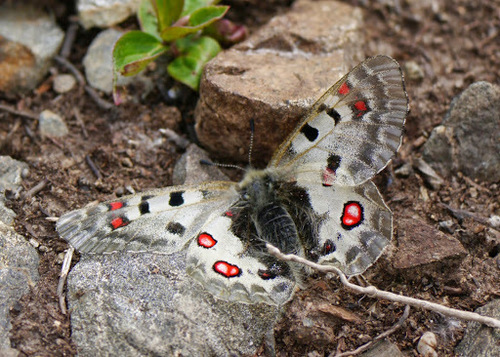
Males have forewings without red costal spots, a faint submarginal band, no hind-margin spot, and small red eye-like spots on the hindwing; veins often show distinct black punctures. Females show clearer, larger markings with white spots separating the forewing margin from the submarginal band, red-pupilled costal spots linked by black scaling, and on the hindwing a grey-white marginal band, contiguous half-moon spots, and two larger red eye-spots.
Source: Wikipedia
Where it lives
It inhabits mountains from about 1,600 to 2,800 m, especially 1,800 to 2,200 m, in humid, damp places near mountain streams, springs, and seepages.
Source: Wikipedia
What it eats
Caterpillars feed on Saxifraga species. They also use Sempervivum montanum as a host plant.
Source: Wikipedia
Where it comes from
Parnassius phoebus occurs in the Palearctic region and North America.
Source: Wikipedia
Where it is found in the US
Recorded in 13 of 51 states and DC. Most records: Alaska, Colorado, Utah, Wyoming, Montana, California, Idaho, Nevada.
Darker = more records. Counts are museum and citizen-science records, not population size.
Source: GBIF
Status: native in North America; native in Canada. Source: iNaturalist
Months it is reported in the US
Source: GBIF
More photos


Same family (Papilionidae)
Sources
- Wikipedia: https://en.wikipedia.org/wiki/Parnassius_phoebus
Look it up elsewhere: GBIF · iNaturalist · BugGuide · ITIS · Wikipedia
Text written 2026-10-24 from the sources above and checked sentence by sentence against them. Data fetched 2026-10-24.