 Bug FAQ
Spring Field Cricket
Gryllus veletis · Order: Orthoptera · Family: Gryllidae
Source: Wikipedia
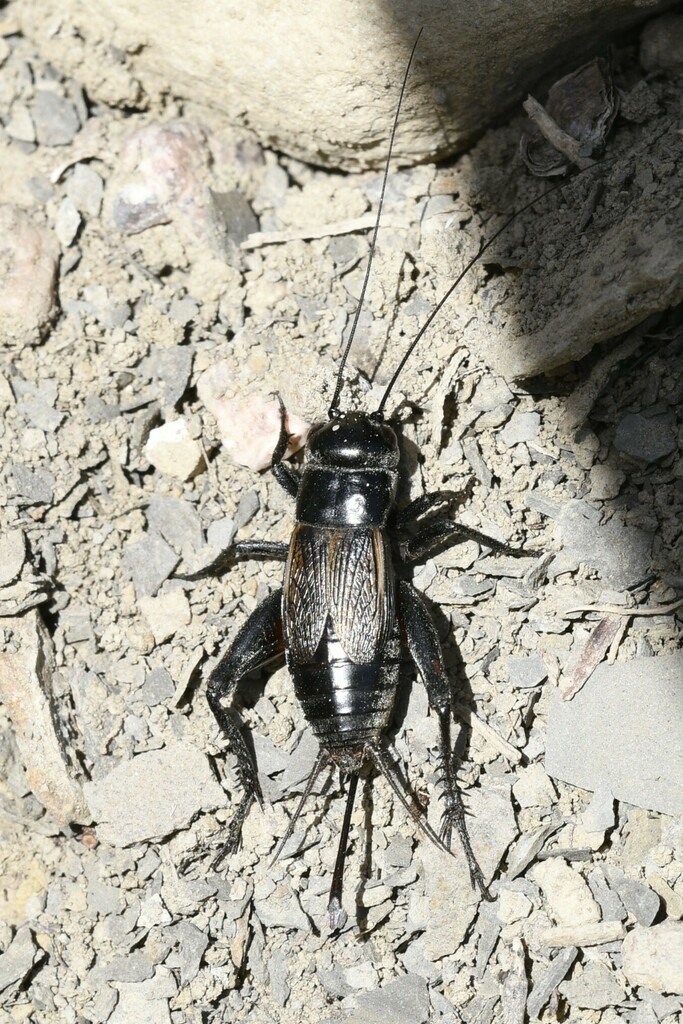
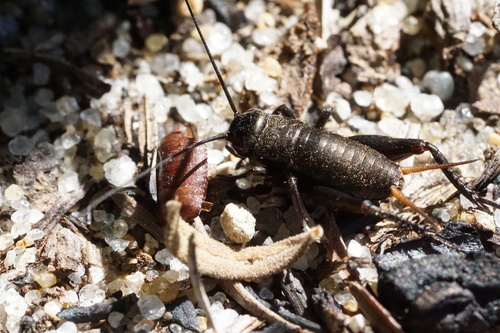
Adults are about 22 mm long and males are black with dark brown legs, while females have lighter reddish legs. They live in disturbed fields and roadsides across most of North America but are absent from the southeastern United States. One generation emerges each year in late May, matures through August, and may enter homes seeking shelter, where they can damage fabrics.
Source: Wikipedia
How to recognize it
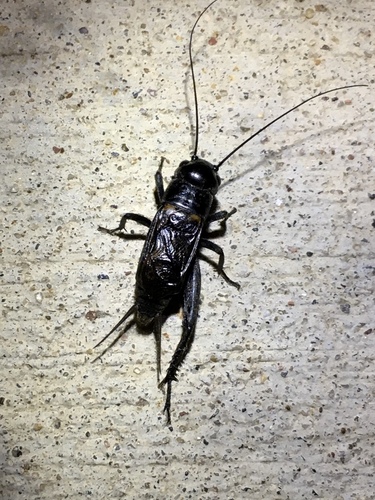
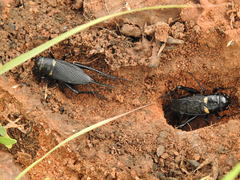
Males are black with dark brown or black legs, while females have lighter, reddish legs.
Source: Wikipedia
Size
Adult body length is about 22 mm (0.87 in).
Source: Wikipedia
Is it a pest in the house?
They may enter homes to escape bad weather, lights, or in search of food like grains and seeds. Inside, they can chew holes in nylon, wool, plastic and leather fabrics.
Source: Wikipedia
How to get rid of it
They can get inside through small cracks and crevices. Their nighttime chirping can be irritating to residents.
Source: Wikipedia
Where it lives
Unlike house crickets, they cannot survive winter in residential areas.
Source: Wikipedia
What it eats
They eat fresh and decaying plant material, dead insects, and sometimes other live insects or crickets.
Source: Wikipedia
Life cycle
Nymphs develop through late instars and overwinter before becoming adults in late May. The species produces one generation each year.
Source: Wikipedia
When you see it
Males call at sunrise for 1.3 to 1.8 hours each night.
Source: Wikipedia
Where it comes from
They are abundant throughout most of North America. In the United States they are missing only from the southeastern states.
Source: Wikipedia
Lookalikes
They are often confused with the fall field cricket (Gryllus pennsylvanicus). All field crickets look similar; subtle differences in colour and ovipositor length help tell them apart.
Source: Wikipedia
Where it is found in the US
Recorded in 43 of 51 states and DC. Most records: Massachusetts, New York, Colorado, Illinois, Texas, Connecticut, Vermont, Montana.
Darker = more records. Counts are museum and citizen-science records, not population size.
Source: GBIF
Status: native in North America; native in Canada. Source: iNaturalist
Months it is reported in the US
Source: GBIF
More photos
Questions people ask
Do they damage anything inside the home?
Yes, they can chew holes in nylon, wool, plastic and leather fabrics.
Source: Wikipedia
When are they most active?
Adults are active and calling from late May through early August, especially at sunrise each night.
Source: Wikipedia
What do they look like compared to other crickets?
Males are black with dark legs, females have lighter reddish legs, and they are often mistaken for the fall field cricket.
Source: Wikipedia
Same family (Gryllidae)


Sources
- Wikipedia: https://en.wikipedia.org/wiki/Gryllus_veletis
Look it up elsewhere: GBIF · iNaturalist · BugGuide · ITIS · Wikipedia
Text written 2026-10-24 from the sources above and checked sentence by sentence against them. Data fetched 2026-10-24.