 Bug FAQ
Tailed Orange
Pyrisitia proterpia · Order: Lepidoptera · Family: Pieridae
Also called: Little Jaune
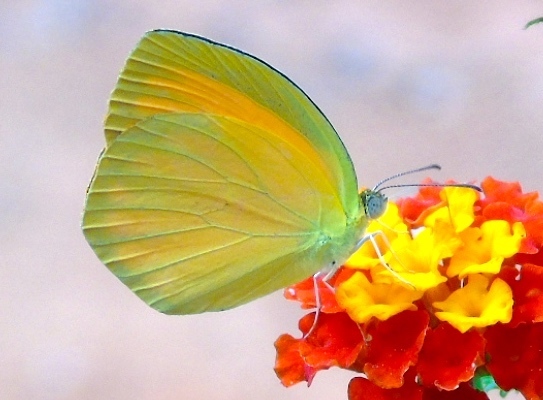
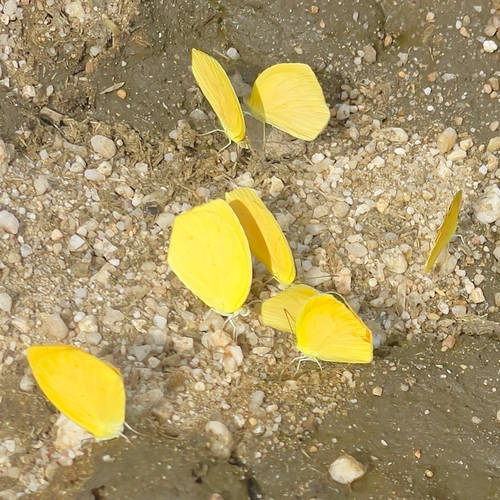
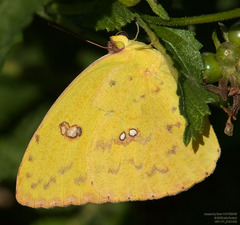
The tailed orange is a small butterfly with a wingspan of about 32 to 44 mm and orange upper wings that may have black along the forewing edge. It lives in open woodlands, deserts and subtropical areas across North and South America, and its caterpillars feed on several legume plants such as Cassia texana and Senna species.
Source: Wikipedia
How to recognize it
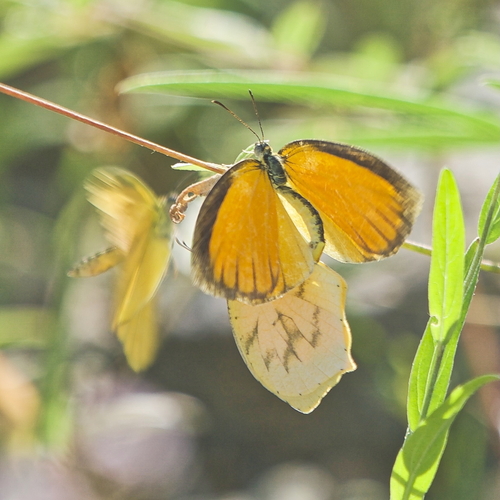
Upper wings are orange with varying black along the forewing costa; the underside changes with the season.
Source: Wikipedia
Size
Wingspan ranges from 1 ¼ to 1 ¾ inches (32 to 44 mm).
Source: Wikipedia
Where it lives
Found in open habitats like woodlands, deserts and subtropical zones.
Source: Wikipedia
What it eats
Caterpillars are bright yellow-green with a yellow side stripe and feed on legumes such as Cassia texana, Chamaecrista, Desmodium, Prosopis reptans and Senna.
Source: Wikipedia
Life cycle
Males spend the day patrolling to find females.
Source: Wikipedia
When you see it
Seen mid-July to early January in Arizona, August to November in Texas, and year-round in Mexico.
Source: Wikipedia
Where it comes from
Native to North and South America.
Source: Wikipedia
Lookalikes
The sleepy orange is similar but has a black spot in the forewing cell, a black border on the hindwing upperside, and a non-pointed hindwing.
Source: Wikipedia
Where it is found in the US
Recorded in 10 of 51 states and DC. Most records: Arizona, Texas, New Mexico, Oklahoma, Kansas, Florida, Oregon, Arkansas.
Darker = more records. Counts are museum and citizen-science records, not population size.
Source: GBIF
Months it is reported in the US
Source: GBIF
More photos
Questions people ask
What plants do tailed orange caterpillars eat?
They feed on legume hosts such as Cassia texana, Chamaecrista, Desmodium, Prosopis reptans and Senna species.
Source: Wikipedia
When can I see tailed oranges in my area?
In Arizona they appear from mid-July to early January, in Texas from August to November, and in Mexico they are present all year.
Source: Wikipedia
How can I tell a tailed orange from a sleepy orange?
The sleepy orange has a black spot in the forewing cell, a black marginal border on the hindwing upperside, and its hindwing is not pointed, unlike the tailed orange.
Source: Wikipedia
Same family (Pieridae)


Sources
- Wikipedia: https://en.wikipedia.org/wiki/Eurema_proterpia
Look it up elsewhere: GBIF · iNaturalist · BugGuide · ITIS · Wikipedia
Text written 2026-10-24 from the sources above and checked sentence by sentence against them. Data fetched 2026-10-23.