 Bug FAQ
Yellow Fever Mosquito
Aedes aegypti · Order: Diptera · Family: Culicidae
Also called: Dengue Fever Mosquito, yellowfever mosquito
Source: Wikipedia

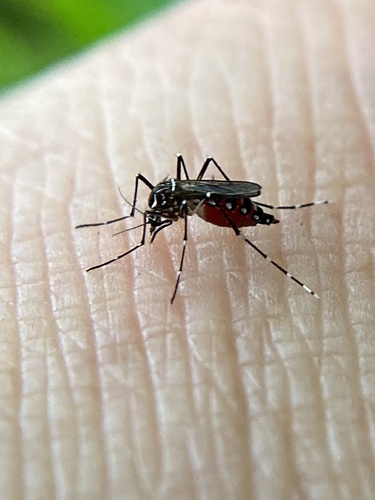
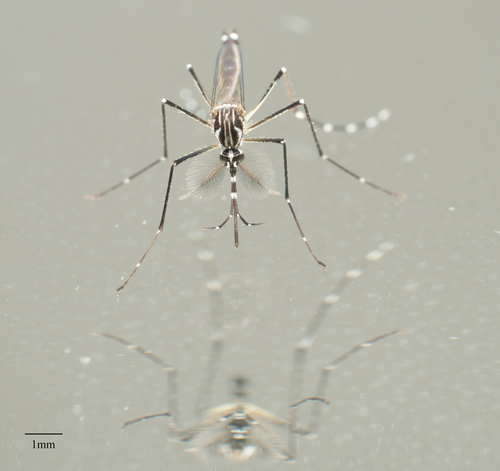
Aedes aegypti is a small dark mosquito about 4-7 mm long with distinctive white leg markings and a lyre-shaped mark on its thorax. Females bite to obtain blood for egg development and can transmit dozens of viruses and two malaria parasites. It originated in Africa, now lives worldwide in tropical, subtropical and temperate areas, and its eggs can survive dry conditions for over a year.
How to recognize it
Look for black and white leg markings and a lyre-shaped spot on the upper thorax to identify it. It can be mistaken for Aedes albopictus, which has a white stripe on the top of its scutum.
Source: Wikipedia
Size
The mosquito measures about 4 to 7 mm in length.
Source: Wikipedia
Is it a pest in the house?
It is a known vector for many pathogens.
Source: Wikipedia
Does it bite or sting?
Only females bite to get blood for egg development. Through bites they can transmit numerous viruses and two Plasmodium species.
How to get rid of it
Urban growth and human movement help spread these mosquitoes, so control measures are needed.
Where it lives
Originally from North Africa, it now lives in many tropical, subtropical and temperate regions worldwide.
Source: Wikipedia
What it eats
Male mosquitoes feed on fruit, while females need blood to mature their eggs. Larvae eat bacteria and tiny organic particles before becoming pupae.
Life cycle
Females lay white eggs on water surfaces; the eggs darken quickly. Adults live 2-4 weeks, but eggs can stay viable for more than a year when dry.
Source: Wikipedia
When you see it
Warmer climates let the species expand its range north and south, and it can persist in warm temperate areas.
Source: Wikipedia
Where it comes from
It started in Africa and spread to the New World via the slave trade, now found globally.
Source: Wikipedia
Lookalikes
It can be confused with Aedes albopictus unless examined closely; the latter has a white stripe on its scutum.
Source: Wikipedia
Where it is found in the US
Recorded in 30 of 51 states and DC. Most records: Texas, Florida, California, Arizona, Hawaii, Louisiana, New Mexico, South Carolina.
Darker = more records. Counts are museum and citizen-science records, not population size.
Source: GBIF
Status: introduced in North America; introduced in United States. Source: iNaturalist
Months it is reported in the US
Source: GBIF
More photos


Questions people ask
Do they bite?
Only female Aedes aegypti bite to obtain blood for egg development.
Can they spread disease?
Yes, they can transmit many viruses and two malaria parasites to humans and animals.
Source: Wikipedia
How can I tell it apart from other mosquitoes?
Look for white leg markings and a lyre-shaped mark on the thorax; Aedes albopictus has a white stripe on its scutum instead.
Source: Wikipedia
Where are they found?
They originated in Africa but now live in tropical, subtropical and temperate regions worldwide.
Source: Wikipedia
Same family (Culicidae)
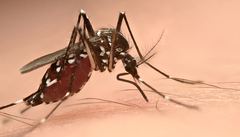 Asian Tiger MosquitoAedes albopictusCan spread germs or disease
 House Mosquito ComplexCulex pipiensCan spread germs or disease
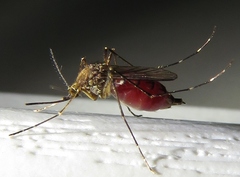 Inland Floodwater MosquitoAedes vexansCan spread germs or disease
 Asian Bush MosquitoAedes japonicusCan bite
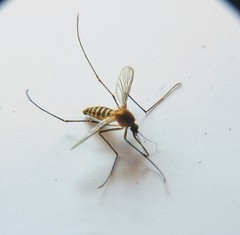 Southern House MosquitoCulex quinquefasciatusCan spread germs or disease
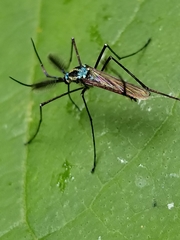 Elephant MosquitoToxorhynchites rutilusHarmless
Sources
- Wikipedia: https://en.wikipedia.org/wiki/Aedes_aegypti
- CDC: https://www.cdc.gov/mosquitoes/about/index.html
Look it up elsewhere: GBIF · iNaturalist · BugGuide · ITIS · Wikipedia
Text written 2026-10-22 from the sources above and checked sentence by sentence against them. Data fetched 2026-10-22.