 Bug FAQ
Yellow-shouldered Drone Fly
Eristalis stipator · Order: Diptera · Family: Syrphidae
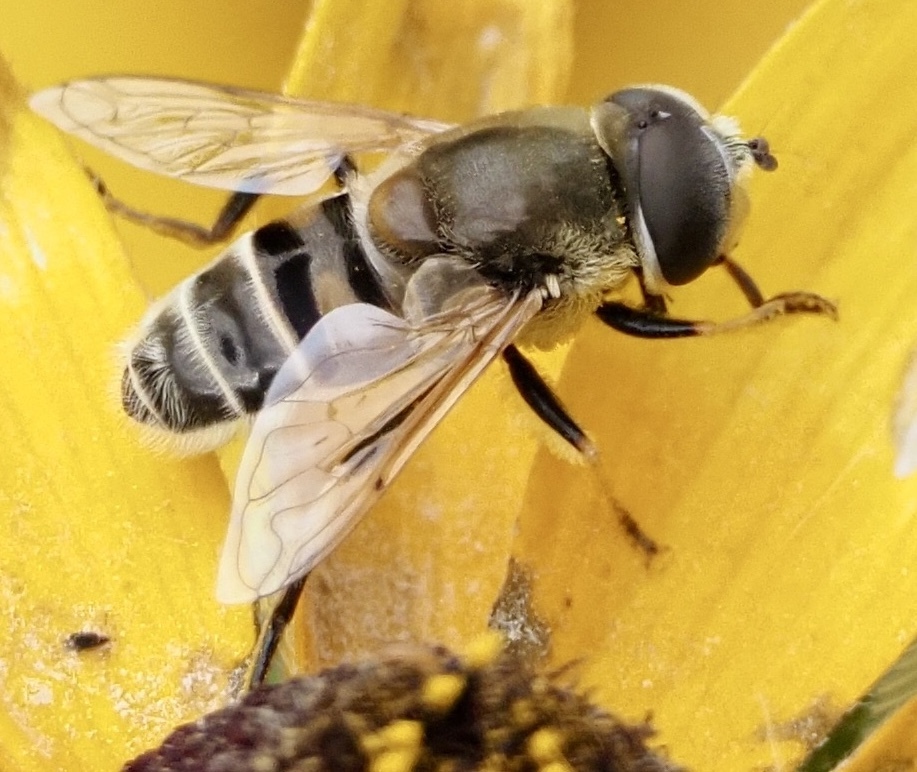
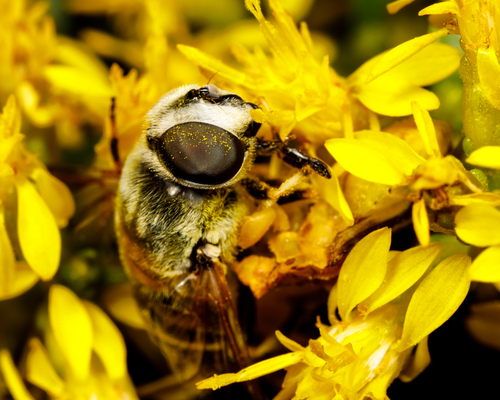
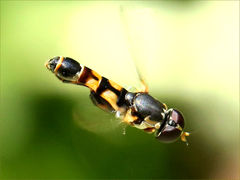
The yellow-shouldered drone fly is a hoverfly native to North America and common in the western part of the continent. Adults are active from early spring (as early as February in the south) through early fall and often fly up on hilltops. It can be recognized by clear wings with a brown spot, a reddish-brown base on the wings, a shiny black third abdominal segment, and a band of long white hairs on the fourth segment.
Source: Wikipedia
How to recognize it
The wings are clear with a small brown pterostigma and the basal half is reddish-brown. The third abdominal segment is shiny black, and the fourth has a distinct band of long white hairs near its rear edge.
Source: Wikipedia
When you see it
Adults fly from mid-May (earlier in the south) to early November and are known to hilltop.
Source: Wikipedia
Where it comes from
Eristalis stipator is native to North America.
Source: Wikipedia
Lookalikes
Darker individuals may look like E. dimidiata, and males can resemble E. arbustorum or E. hirta.
Source: Wikipedia
Where it is found in the US
Recorded in 46 of 51 states and DC. Most records: Texas, California, Minnesota, Nebraska, Colorado, Arizona, Illinois, New Mexico.
Darker = more records. Counts are museum and citizen-science records, not population size.
Source: GBIF
Status: native in North America; native in United States; native in Canada. Source: iNaturalist
Months it is reported in the US
Source: GBIF
More photos
Questions people ask
Does the yellow-shouldered drone fly bite or sting?
No sources indicate it bites, stings, or causes any harm to people or pets.
Source: Wikipedia
Same family (Syrphidae)


Sources
- Wikipedia: https://en.wikipedia.org/wiki/Eristalis_stipator
Look it up elsewhere: GBIF · iNaturalist · BugGuide · ITIS · Wikipedia
Text written 2026-10-22 from the sources above and checked sentence by sentence against them. Data fetched 2026-10-22.