 Bug FAQ
American Bumble Bee
Bombus pensylvanicus · Order: Hymenoptera · Family: Apidae
Also called: Bumble Bee, Sonoran Bumblebee, American Bumblebee
Source: Wikipedia

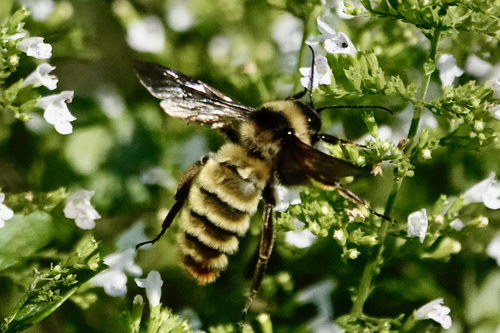
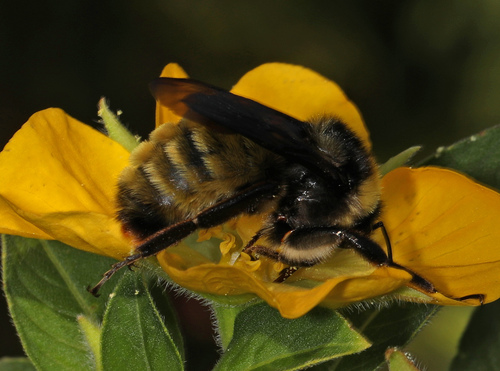
The American bumble bee is a larger bee with queens 22 to 26 mm and workers 13 to 19 mm in length. It has pale yellow hair on the pronotum, a usually black scutellum, and a distinctive yellow-black band pattern.
Source: Wikipedia
How to recognize it
Look for yellow hairs on the pronotum and a black scutellum, often mixed with yellow and black hairs. Its overall coloration is a paler yellow with a different yellow-black band pattern than close relatives.
Source: Wikipedia
Size
Queens measure 22 to 26 mm, while workers are 13 to 19 mm long.
Source: Wikipedia
Where it lives
It nests in open farmland and fields.
Source: Wikipedia
What it eats
Feeds on many plants, especially sunflowers and clovers, and acts as a pollinator.
Source: Wikipedia
Life cycle
Its reproductive cycle runs from February to November or December, similar to other bumblebees.
Source: Wikipedia
When you see it
Males become more common in late summer. Mating occurs in July or August when a male mates with a newly emerged queen.
Source: Wikipedia
Lookalikes
It can be confused with B. sonorus, B. fervidus, and B. auricomus because of similar coloration.
Source: Wikipedia
Where it is found in the US
Recorded in 49 of 51 states and DC. Most records: Texas, Florida, Nebraska, Illinois, Missouri, Colorado, Oklahoma, North Carolina.
Darker = more records. Counts are museum and citizen-science records, not population size.
Source: GBIF
Status: native in North America; native in Canada; native in United States. Source: iNaturalist
Months it is reported in the US
Source: GBIF
More photos
Questions people ask
How can I tell this bumble bee apart from similar species?
Look for pale yellow hair on the pronotum and a mostly black scutellum; the band pattern is also paler than in close relatives.
Source: Wikipedia
Where do they live?
They nest in open farmland and fields across eastern Canada, the eastern U.S., and much of Mexico.
Source: Wikipedia
What do they eat?
They visit many flowers, especially sunflowers and clovers, and help pollinate them.
Source: Wikipedia
Same family (Apidae)





Sources
- Wikipedia: https://en.wikipedia.org/wiki/Bombus_pensylvanicus
Look it up elsewhere: GBIF · iNaturalist · BugGuide · ITIS · Wikipedia
Text written 2026-10-22 from the sources above and checked sentence by sentence against them. Data fetched 2026-10-22.