 Bug FAQ
Banded Sugar Ant
Camponotus consobrinus · Order: Hymenoptera · Family: Formicidae
Source: Wikipedia
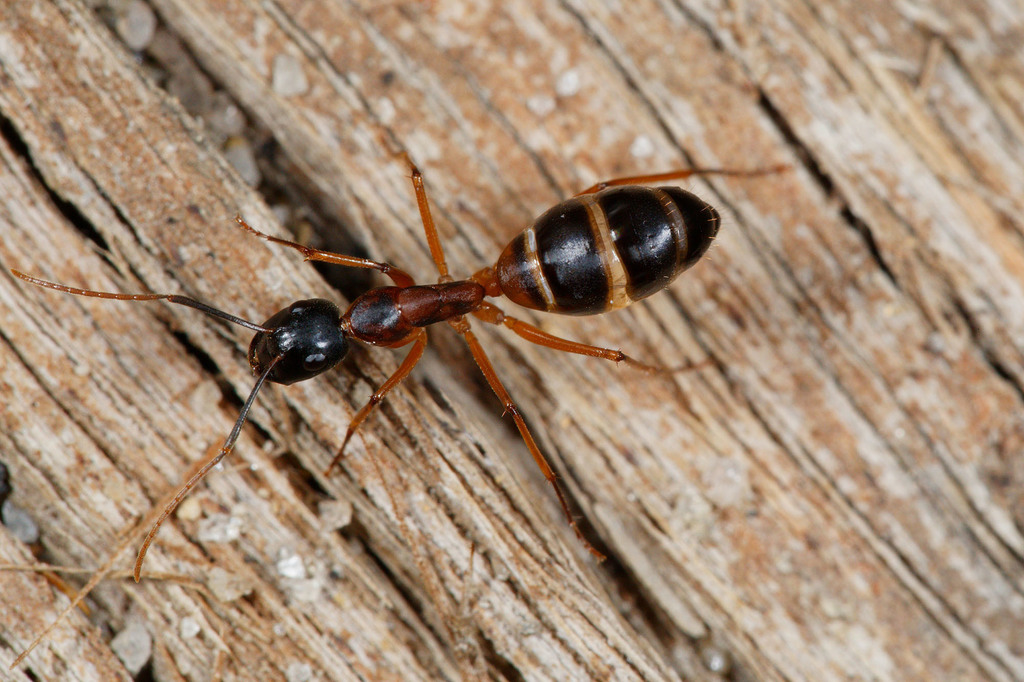
Female banded sugar ants have a black head, orange thorax and an orange-brown band around the gaster, while males are all black. They are large ants, 4 to 16 mm long, with major and minor workers ranging from about 5 to 15 mm. Native to Australia, especially south-east regions, they live in forests, woodlands and urban areas where they can become household pests that chew wood.
Source: Wikipedia
How to recognize it
Female workers show a black head, orange thorax and an orange-brown band around the abdomen. Males are completely black.
Source: Wikipedia
Size
Workers vary from about 5 to 15 mm, while the whole species ranges from 4 to 16 mm in length.
Source: Wikipedia
Is it a pest in the house?
In homes they can damage furniture and fittings by chewing wood.
Source: Wikipedia
Does it bite or sting?
They cannot sting, but larger soldiers can bite painfully with their strong jaws. The formic acid they spray can corrode human skin.
Source: Wikipedia
How to get rid of it
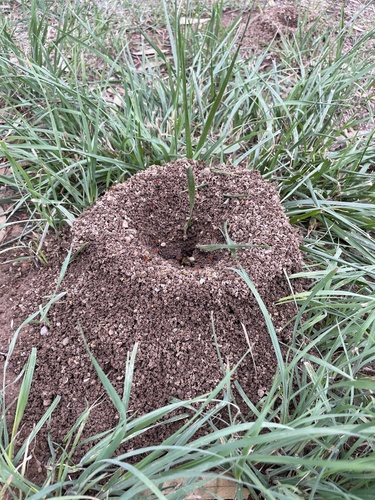
Carbon disulphide can be applied to treat and remove their nests.
Source: Wikipedia
Where it lives
They are mainly nocturnal and prefer moist forest and woodland habitats. They also occur in urban settings and are regarded as household pests.
Source: Wikipedia
What it eats
Workers harvest sweet secretions from aphids and other insects they tend. They also kill prey insects by spraying formic acid.
Source: Wikipedia
When you see it
They are mainly active at night and are often seen inside houses after dark.
Source: Wikipedia
Where it comes from
The banded sugar ant is native to Australia. It is most common in south-east Australia but is widely distributed across the continent.
Source: Wikipedia
Lookalikes
The black-headed sugar ant looks similar but lacks the orange-brown band and is lighter in colour.
Source: Wikipedia
More photos
Questions people ask
How can I identify a banded sugar ant?
Look for a black head, orange thorax and an orange-brown band around the abdomen on females; males are all black.
Source: Wikipedia
Do they bite or sting?
They do not sting, but larger soldiers can bite with powerful jaws and their formic-acid spray can burn skin.
Source: Wikipedia
Are they a problem in the house?
Yes, they can chew wood in furniture and fittings, causing damage.
Source: Wikipedia
How do I get rid of them?
Treating the nest with carbon disulphide can eliminate the colony.
Source: Wikipedia
Same family (Formicidae)
 Eastern Black Carpenter AntCamponotus pennsylvanicusCan damage your home
 Red Imported Fire AntSolenopsis invictaCan sting
 American Winter AntPrenolepis imparis
 Argentine AntLinepithema humileNuisance, not dangerous
 Immigrant Pavement AntTetramorium immigransCan sting
 Odorous House AntTapinoma sessileCan damage your home
Sources
- Wikipedia: https://en.wikipedia.org/wiki/Banded_sugar_ant
Look it up elsewhere: GBIF · iNaturalist · BugGuide · ITIS · Wikipedia
Text written 2026-10-24 from the sources above and checked sentence by sentence against them. Data fetched 2026-10-22.