 Bug FAQ
Odorous House Ant
Tapinoma sessile · Order: Hymenoptera · Family: Formicidae
Also called: American Sugar Ant, Coconut Ant
Source: Wikipedia, Penn State Extension

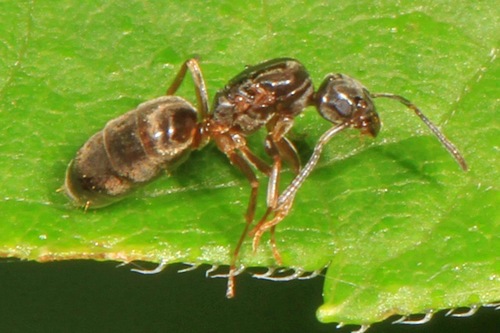
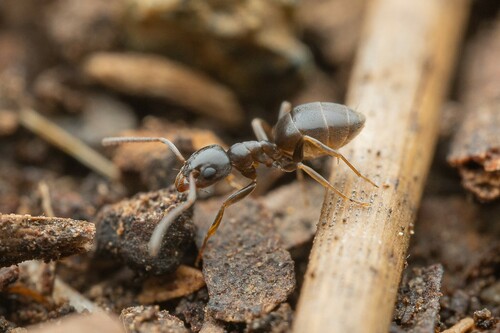
These ants are small, brown to black ants about 1⁄16-1⁄8 in (1.5-3.2 mm) long and have a uniform color with a single hidden node on the petiole. They live in many habitats, including homes, where they forage for sugary foods and honeydew, often entering buildings in late winter or early spring. Control is easiest when caught early; baiting, sealing entry points, and keeping food areas clean can eliminate a colony in a few weeks.
Source: Wikipedia, Penn State Extension, UC IPM
How to recognize it
The abdomen’s gaster sits directly on the petiole, a key feature that separates them from other small dark ants. Workers are all about the same size and lack a clubbed antenna; the antenna has twelve segments.
Source: Wikipedia, Penn State Extension
Size
Adults measure between 1⁄16 and 1⁄8 inch (1.5-3.2 mm).
Source: Wikipedia
Is it a pest in the house?
They are common indoor pests attracted to water and sweets. They usually invade homes in late winter or early spring, especially after rain. They feed on many household items, preferring sugary foods, and can contaminate stored pantry goods. Ants in general are among the most frequent household pests and also invade restaurants, hospitals, offices, and warehouses.
Source: Wikipedia, Penn State Extension, UC IPM
How to get rid of it
They are not hard to control; most ant killers work well if applied promptly. Early treatment can reduce numbers within a few days. Baits are effective for foraging workers, though full control may take two weeks or more. Combine sealing cracks, cleaning food sources, and baiting for best results. Use outdoor baits for colonies; indoor sprays give only temporary relief and may be unsafe.
Source: Wikipedia, Penn State Extension, UC IPM
Where it lives
They occupy a wide range of habitats, from outdoors to inside houses.
Source: Wikipedia
What it eats
When given choices, they prefer sugar and protein over fats throughout the year.
Source: Wikipedia
Life cycle
Queens lay eggs that hatch in 11-26 days; larvae develop for 13-29 days, then pupate for 10-24 days.
Source: Wikipedia
When you see it
Colony activity peaks from March to September and drops sharply from October to December. In March they forage by day, but by April they also forage at night.
Source: Wikipedia
Where it comes from
Native to North America, they occur from southern Canada to northern Mexico, but are rarer in desert southwest.
Source: Wikipedia
Lookalikes
Winged ants leaving nests to mate are often mistaken for winged termites.
Source: UC IPM
Where it is found in the US
Recorded in 50 of 51 states and DC. Most records: California, Colorado, New York, Virginia, Mississippi, North Carolina, Illinois, Pennsylvania.
Darker = more records. Counts are museum and citizen-science records, not population size.
Source: GBIF
Status: native in North America; native in United States; native in Canada. Source: iNaturalist
Months it is reported in the US
Source: GBIF
More photos

Questions people ask
How do I get rid of odorous house ants?
Apply ant baits outdoors, seal entry points, keep food areas clean, and use ant-killing sprays early for quick reduction.
When are odorous house ants most likely to appear inside?
They usually enter homes in late winter and early spring, especially after rain, and are most active from March through September.
Source: Wikipedia
What do odorous house ants eat in the house?
They are attracted to sugary foods, honeydew, and other sweet items, contaminating stored pantry goods.
Source: Wikipedia, Penn State Extension
How can I tell odorous house ants apart from other small ants?
Their gaster sits directly on the petiole, they have a uniform brown-to-black color, 12-segment antennae without a club, and a single hidden node on the pedicel.
Source: Wikipedia, Penn State Extension
Same family (Formicidae)
 Eastern Black Carpenter AntCamponotus pennsylvanicusCan damage your home
 Red Imported Fire AntSolenopsis invictaCan sting
 American Winter AntPrenolepis imparis
 Argentine AntLinepithema humileNuisance, not dangerous
 Immigrant Pavement AntTetramorium immigransCan sting
 Red Harvester AntPogonomyrmex barbatusVenomous
Sources
- Wikipedia: https://en.wikipedia.org/wiki/Tapinoma_sessile
- Penn State Extension: https://extension.psu.edu/odorous-house-ant
- UC IPM: https://ipm.ucanr.edu/PMG/PESTNOTES/pn7411.html
Look it up elsewhere: GBIF · iNaturalist · BugGuide · ITIS · Wikipedia
Text written 2026-10-23 from the sources above and checked sentence by sentence against them. Data fetched 2026-10-22.