 Bug FAQ
Red Harvester Ant
Pogonomyrmex barbatus · Order: Hymenoptera · Family: Formicidae
Source: Wikipedia, extension.unr.edu
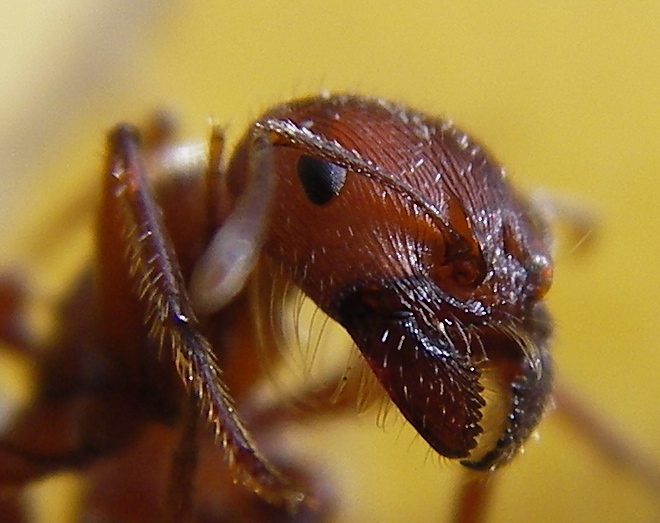
These ants are 5-7 mm long, reddish, and have two nodes between the thorax and abdomen. They build deep underground nests in open chaparral, feed mainly on seeds, and a single queen starts each colony. If their nest is disturbed they will defend it by biting and stinging, and their venom can cause painful, sometimes serious allergic reactions.
Source: Wikipedia, extension.unr.edu
How to recognize it
Red harvester ants belong to the genus Pogonomyrmex and are not closely related to fire ants.
Source: Wikipedia
Size
Workers measure about 5 to 7 mm (roughly 1/5 to 1/2 inch) in length.
Source: Wikipedia, extension.unr.edu
Is it a pest in the house?
They do not invade homes but can become a nuisance in lawns, gardens, and pet areas.
Source: extension.unr.edu
Does it bite or sting?
When disturbed they bite and their stings are venomous, causing painful reactions that can spread through the lymphatic system and sometimes trigger dangerous allergic responses.
Source: Wikipedia, extension.unr.edu
How to get rid of it
Remove nests if children or pets frequent the area, and encourage birds and lizards that naturally keep their numbers down.
Source: extension.unr.edu
What it eats
Their diet is mainly seeds, which they store in large numbers and help disperse for plants.
Source: Wikipedia
Life cycle
A single queen founds each colony, and after six to eight weeks the first worker brood emerges to forage.
Source: Wikipedia
When you see it
Winged males and virgin queens fly after midsummer monsoon rains to mate, and all colony members are female except those males.
Source: Wikipedia
Where it comes from
They are native to the southwestern United States.
Source: Wikipedia
Lookalikes
They are often mistaken for fire ants, but fire ants are smaller and have a darker abdomen. In certain seasons adult harvester ants may have four clear amber-veined wings.
Source: Wikipedia, extension.unr.edu
Where it is found in the US
Recorded in 13 of 51 states and DC. Most records: Texas, Arizona, New Mexico, Oklahoma, Colorado, Kansas, California, Arkansas.
Darker = more records. Counts are museum and citizen-science records, not population size.
Source: GBIF
Status: native in North America; native in United States. Source: iNaturalist
Months it is reported in the US
Source: GBIF
More photos


Questions people ask
Do red harvester ants bite or sting?
Yes, they bite and their stings are venomous, causing painful reactions and sometimes allergic responses.
Source: Wikipedia, extension.unr.edu
How can I get rid of a red harvester ant nest?
Remove the nest if children or pets are often nearby, and support birds and lizards that naturally control them.
Source: extension.unr.edu
Are red harvester ants dangerous to people or pets?
Their stings can be painful and may cause dangerous allergic reactions in sensitive individuals or animals.
Source: Wikipedia, extension.unr.edu
What do red harvester ants look like?
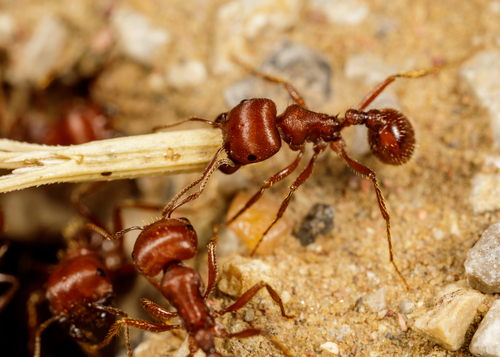
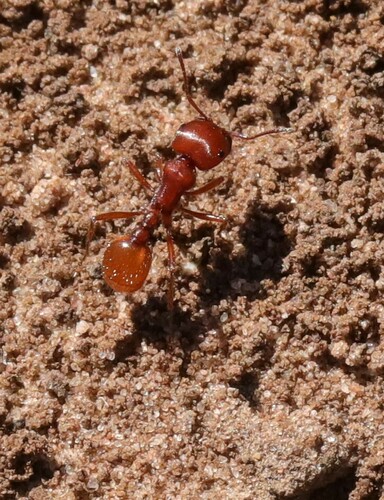
They are reddish, 5-7 mm long, have two nodes between the thorax and abdomen, and sometimes have clear amber-veined wings.
Source: Wikipedia, extension.unr.edu
Same family (Formicidae)
 Eastern Black Carpenter AntCamponotus pennsylvanicusCan damage your home
 Red Imported Fire AntSolenopsis invictaCan sting
 American Winter AntPrenolepis imparis
 Argentine AntLinepithema humileNuisance, not dangerous
 Immigrant Pavement AntTetramorium immigransCan sting
 Odorous House AntTapinoma sessileCan damage your home
Sources
- Wikipedia: https://en.wikipedia.org/wiki/Red_harvester_ant
- extension.unr.edu: https://extension.unr.edu/publication.aspx?PubID=5496
Look it up elsewhere: GBIF · iNaturalist · BugGuide · ITIS · Wikipedia
Text written 2026-10-23 from the sources above and checked sentence by sentence against them. Data fetched 2026-10-23.