 Bug FAQ
Immigrant Pavement Ant
Tetramorium immigrans · Order: Hymenoptera · Family: Formicidae
Also called: North American Pavement Ant, Pavement Ant
Source: Wikipedia, ask.ifas.ufl.edu

They thrive in urban and suburban areas across North America, where they forage on many foods and can enter homes looking for leftovers. Workers have a tiny stinger that may cause mild discomfort if they bite or sting, but they are not dangerous.
Source: Wikipedia, ask.ifas.ufl.edu
How to recognize it
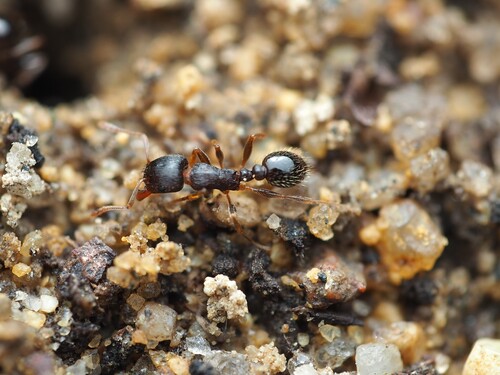
They have one pair of spines on the back, two petiole nodes, and grooves on the head and thorax. Workers range from dark brown to almost black, while queens and males are larger and winged.
Source: Wikipedia, ask.ifas.ufl.edu
Size
Adults measure between 2.5 and 4 mm in length.
Source: Wikipedia
Is it a pest in the house?
They may enter homes looking for food, becoming a minor nuisance. They also prey on codling moth larvae.
Source: Wikipedia
Does it bite or sting?
Workers possess a small stinger that can cause mild discomfort but rarely stings people. The stinger is broadened into a triangular flag, which reduces its effectiveness as a weapon but helps spread pheromones.
Source: Wikipedia, ask.ifas.ufl.edu
How to get rid of it
Their rapid spread is linked to unintentional human transport.
Source: ask.ifas.ufl.edu
Where it lives
They are common in cities and suburbs throughout North America.
Source: Wikipedia
What it eats
They eat almost anything, including insects, seeds, honeydew, and human foods like bread, meat, cheese, and ice cream. In urban areas they are among the first ants to discover and recruit to new food sources.
Source: Wikipedia, ask.ifas.ufl.edu
Life cycle
Colonies contain workers, winged males (drones), winged queens, and a queen. Mating flights happen in spring and summer, after which a fertilized queen starts a new nest. The queen raises the first brood alone until the workers can forage.
Source: Wikipedia
When you see it
Nuptial flights occur during spring and summer.
Source: Wikipedia
Where it comes from
The species originates from Europe but is now an introduced pest in North America.
Source: Wikipedia
Lookalikes
In parts of Missouri, Kansas, and Illinois, the similar species Tetramorium tsushimae can outcompete T. immigrans. Young T. tsushimae workers have a lighter thorax than the head and gaster, unlike T. immigrans.
Source: ask.ifas.ufl.edu
Where it is found in the US
Recorded in 46 of 51 states and DC. Most records: New York, Massachusetts, California, Ohio, Virginia, Pennsylvania, Utah, Washington.
Darker = more records. Counts are museum and citizen-science records, not population size.
Source: GBIF
Status: introduced in North America; introduced in Canada; introduced in United States. Source: iNaturalist
Months it is reported in the US
Source: GBIF
More photos

Questions people ask
Do they sting people?
Yes, workers have a tiny stinger that can cause mild discomfort, but stings are rare and not dangerous.
Source: Wikipedia, ask.ifas.ufl.edu
How can I keep them out of my house?
Since they are attracted to food leftovers, keep food sealed and clean up crumbs to reduce their nuisance presence.
Source: Wikipedia, ask.ifas.ufl.edu
Same family (Formicidae)
 Eastern Black Carpenter AntCamponotus pennsylvanicusCan damage your home
 Red Imported Fire AntSolenopsis invictaCan sting
 American Winter AntPrenolepis imparis
 Argentine AntLinepithema humileNuisance, not dangerous
 Odorous House AntTapinoma sessileCan damage your home
 Red Harvester AntPogonomyrmex barbatusVenomous
Sources
- Wikipedia: https://en.wikipedia.org/wiki/Tetramorium_immigrans
- ask.ifas.ufl.edu: https://ask.ifas.ufl.edu/publication/IN1047
Look it up elsewhere: GBIF · iNaturalist · BugGuide · Wikipedia
Text written 2026-10-23 from the sources above and checked sentence by sentence against them. Data fetched 2026-10-23.