 Bug FAQ
Eastern Black Carpenter Ant
Camponotus pennsylvanicus · Order: Hymenoptera · Family: Formicidae
Also called: (Eastern) black carpenter ant, Black Carpenter Ant, carpenter ant
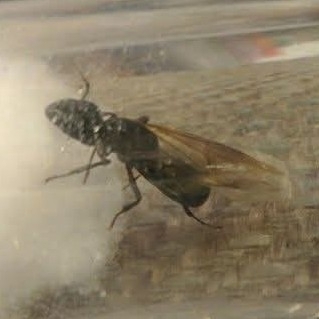
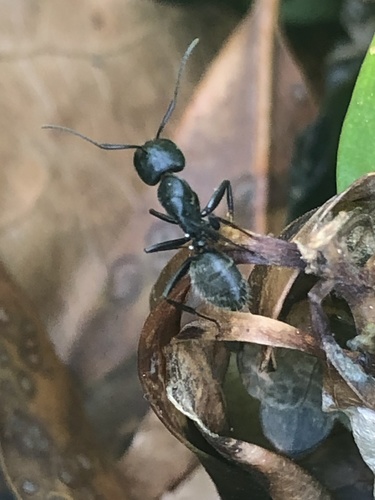
Eastern Black Carpenter Ants are large, black ants that live in dead wood and can move into houses looking for moist wood to excavate. Workers bite with strong jaws and spray formic acid, causing a painful, burning wound, and the colonies can hollow out structural wood.
How to recognize it
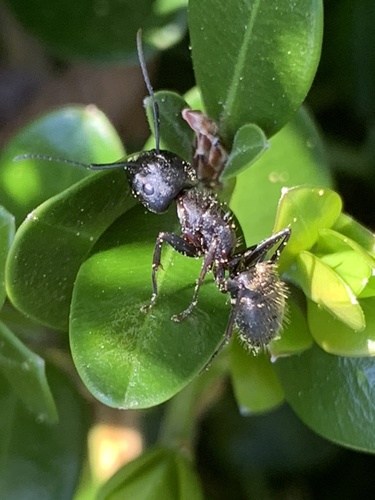
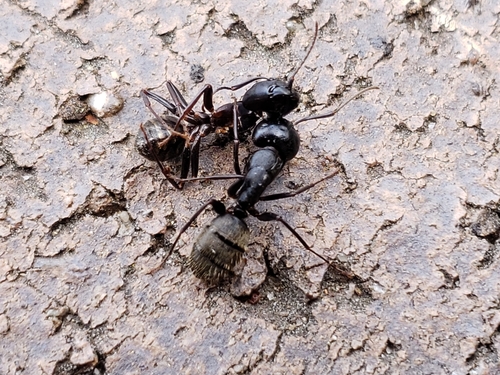
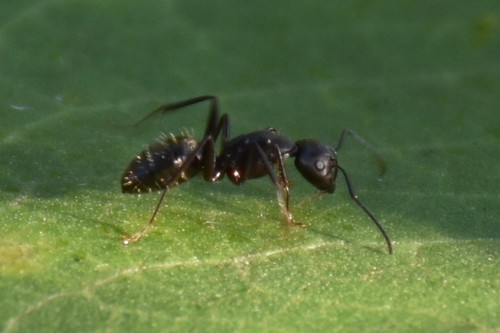
All castes are black or blackish, with the abdomen showing whitish or yellowish hairs.
Source: Wikipedia
Size
Queens grow to about 19 to 21 mm and the biggest workers reach 14 to 17 mm. Workers have elbowed antennae with 12 segments; winged reproductives have yellowish wings.
Source: Wikipedia
Is it a pest in the house?
They become pests when they invade house wood, damaging structural integrity, and can build nests of several thousand ants. They do not eat wood but excavate it to create galleries for their activities.
Does it bite or sting?
They cannot sting, but larger workers can deliver a sharp bite that is worsened by formic acid spray, causing a burning sensation.
How to get rid of it
Reduce moisture by keeping gutters clear to make wood less attractive. Licensed professionals can apply perimeter fipronil sprays, and slow-acting toxic baits can be used to spread poison to the colony.
Where it lives
When they enter a house they damage the structural wood by removing it to make galleries.
Source: Wikipedia
What it eats
Workers tend aphids for honeydew, eat dead insects and plant juices, and forage at night.
Source: Wikipedia
Life cycle
Colonies can contain thousands of ants and may be heard making cracking sounds as workers work.
Source: Wikipedia
When you see it
Foraging is mainly nocturnal and they can travel up to 100 yd while leaving pheromone trails.
Source: Wikipedia
Where it comes from
They are common in the central and eastern United States and eastern Canada, east of the Rockies.
Source: Wikipedia
Lookalikes
They may be confused with winged termites during mating flights, and with other large Camponotus species that differ in color.
Where it is found in the US
Recorded in 47 of 51 states and DC. Most records: New York, Texas, Massachusetts, Pennsylvania, Virginia, Ohio, Illinois, North Carolina.
Darker = more records. Counts are museum and citizen-science records, not population size.
Source: GBIF
Status: native in North America; native in Canada; native in United States. Source: iNaturalist
Months it is reported in the US
Source: GBIF
More photos
Questions people ask
Do Eastern Black Carpenter Ants bite?
Yes, larger workers can bite sharply and spray formic acid, causing a painful, burning wound.
Do they damage my house?
They excavate moist wood in structures, creating galleries that weaken the wood’s structural integrity.
Source: Wikipedia
Same family (Formicidae)






Sources
- Wikipedia: https://en.wikipedia.org/wiki/Black_carpenter_ant
- UC IPM: https://ipm.ucanr.edu/PMG/PESTNOTES/pn7416.html
Look it up elsewhere: GBIF · iNaturalist · BugGuide · ITIS · Wikipedia
Text written 2026-10-22 from the sources above and checked sentence by sentence against them. Data fetched 2026-10-22.