 Bug FAQ
California harvester ant
Pogonomyrmex californicus · Order: Hymenoptera · Family: Formicidae
Source: Wikipedia
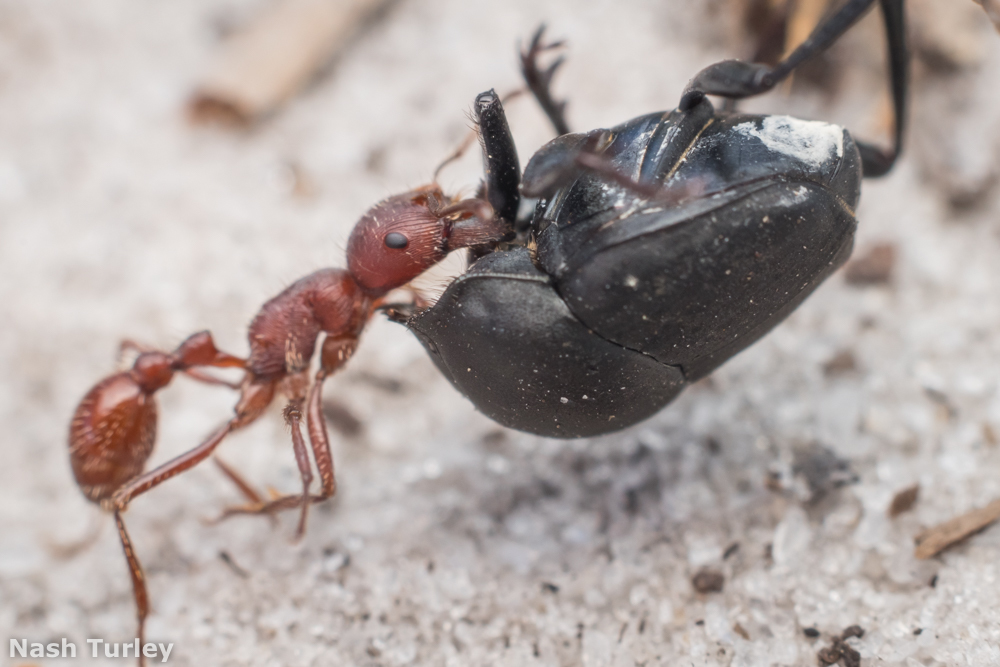
They hunt arthropod larvae and collect seeds, and they reproduce mainly from May to July in hot, humid afternoons. Workers forage during the day, sometimes forming columns, and their venom can cause hallucinations if it enters the mouth or throat.
Source: Wikipedia
How to recognize it
This species is the ant used in Uncle Milton's Ant Farm.
Source: Wikipedia
Size
It belongs to the Myrmicinae subfamily of ants.
Source: Wikipedia
Does it bite or sting?
When swallowed alive, the ants inject venom that can cause hallucinations in the mouth and throat.
Source: Wikipedia
Where it lives
It prefers open, warm, sandy environments.
Source: Wikipedia
What it eats
It preys on arthropods such as raisin-moth larvae and also gathers seeds.
Source: Wikipedia
Life cycle
Reproduction occurs mainly from May to July during hot daytime temperatures of 80 to 90 °F with afternoon humidity, though in some areas it may happen from April to August if conditions allow.
Source: Wikipedia
When you see it
Workers forage during daylight, either alone or in columns.
Source: Wikipedia
Where it comes from
It is native to the southwestern United States and northern Mexico.
Source: Wikipedia
Where it is found in the US
Recorded in 7 of 51 states and DC. Most records: California, Arizona, Nevada, New Mexico, Texas, Utah, Kansas.
Darker = more records. Counts are museum and citizen-science records, not population size.
Source: GBIF
Status: native in North America; native in United States. Source: iNaturalist
Months it is reported in the US
Source: GBIF
More photos


Questions people ask
When do California harvester ants reproduce?
They mainly reproduce from May to July in hot, humid afternoons, but can also breed from April to August if weather permits.
Source: Wikipedia
What do these ants eat?
They hunt arthropod larvae such as the raisin moth and collect seeds.
Source: Wikipedia
Where are they found?
They live in open, warm, sandy areas of the southwestern United States and northern Mexico.
Source: Wikipedia
Do they sting people?
Yes, their venom can cause hallucinations when it enters the mouth or throat.
Source: Wikipedia
Same family (Formicidae)
 Eastern Black Carpenter AntCamponotus pennsylvanicusCan damage your home
 Red Imported Fire AntSolenopsis invictaCan sting
 American Winter AntPrenolepis imparis
 Argentine AntLinepithema humileNuisance, not dangerous
 Immigrant Pavement AntTetramorium immigransCan sting
 Odorous House AntTapinoma sessileCan damage your home
Sources
- Wikipedia: https://en.wikipedia.org/wiki/Pogonomyrmex_californicus
Look it up elsewhere: GBIF · iNaturalist · BugGuide · ITIS · Wikipedia
Text written 2026-10-23 from the sources above and checked sentence by sentence against them. Data fetched 2026-10-23.