 Bug FAQ
Desert Leaf-cutter Ant
Acromyrmex versicolor · Order: Hymenoptera · Family: Formicidae
Also called: Desert Leaf-cutting Ant, Desert Leafcutter Ant, Desert Leafcutting Ant
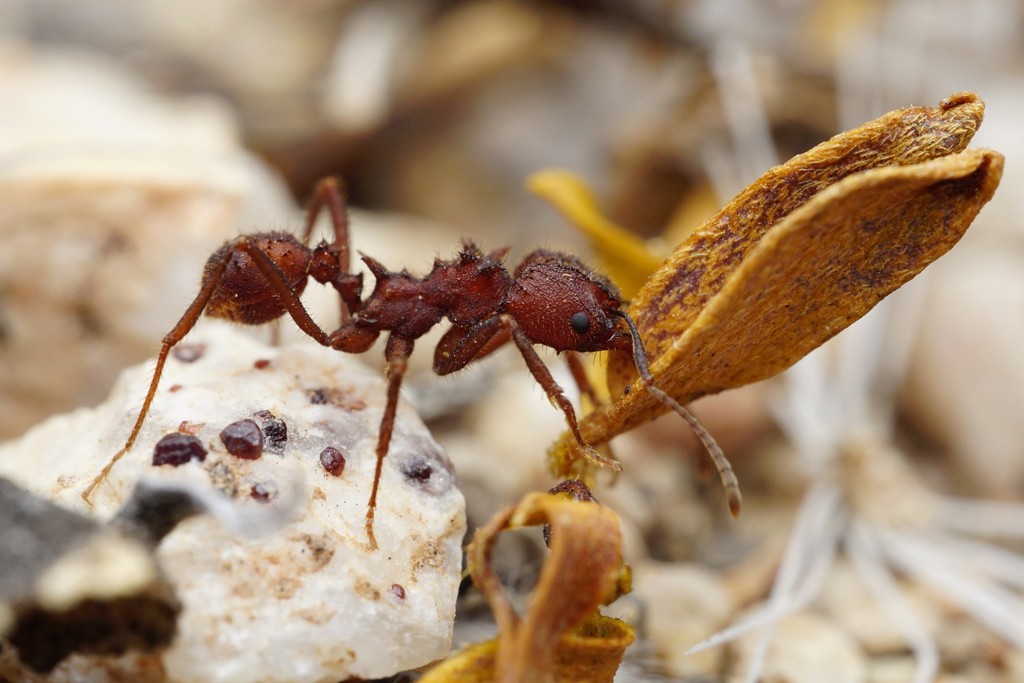
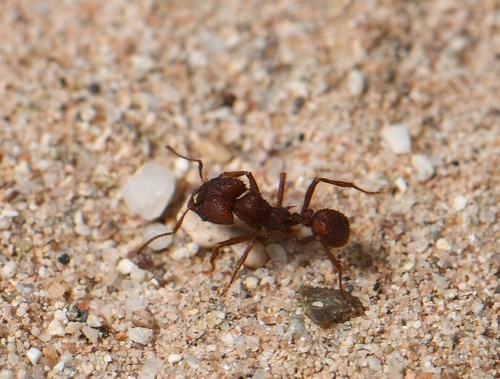
Desert leaf-cutter ants are small reddish-brown workers 2 to 6 mm long with a narrow waist and several spines on the thorax, head and abdomen. They appear in the Colorado and Sonoran deserts during summer rains, build large nest craters covered in leaf fragments, and harvest leaves and grasses to grow fungus gardens. Colonies may have several queens (polygyny) each starting their own fungus, and queens mate with multiple males, which can lower genetic relatedness within the colony.
Source: Wikipedia
How to recognize it
Workers are reddish brown, have a narrow waist, and bear at least four spines on the rear of the thorax, distinct head spines, and small abdominal bumps.
Source: Wikipedia
Size
The average worker measures between 2 and 6 mm in length.
Source: Wikipedia
Does it bite or sting?
This species does not sting.
Source: Wikipedia
Where it lives
They are found in the Colorado and Sonoran deserts during the summer months when there is precipitation. Their nests form large, distinctive craters that are covered with leaf fragments.
Source: Wikipedia
What it eats
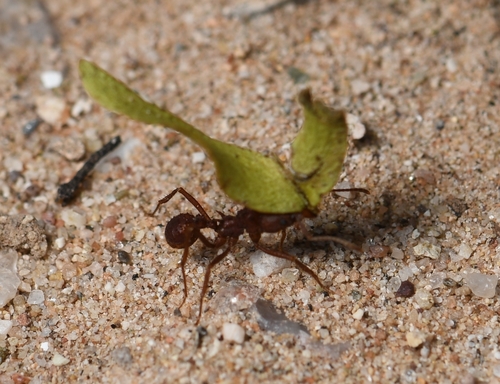
Workers collect living and dead leaves to cultivate fungus gardens.
Source: Wikipedia
Life cycle
Colonies can have multiple queens (polygyny), each providing her own starter fungus for the colony. Queens mate with several males (polyandry), which can reduce genetic relatedness among colony members.
Source: Wikipedia
When you see it
They are present during summer months when there is precipitation in their desert habitats. Mating occurs from late July through October.
Source: Wikipedia
Where it comes from
Desert leaf-cutter ants occur in the Colorado and Sonoran deserts of the southwestern United States.
Source: Wikipedia
Where it is found in the US
Recorded in 4 of 51 states and DC. Most records: Arizona, California, Texas, New Mexico.
Darker = more records. Counts are museum and citizen-science records, not population size.
Source: GBIF
Status: native in North America; native in United States. Source: iNaturalist
Months it is reported in the US
Source: GBIF
More photos


Questions people ask
What do desert leaf-cutter ants eat?
They gather living and dead leaves to grow fungus, and they also collect green vegetation and especially dry grasses for their fungus gardens.
Source: Wikipedia
When are desert leaf-cutter ants active?
They appear in the summer months after rain in the Colorado and Sonoran deserts, and queens mate from late July through October.
Source: Wikipedia
Same family (Formicidae)
 Eastern Black Carpenter AntCamponotus pennsylvanicusCan damage your home
 Red Imported Fire AntSolenopsis invictaCan sting
 American Winter AntPrenolepis imparis
 Argentine AntLinepithema humileNuisance, not dangerous
 Immigrant Pavement AntTetramorium immigransCan sting
 Odorous House AntTapinoma sessileCan damage your home
Sources
- Wikipedia: https://en.wikipedia.org/wiki/Acromyrmex_versicolor
Look it up elsewhere: GBIF · iNaturalist · BugGuide · ITIS · Wikipedia
Text written 2026-10-23 from the sources above and checked sentence by sentence against them. Data fetched 2026-10-23.