 Bug FAQ
Florida Trap-jaw Ant
Odontomachus brunneus · Order: Hymenoptera · Family: Formicidae
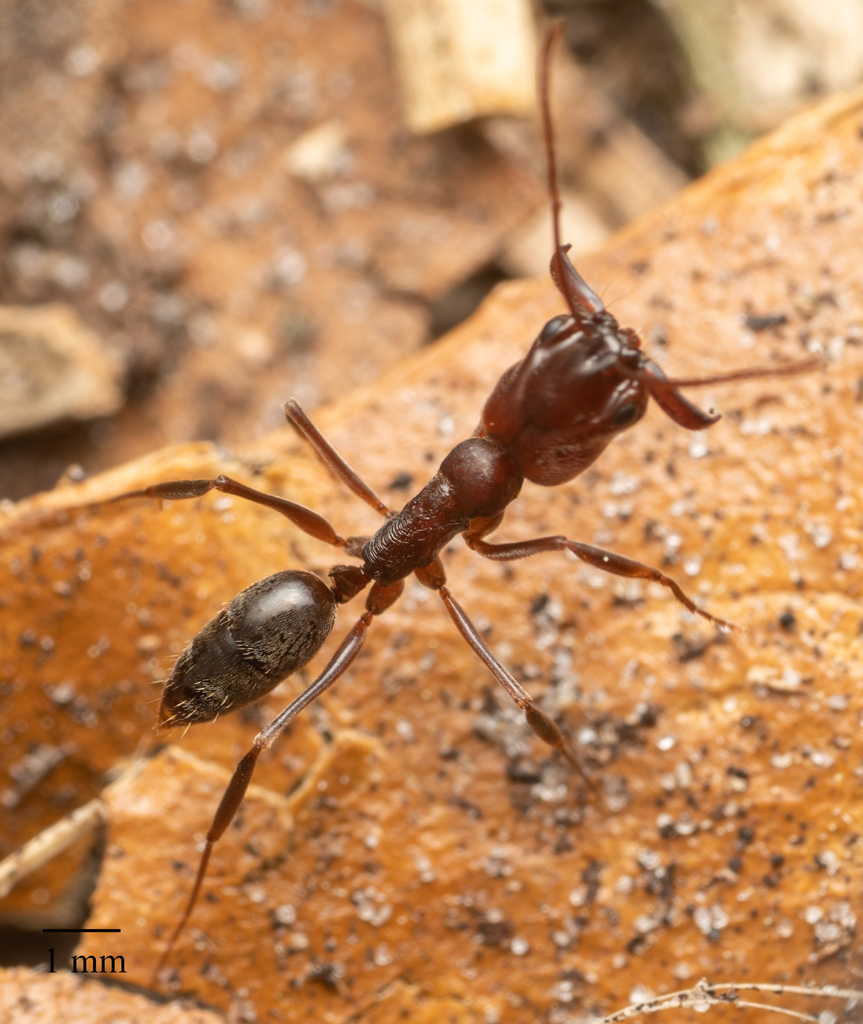
Trap-jaw ants have huge straight mandibles that can open fully and snap shut on prey. Queens produce offspring only in the first half of the year; no new ants appear in the latter six months.
Source: Wikipedia
Size
Their mandibles can open to a full 180° and snap shut quickly.
Source: Wikipedia
What it eats
They are timid hunters, taking only prey they can definitely subdue.
Source: Wikipedia
When you see it
Breeding happens in the first half of the year and stops for the remaining six months.
Source: Wikipedia
Lookalikes
They belong to the trap-jaw ant genus, recognizable by their large straight mandibles that open wide.
Source: Wikipedia
Where it is found in the US
Recorded in 5 of 51 states and DC. Most records: Florida, Georgia, Mississippi, Alabama, South Carolina.
Darker = more records. Counts are museum and citizen-science records, not population size.
Source: GBIF
Status: endemic in United States; native in North America. Source: iNaturalist
Months it is reported in the US
Source: GBIF
More photos

Questions people ask
What do they look like?
They have very large, straight mandibles that can open to 180° and snap shut on prey.
Source: Wikipedia
Same family (Formicidae)
 Eastern Black Carpenter AntCamponotus pennsylvanicusCan damage your home
 Red Imported Fire AntSolenopsis invictaCan sting
 American Winter AntPrenolepis imparis
 Argentine AntLinepithema humileNuisance, not dangerous
 Immigrant Pavement AntTetramorium immigransCan sting
 Odorous House AntTapinoma sessileCan damage your home
Sources
- Wikipedia: https://en.wikipedia.org/wiki/Odontomachus_brunneus
Look it up elsewhere: GBIF · iNaturalist · BugGuide · ITIS · Wikipedia
Text written 2026-10-23 from the sources above and checked sentence by sentence against them. Data fetched 2026-10-23.