 Bug FAQ
Western Black Carpenter Ant
Camponotus modoc · Order: Hymenoptera · Family: Formicidae
Also called: (Western) black carpenter ant
Source: Wikipedia

Workers are black with dark red legs and measure about 7 to 13 mm long. They live in dead wood in western North America, including forest logs and human homes. A colony may start with a few hundred ants, grow to tens of thousands, and often has many satellite nests.
Source: Wikipedia
How to recognize it
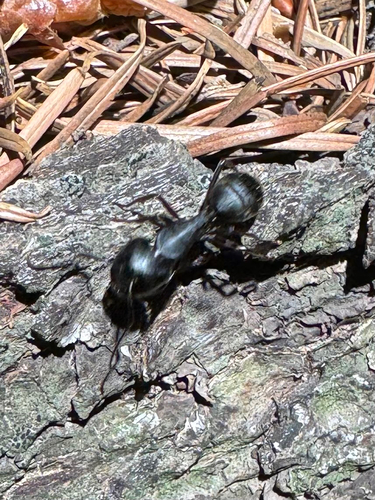
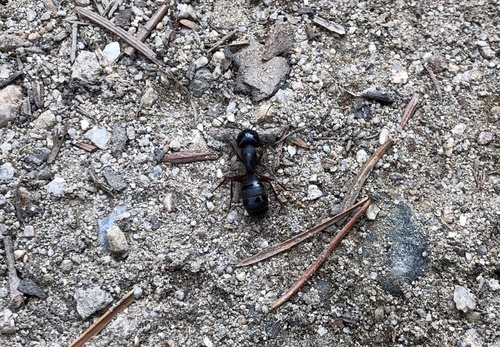
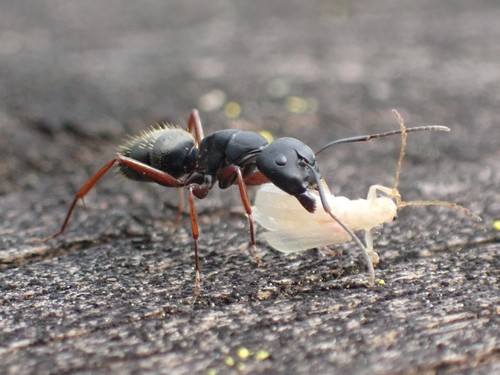
The ant is black with dark red legs.
Source: Wikipedia
Size
Workers range from about 7 mm to 13 mm in length.
Source: Wikipedia
Is it a pest in the house?
Carpenter ants damage homes by nesting inside the structure. They excavate tunnels in wood, which can weaken the building.
Source: Wikipedia
How to get rid of it
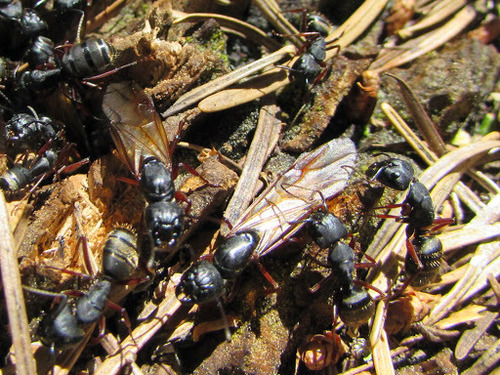
Colonies may begin with a few hundred ants but can expand to tens of thousands. Often more than twenty satellite colonies are present.
Source: Wikipedia
Where it lives
It nests in dead wood such as fallen logs and also in the wood of houses.
Source: Wikipedia
Where it comes from
It is found in western North America.
Source: Wikipedia
Lookalikes
It looks like other black carpenter ants with dark red legs.
Source: Wikipedia
Where it is found in the US
Recorded in 21 of 51 states and DC. Most records: California, Washington, Oregon, Colorado, Arizona, New Mexico, Utah, Montana.
Darker = more records. Counts are museum and citizen-science records, not population size.
Source: GBIF
Status: native in North America; native in United States; native in Canada. Source: iNaturalist
Months it is reported in the US
Source: GBIF
More photos
Questions people ask
How can I get rid of them in my house?
Treat the infestation early, because colonies can quickly grow large and spread to many satellite nests.
Source: Wikipedia
Same family (Formicidae)
 Eastern Black Carpenter AntCamponotus pennsylvanicusCan damage your home
 Red Imported Fire AntSolenopsis invictaCan sting
 American Winter AntPrenolepis imparis
 Argentine AntLinepithema humileNuisance, not dangerous
 Immigrant Pavement AntTetramorium immigransCan sting
 Odorous House AntTapinoma sessileCan damage your home
Sources
- Wikipedia: https://en.wikipedia.org/wiki/Camponotus_modoc
Look it up elsewhere: GBIF · iNaturalist · BugGuide · ITIS · Wikipedia
Text written 2026-10-22 from the sources above and checked sentence by sentence against them. Data fetched 2026-10-22.