 Bug FAQ
Yellow-faced Bumble Bee
Bombus vosnesenskii · Order: Hymenoptera · Family: Apidae
Also called: Vosnesensky Bumble Bee

The yellow-faced bumble bee is a West Coast native that nests underground in colonies of a few hundred workers and forages on a limited set of plants such as lupine and phacelia. Queens emerge in spring, start a nest, and after about a month the first workers appear; the species often appears early in the season, giving it an advantage over other bumble bees.
Source: Wikipedia
How to recognize it
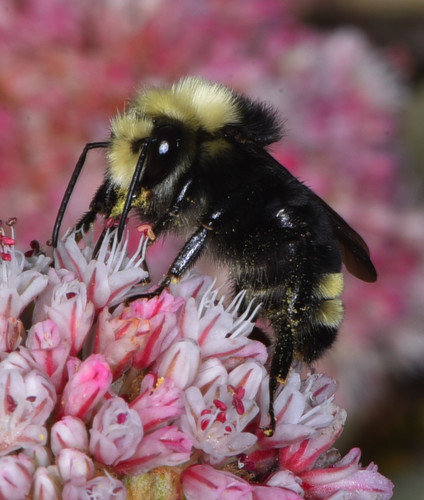
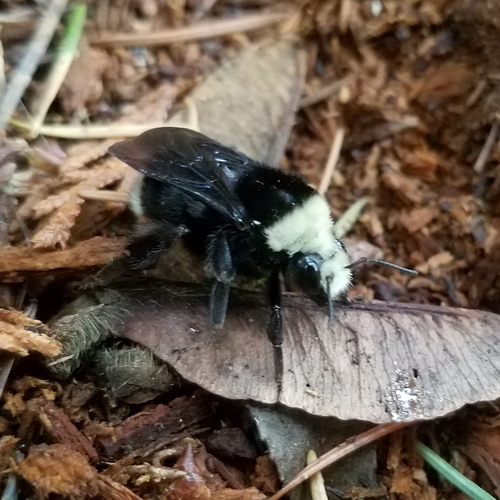
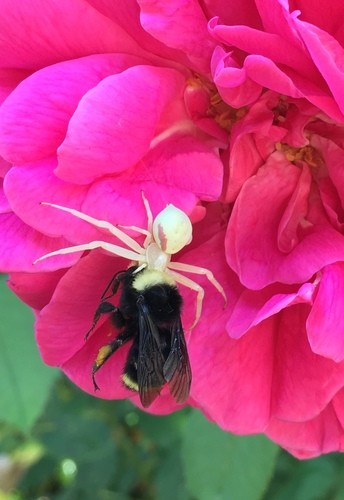
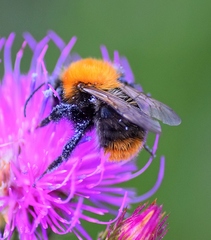
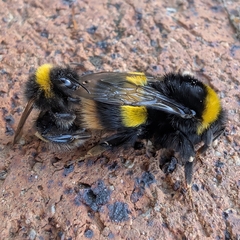
These bees have black and yellow hairs, and queens look the same as female workers.
Source: Wikipedia
Size
Queens measure 18 to 21 mm, workers 8 to 17 mm, and males 10 to 15 mm in length.
Source: Wikipedia
How to get rid of it
Restoring grassland can provide habitat refuges for them in urban areas, while paved surfaces reduce their nesting density.
Source: Wikipedia
Where it lives
They build nests underground and typically have colonies of about 200 to 300 workers.
Source: Wikipedia
What it eats
Foraging is focused on a few genera, including Lupinus, Cirsium, Eriogonum, Phacelia, Clarkia, and Ericameria.
Source: Wikipedia
Life cycle
Overwintering queens emerge in spring to start a colony, and the first workers hatch about a month later.
Source: Wikipedia
When you see it
The species emerges early in the season, allowing it to claim nest sites before many other bumble bees.
Source: Wikipedia
Where it comes from
They are native to the western coast of North America, from British Columbia down to Baja California.
Source: Wikipedia
Lookalikes
It has largely replaced the once-common western bumble bee (Bombus occidentalis) in many areas.
Source: Wikipedia
Where it is found in the US
Recorded in 14 of 51 states and DC. Most records: California, Oregon, Washington, Nevada, Idaho, Arizona, Colorado, Illinois.
Darker = more records. Counts are museum and citizen-science records, not population size.
Source: GBIF
Status: native in North America; native in United States; native in Canada. Source: iNaturalist
Months it is reported in the US
Source: GBIF
More photos

Questions people ask
Where can I find these bees?
They live underground in colonies of a few hundred workers along the West Coast from British Columbia to Baja California.
Source: Wikipedia
What plants do they visit?
They prefer flowers of lupine, thistle, buckwheat, phacelia, Clarkia and Ericameria.
Source: Wikipedia
How big are they?
Queens are 18 to 21 mm long; workers 8 to 17 mm; males 10 to 15 mm.
Source: Wikipedia
Same family (Apidae)


Sources
- Wikipedia: https://en.wikipedia.org/wiki/Bombus_vosnesenskii
Look it up elsewhere: GBIF · iNaturalist · BugGuide · ITIS · Wikipedia
Text written 2026-10-22 from the sources above and checked sentence by sentence against them. Data fetched 2026-10-22.